For commercial plumbing, expect about $110 to $225 an hour in published Southern California guides, plus a service or dispatch fee. Evenings, weekends and holidays usually run 1.5 to 2 times the daytime rate. Those are guide numbers, not a quote. The rate depends on the work, the building and the hour. If your building needs more than one-off repairs, the commercial plumbing services page covers what we arrange for businesses in Pasadena and the San Gabriel Valley.
What is the hourly rate for commercial plumbing here?
Roughly $110 to $225 an hour in one Southern California guide, and published figures vary from site to site. Service calls are extra, commonly $110 to $185.
The spread comes from who publishes the number. Plumbing companies, lead-generation sites and cost guides all quote different ranges, and few say what the rate includes. A rate may cover the plumber's wages, truck, insurance, tools and overhead, or it may be the bare labor rate with a separate trip fee. Ask. As a yardstick, the Bureau of Labor Statistics gives a midpoint of $30.67 per hour for plumbing trades workers as of May 2025. That is what a worker earns, not what a customer is billed, and the difference pays for trucks, insurance, tools and everything else a business carries. the plumber cost per hour article covers the residential side.
What counts as a normal or reasonable hourly rate?
A normal rate is one that fits the work, the hour and the credentials, and that comes with an itemized quote. Averages are a poor guide: a figure near $100 may suit a simple diagnostic visit, while a rate near $200 can be reasonable for specialized work at night. Look at the total for the job before you fixate on the hourly figure.
Older figures, such as 2022 rates you might find in search results, are out of date: labor and parts costs have moved since. Rates quoted in other countries, such as New Zealand dollars, do not apply to a California building. When a rate is much lower than every other bid, ask what it leaves out: a trip fee, a minimum number of hours, markup on parts, or a missing permit. When it is much higher, ask whether the crew or the equipment is the reason.
Does a master plumber cost more than a journeyman?
Often, but California does not frame it that way for customers. The state licenses plumbing contractors, class C-36, rather than listing individual masters and journeymen the way some states do. What matters is that the business holds the license, and who from the business is sent for your job.
The Contractors State License Board describes the C-36 class as covering water supply and drainage, gas piping and appliance connections, water heating equipment, and related health and safety devices. Within a company, a more experienced lead may cost more per hour than an apprentice, and a company whose business specializes in commercial plumbing can price differently from a general residential shop. Ask for the rate of the person who will actually do the job, whether an apprentice may assist, and what the minimum charge is.
What makes a commercial plumbing quote go up?
After-hours work, rush response, hard access and large equipment raise it. A restaurant fixed at 2 a.m. costs more than a weekday morning visit. Lifts, roof access, confined ceiling spaces, permits, and parts such as water heaters, backflow assemblies or grease interceptors add to the bill on top of labor.
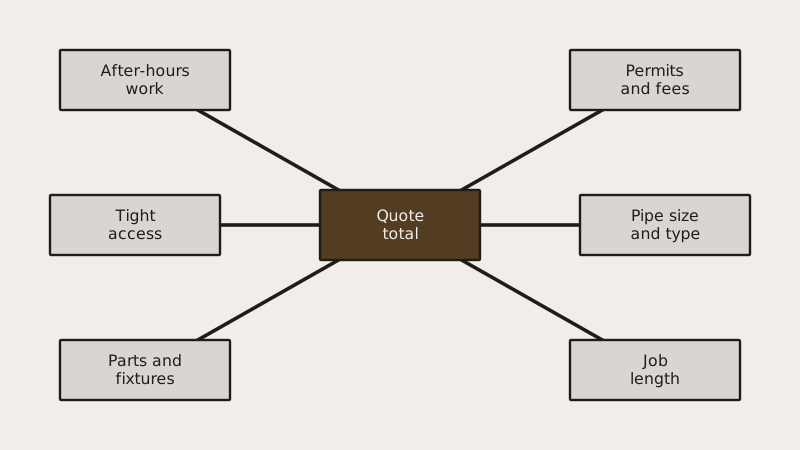
Time of day is the clearest factor. Guides publish after-hours and weekend rates at 1.5 to 2 times the standard rate, and some add an after-hours dispatch fee of $150 to $300. Minimum charges, often one or two hours, apply to short jobs. Building type matters: older Pasadena commercial buildings, such as the brick storefronts around the city's historic districts, may have mixed pipe materials that slow a repair. Required work also adds cost: annual backflow testing is a fixed per-device charge, and permits come from the city's Permit Center. If you operate a food business, ask how the plumber handles grease lines and floor drains.
How do I turn an hourly rate into a job total?
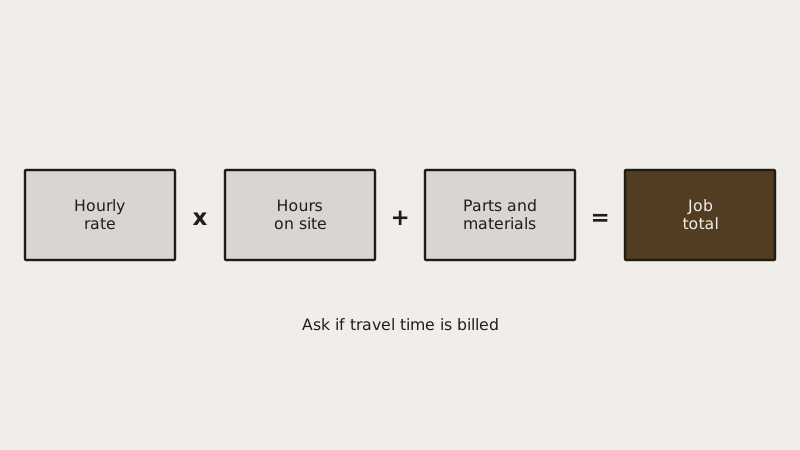
Multiply the rate by the hours, then add the service fee, parts with any markup, permit costs and any after-hours surcharge. A made-up example, round numbers for illustration only: two hours at $150, a $125 service fee and $200 in parts adds up to $625 before surcharges or tax.
A plumbing hourly rate calculator is just that sum. Ask for the same sum on paper before the job: estimated hours, hourly rate, any minimum, the service fee and whether it is deducted if you go ahead, parts and who supplies them, permit fees, and the plan if work runs long. A good quote lists a not-to-exceed figure or says how the plumber will approve extra work. Without that, the final bill can drift above the first number you heard.
Is hourly billing or a flat price better?
For small, well-defined jobs such as replacing a faucet or a water heater, a flat price is easier to compare and protects you if the work runs long. For diagnosis, repairs in old buildings and anything where the cause is unknown, hourly billing is common and fair, as long as there is an estimate and a cap.
Ask which model the plumber uses and why. Many plumbers diagnose hourly and then give a fixed price for the repair. For recurring work such as scheduled inspections and backflow tests, a maintenance arrangement can fix the price per visit: see our maintenance plumbing services page. For an urgent leak or blockage at a business, the emergency commercial plumber page sets out the steps to take while you wait, and commercial versus residential plumbers lays out when to use which.
Common questions
Why do commercial hourly rates differ from residential ones?
Commercial rates are often higher per hour because the work involves larger systems, stricter codes, after-hours scheduling and more equipment, but not always: some residential rates in California match or exceed commercial ones. Compare what each quote includes, such as the trip fee, minimum hours and parts, instead of the hourly figure alone.
Do plumbers charge for travel time and service calls?
Many do. A service call or dispatch fee, commonly $110 to $185 in California guides, covers the drive and the diagnosis, and a few plumbers take it off the repair bill. Ask if travel time is billed hourly, whether a minimum applies, and whether the fee is waived when you proceed.
Which questions should a business owner put to a plumber?
Write down the contractor's license number, check it with the state, the hourly rate of whoever does the work, the service fee and any minimum, an itemized written estimate, and whether permits are included. Also ask about insurance in writing, how extra work is approved, and who patches walls or ceilings afterward.
Can I get a firm price instead of an hourly rate?
Often, yes, for defined work. A walk-through of the site comes first, then a written quote, then the work. Some jobs, such as finding a hidden leak, cannot be fixed to a price until the cause is known, and those start hourly with a limit.
You can begin on the quote form, browse other services from the home page, or check where we work to confirm your city.
Sources
Page updated