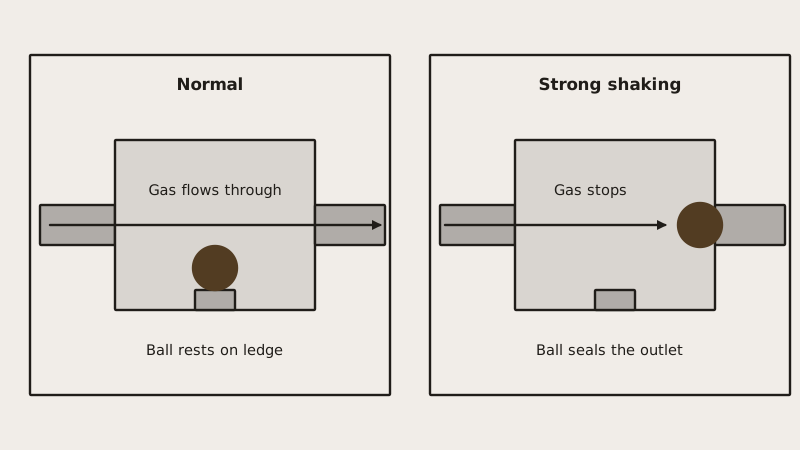
Picture a small device bolted to the gas pipe beside your house. Once shaking passes a set strength, it seals the gas line with nobody there to touch it. That device is the topic here, and it belongs with gas lines, since a plumber mounts it downstream of the meter. Published guides put the installed price near $250 to $800.
What does an automatic earthquake gas shut-off valve do?
An earthquake valve closes natural gas service automatically when shaking of sufficient size occurs at your property, according to SoCalGas. It does not detect a leak, it detects motion, so a pipe that fails in a small tremor or a slow leak will not trip it. Think of it as backup for the worst shaking, not a general leak alarm.
Two designs dominate. The motion-triggered one, where a ball or pendulum drops and shuts the gas, is what most people mean by "seismic." The excess-flow type closes when gas surges faster than normal, as it would through a broken pipe. Some models do both. All of them belong on the owner's house line: the utility will not mount one for you and does not allow them on its own equipment or inside meter vaults.
Pasadena sits in a region with several active faults. An older Craftsman with a gas furnace in the basement, a water heater in the garage and a range in the kitchen has several places where a failed connector could feed a fire. That is the reasoning behind the valve, though whether you need one depends on your building, your insurer and the city.
Should I shut off the gas myself after an earthquake?
The utility's advice is to leave the meter alone unless there is a smell, a hiss or visible damage, and even then only when you can reach the meter without risk. Shaking rarely breaks gas pipe by itself. Where closing is warranted, a 12-inch adjustable wrench turns the meter valve one quarter turn, so the handle ends up across the pipe.
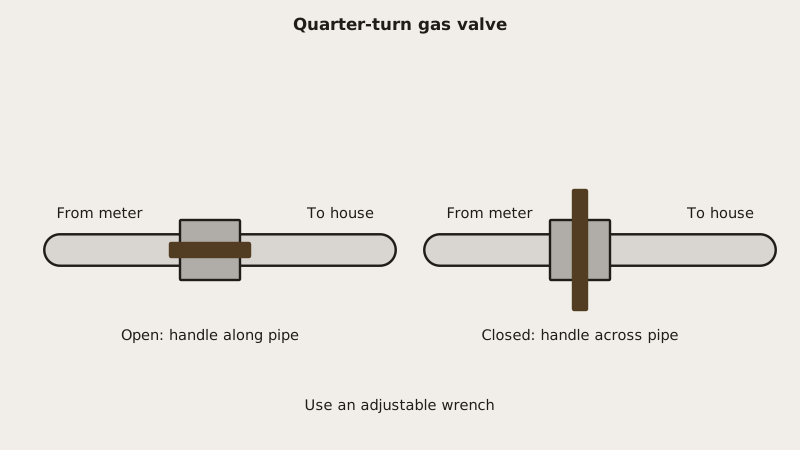
Practical points from the utility's guidance:
- The valve sits on the pipe rising out of the ground to the meter, usually 6 to 8 inches up.
- Keep the wrench with your emergency kit or near the exit, not hanging on the meter or any gas pipe.
- Once it is off, leave it off. Do not turn it back on or relight pilots yourself. SoCalGas restores service.
- The company's own service valve is off limits to everyone except SoCalGas and its contractors.
Think there is a leak? Exit the building. Leak reports go to the utility on 1-800-427-2200, while 911 handles immediate danger. Keep switches, ignition keys and open flames away from the area until it is cleared.
What does a seismic valve cost to install in Pasadena?
Cost guides and Southern California plumbing companies put an installed seismic valve at about $250 to $800, with most sitting between $300 and $700. A basic motion valve on an ordinary meter lands in the lower half. A dual-function unit, bigger pipe or a meter buried behind a fence pushes the price up. Many quotes fold in the permit and inspection.
A few outliers show up at both ends, from about $200 to well over $1,000, so ask what the number includes. What moves it:
- Pipe size and meter location (a tight side yard versus an open wall).
- The valve model and whether it is combined with excess-flow protection.
- Whether the house line needs modification, such as a new union or a longer riser.
- Local permit charges and the inspection visit.
A fuller price breakdown is on the valve installation cost page. Treat everything here as a range to compare against, with the final number set after someone sees your meter.
Who can install the valve, and is a permit needed?
The state's plumbing classification, C-36, lists maintenance and replacement of gas earthquake valves and gas control valves in its scope, which makes it the license to ask for. Gas piping work normally needs a permit. Local rules sit with the Building and Safety division at the Permit Center in Pasadena, reachable at (626) 744-7601.
A building rule or an insurance condition could make the valve mandatory for you. The gas company points owners to the building department for valve size and maker requirements, and to the insurer for any policy terms. Rules for existing homes and for new builds have not been the same over the years, and we found no single Pasadena rule worth quoting, so a call to the division settles it.
The valve itself must carry California approval, and the plumber will know which models the building department takes. For a look at the actual steps of the job, read how the valve gets installed.
What happens after the valve trips?
SoCalGas says you may follow the manufacturer's reset steps but recommends having a qualified professional or the utility do it. Before appliances go back into use, someone should check that no gas is leaking and pilot lights need relighting. After a major emergency, help can take days or weeks, so it pays to know your pilot-light routine in advance.
SoCalGas may bill a fee for resetting a valve and relighting pilots when the closure had nothing to do with a quake. A valve that keeps tripping from small tremors or passing traffic may be mounted loosely, and a plumber can inspect that. The manufacturer sets how the unit must be mounted, so the installer follows those instructions.
Do not tape, tie or wedge a valve open. If it keeps closing, that is a symptom to look at, not a nuisance to silence.
To find out what yours would take, begin at the quote page. After that, a local plumber we arrange inspects the meter and the pipe. Wider gas topics are collected under gas lines, and everything else starts from Pasadena Pipe Works.
Common questions
Is an earthquake gas shut-off valve required in Pasadena?
That turns on the building and the circumstances, and no single Pasadena rule turned up that we could cite. New construction and existing homes are treated differently, and some insurers ask for a valve. SoCalGas suggests asking the local building department and your insurer. The Building and Safety division in Pasadena can answer for a specific address.
How long does the install take?
A straightforward fitting on an accessible house line is generally a short visit, though the gas must be off and the system tested afterward. Complex pipe, tight access or a permit inspection adds time. The plumber who visits will give you a better estimate for your meter.
Will the valve protect me from every gas leak?
No. One senses shaking, the other a sudden large flow, and a slow seep at a loose fitting can slip past both. Whenever you smell gas, go outdoors and phone the SoCalGas emergency line from there, then wait for instructions before going back in.
What questions should come before booking this install?
Find out which valve model goes in, whether California approves it, if testing and the permit sit inside the price, and who resets it after a trip. Ask for the C-36 number, check it against the state's contractor records, and get the answers in writing.
Can I install one myself?
Fuel gas piping is regulated, and one wrong connection can leak or start a fire. State scope for the plumbing classification names earthquake valves, and cities expect a permit. Hire a plumber for it, and after any closure leave the relighting and restoring to the utility or a professional.
Sources
- SoCalGas, earthquake and excess flow valves
- SoCalGas, how to shut off your natural gas
- California Contractors State License Board, C-36 plumbing classification
- City of Pasadena, Permit Center
- Earthquake valve, Wikipedia
- Published prices from cost guides and Southern California plumbing companies for seismic gas valves, checked November 2026
Page updated