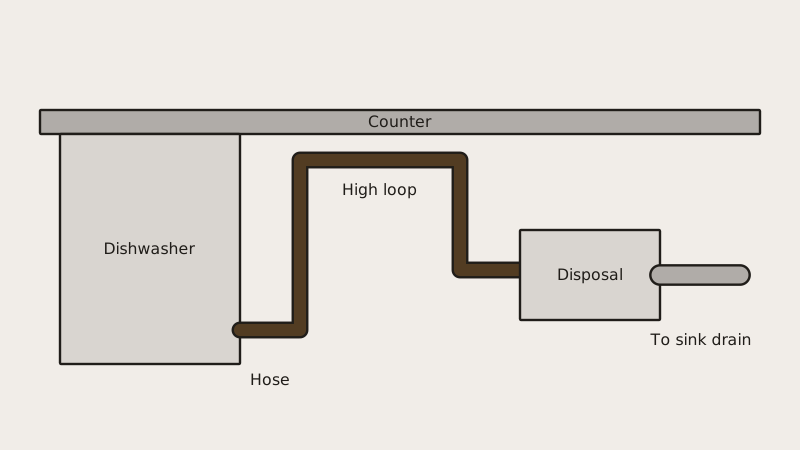
A dishwasher that leaves dirty water in the bottom is nearly always blocked in one of five places: the filter in the tub, the drain hose, the air gap on the counter, the connection to the garbage disposal, or the sink drain it empties into. Start with the filter, which manufacturers name as the most common culprit, then work outward. Our clogged drains and toilets guide sits above this one. Read to the end for the signs that the blockage is in the house plumbing, not the appliance.
Why is the water not draining out of my dishwasher?
Something is stopping the water on its way to the sink drain. The usual suspects, in order of likelihood, are a clogged filter or sump, a kinked or clogged drain hose, a plugged air gap, a disposal whose knockout plug was never removed, or a backed-up kitchen drain.
Food scraps, labels from jars, glass shards, seeds and toothpicks gather at the filter. Grease cools in the hose and in the sink trap and narrows them over months. Hair has little role here, unlike in a shower drain, but soap scum and coffee grounds do. If the dishwasher was installed or the disposal replaced recently, the plug inside the disposal inlet is the first thing to rule out. Which of these it is shows up when you look: standing water that smells points to food and grease, and water that drains slowly but steadily points to a partial blockage.
How do I clean the filter and check the drain hose?
Unplug the dishwasher or switch off its breaker, pull out the bottom rack, twist and lift the filter out, and rinse it under the tap. Look into the sump with a flashlight and remove any glass or debris. Then look at the drain hose behind or under the machine for kinks or crushing.
Bail out the standing water with a cup and a sponge first. Most manufacturers say to check that the drain hose is not bent, flattened or pinched between the cabinet and the machine. Some hoses carry a built-in check valve that works in one direction, and one installed backward blocks drainage. The hose should either climb in a loop beneath the counter or feed an air gap; one that hangs low can let sink water run back into the tub. Do not use a screwdriver in the pump area while the machine has power.
What is an air gap and how do I clear it?
An air gap is a small fitting, often chrome, that sits on the counter or sink rim near the faucet. It breaks the connection between dirty drain water and the dishwasher, and it can clog with food and grease. Lift off the cap, unscrew the inner cover and clean out the debris with a brush.
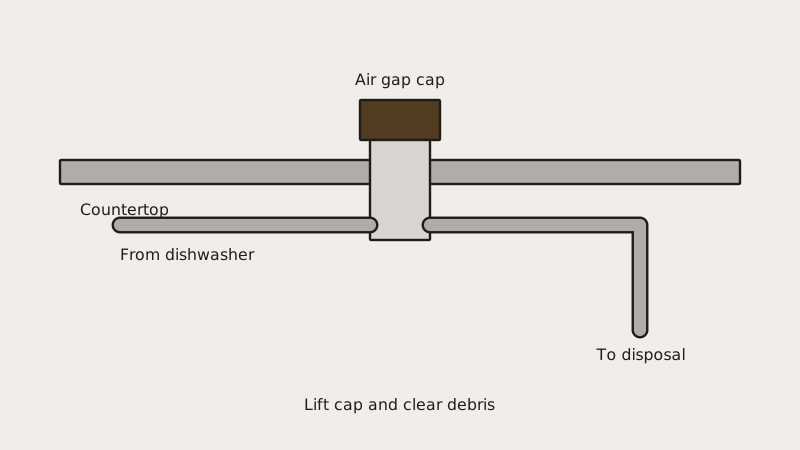
Not every home has one; some use a high loop under the counter instead, and the choice depends on local code. If you do have an air gap, the hose running from it to the sink drain or disposal should be cleared as well, since a clog there stops everything upstream. Water spilling out of the air gap while the machine drains is a symptom that the sink drain or disposal side is blocked. In that case, run the disposal and test the sink before you pull anything apart.
Could the garbage disposal be the problem?
Yes, and it is the standard reason a new dishwasher or new disposal will not drain. Disposals ship with a plastic knockout plug in the dishwasher inlet. If the plug is still there, no water gets through. Whirlpool and Bosch both tell owners to check it. Removing it takes a hammer, a screwdriver and care.
To check, unplug the disposal or turn off its breaker and disconnect the dishwasher hose from the inlet. Look inside the port. If a plastic disc is present, knock it out and fish the piece out of the disposal, because it can jam the blades. Then reconnect the hose and clean the disposal of grease and bits. If you cannot reach the inlet or are uneasy near the wiring, leave it to a plumber. If the sink itself is also slow, work through unclogging a kitchen sink first.
Is the clog in the sink line rather than the appliance?
If the kitchen sink drains slowly, gurgles or fills up while the dishwasher runs, the blockage sits in the sink line. Run the sink full, drain it, and watch the dishwasher tub for rising water. The pattern gives it away: two fixtures on one line failing together means a shared clog.
Kitchen lines in Pasadena's older homes can be cast iron or galvanized steel inside the walls, where grease and scale narrow the pipe over decades, and a plunger cannot reach that. A clog deep in the line may also affect the nearest fixtures, such as a washing machine standpipe, a bathroom sink or a shower drain. If you see several drains slow at once, or a smell coming from the drain, the problem could be the main line or a blocked vent; see a clogged drain vent and sewer smell in the house. That is a job for drain cleaning services, not a bottle of cleaner.
Which fixes should I avoid?
Avoid pouring chemical drain openers into a dishwasher or sink that has standing water. Harsh chemicals can damage seals and plastic, splash back, and sit in water you then have to bail out. Do not run the cycle repeatedly hoping it will clear, and do not use a metal snake in the sump.
Manufacturers recommend mechanical steps first: clean the filter, clear the hose, clean the air gap, check the plug. Baking soda followed by white vinegar is a common home remedy for light odors, yet it will not clear a real blockage. A stubborn clog is plumber territory, with a drain snake or a camera. When you ask for a visit on the quote page, include the machine's make, model and any error code.
Common questions
Will a plumber clear a dishwasher drain in one visit?
Usually yes. Clearing a sink trap or kitchen line often takes about an hour, longer when the clog is deep or the pipe is old. Cleaning the filter and hose yourself takes 20 to 30 minutes. If the fault is the dishwasher's own pump, the repair belongs to an appliance technician.
What should I verify about a plumber before booking?
Get the contractor license number and check it with the state board. Ask if the visit fee includes clearing the line, whether the plumber handles appliance connections or only pipes, and what happens if the cause turns out to be the machine rather than the plumbing.
Does anyone need to be at the house during the visit?
An adult should be there so the plumber can get under the sink, disconnect the dishwasher if needed and agree changes to the price. Empty the cabinet beforehand and write down any error code the display shows, since that tells the plumber what to expect before the visit starts.
Can a clogged dishwasher cause a bad smell or a leak?
Yes. Trapped food and grease smell as they rot, and a hose that cannot drain can push water out of the air gap or back into the tub. If the smell continues after cleaning the filter, the sink trap or line is the likely source.
This guide is one of many on the plumber guide for Pasadena.
Sources
Page updated