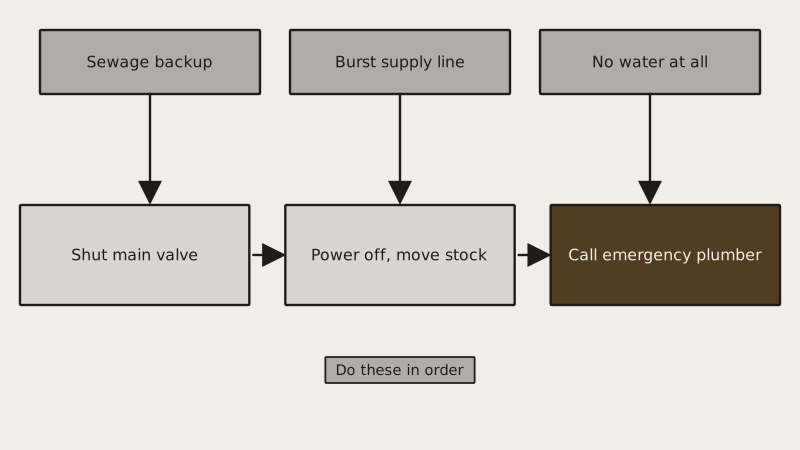
A commercial plumbing emergency is whatever keeps a business from running safely: a split supply line, sewage rising in a floor drain, a kitchen with no hot water, a whiff of gas. The opening moves never change. Close the correct valve, protect people and stock, phone the gas utility if gas is involved, then request a plumber. Below is that sequence, plus what the visit and the invoice look like.
Tenant, restaurant and building work in general is covered on our commercial plumbing services page. Requesting a visit starts on our quote form.
When does a plumbing problem become a business emergency?
It becomes one when people, the building or your opening hours are at risk: water you can't stop, sewage surfacing through floor drains or toilets, a food business that has lost water or hot water, gas odor, or flooding close to electrical equipment. One slow drain or a lazy drip can normally wait for a scheduled visit.
Restaurants and food shops have extra reason to hurry. Pasadena runs its own Public Health Department for food inspections inside the city, and its guidance lists sewage overflow and loss of running or hot water among the conditions that can bring a closure placard. A shuttered kitchen bleeds income by the hour, so the plumbing call doubles as a permit call.
Offices, retail strips, medical suites and apartment buildings have different tripwires: a restroom out of service, a riser leak dripping through a neighbor's ceiling, one failed heater serving an entire floor. Landlords and tenants should decide ahead of time who makes the call, since leases differ.
What are the first ten minutes supposed to look like?
Stop the flow, save what you can, then call. Close the main or the nearest isolation valve, kill power to wet zones only if the panel is safely reachable, lift stock and paperwork off the floor, and photograph the scene. With gas, leave first and call the gas company once outdoors. Then ask for a plumber.
A checklist worth taping up in the back office:
- Locate every shutoff before anything breaks. Main water valve, riser and floor valves, the heater valve and the gas meter shutoff. Tag each one.
- Water: rotate the main clockwise until it stops, then open a low tap to bleed pressure.
- Gas: at the first smell, empty the building, leave switches alone, and, from a safe distance, SoCalGas answers at 1-800-427-2200. Someone in danger means 911.
- Electrical: water plus live power is a shock risk. If it is reaching outlets or a panel, step back and bring in the utility or an electrician.
- Record it: photos and a rough timeline help later with the insurer and the landlord.
- Block off wet or contaminated areas, above all after sewage.
Sewage is a health matter. Mopping a floor-drain backup and walking away fixes nothing, because the blockage is still in the line. A plumber has to find where it sits, and cleaning up after contaminated water is often another trade altogether.
Do you offer 24 hour commercial plumbing?
No promise of that. Our weekday request hours are nine to five, and there is no commitment on overnight response or a set arrival time. Water ignores business hours, which is why people look for a "24 hour commercial plumber," but we would rather be straight about limits. Send a request early, and we arrange a local commercial plumber as the schedule permits.
Outside those hours your own steps carry the most weight: isolate the water, protect the space, record the damage. If a plumber you already work with offers after-hours dispatch, that is a good number to keep posted in the back office. Commercial customers with several sites sometimes set up a service arrangement ahead of time so a call is answered quickly. Ask any plumber what that includes before you need it.
For urgent residential-style jobs inside weekday hours, read emergency plumbing.
What sets commercial plumbing apart from work on a house?
Commercial jobs mean bigger pipe, heavier flow, code rules tied to the type of business, and more people exposed when something fails. A plumbing business that specializes in commercial buildings deals with grease interceptors, backflow assemblies, flushometer toilets, gang restrooms, roof drains and shared risers. Some residential plumbers can do part of that; not all own the equipment.
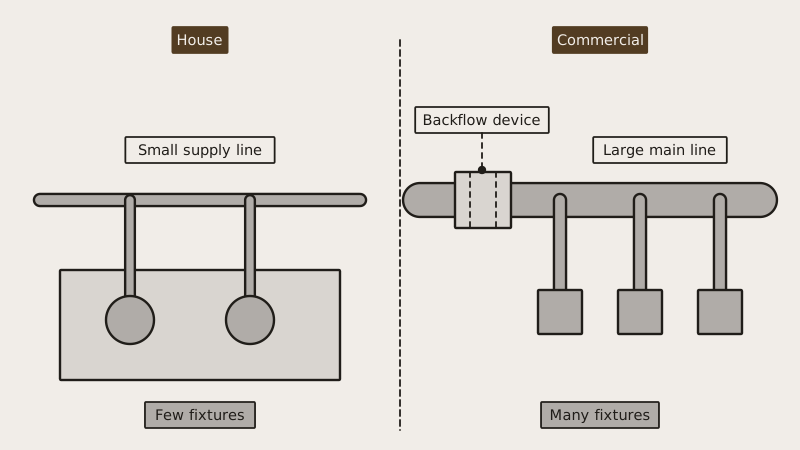
Typical commercial emergencies include:
- Grease and sewer backups in restaurants and food courts, often tied to a clogged interceptor or a shared building lateral.
- Burst or failed supply lines feeding a restroom block or a rooftop unit.
- Water heater and boiler failures in kitchens, salons, gyms and apartment buildings.
- Flushometer and fixture failures that take restrooms out of service.
- Backflow assembly problems. Commercial properties often have devices that protect the public water supply and need regular testing. See backflow testing for how that works.
The longer comparison lives on our page about commercial versus residential plumbers. For Pasadena's older commercial districts, expect cast iron and clay lines and a lot of hidden piping. Where a lateral crosses a street or sidewalk, the city or a utility may have rules, and the plumber should flag it when a permit applies.
How is emergency commercial plumbing priced?
Expect more than a scheduled visit costs. National price guides show commercial plumbing opening around $100 to $200 an hour, emergency or complex calls reaching $150 to $300, and a dispatch fee on top. After-hours premiums often land at 1.5x to 3x the normal rate. Consider these yardsticks; your written quote is the actual number.
We could not find a published source that isolates commercial after-hours rates in Pasadena, so treat the figures as a national yardstick. Parts, access, lift or excavation needs, and any permit add to the total.
What to ask for before work starts:
- The hourly rate, the dispatch fee, and whether travel time is charged.
- A cap or an approval step if the diagnosis changes the scope.
- Whether a permit applies, and which party files it.
- Whether the contractor has an active California license. The state requires one once labor and materials pass $1,000, and for any permitted work regardless of price.
The state board's license search answers that in a minute. Hourly and project ranges get more space in commercial plumber hourly cost.
How can I avoid the next emergency?
Most commercial plumbing emergencies have warnings: slow drains, gurgling, stained ceilings, pressure swings, and heaters that run constantly. Schedule maintenance on grease traps, water heaters and backflow devices, label every shutoff, and train staff on the first ten minutes. Annual walkthroughs often find the weak valve before it fails.
Our page on maintenance plumbing services lays out what a routine visit checks. Hard water in Pasadena, about 13 grains per gallon in recent reports, shortens the life of heaters and valves, so descaling and flushing are not optional extras for a restaurant or salon. The home page shows what else we arrange across the city.
Common questions
How quickly will a commercial plumber show up?
We won't name an arrival time for a plumber who hasn't been dispatched. Speed depends on the hour, the schedule and the distance. Send the address, the problem and a callback number, and close the main valve before anyone gets there.
Who pays for the repair, the landlord or the tenant?
It depends on the lease. In many leases the landlord covers the building's lines and risers, while the tenant covers fixtures and equipment inside the space. Read your lease before you call, tell the landlord right away, and keep receipts and photos. If the call is unclear, a lawyer or property manager can interpret the lease for you.
Can a restaurant stay open during a plumbing emergency?
Not if the problem is a condition the health department treats as serious, such as sewage backing up, no running water or no hot water. Pasadena's Public Health Department inspects food facilities in the city and can suspend a permit until the problem is fixed. If unsure, ask them directly.
Is a different license needed for commercial plumbing?
State records file plumbing under C-36, and we found no separate commercial class. Boilers and some other trades carry their own, so ask. Look for experience with a system your size, request similar past work, and confirm the license is active on the state site.
What details help most when I request a visit?
Give the address, a line on what failed, whether the water is off, and a number that gets answered. Add the kind of business, the building's age if known, and shutoff locations. Photos help. Mention any fix already attempted, such as a bottle of drain opener.
Sources
Page updated