Azusa is the city at the mouth of San Gabriel Canyon, about 9.7 square miles at roughly 610 feet, with some 15,300 housing units and 50,000 residents. The mountains rise right behind it. Plumbing questions here start with that setting, so this page begins with the canyon. We arrange the visits across the whole city, and the areas page places Azusa among the neighbouring cities.
Why is Azusa's tap water softer than the rest of the valley?
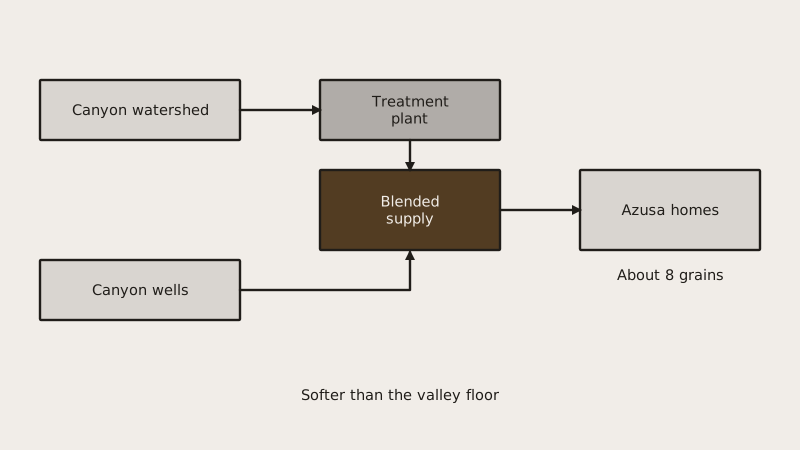
Azusa Light and Water treats surface water from the San Gabriel Canyon watershed at its Hsu Filtration Plant and adds groundwater pumped from wells in the Canyon Aquifer. Neither source is the valley-floor basin that supplies many neighbours, and both run softer than the regional norm.
The city's 2025 report lists hardness of 99 to 260 mg/L with an average of 141, which is about 8 grains per gallon on the usual 17.1 mg/L conversion. That is moderately hard, well short of the 12 to 16 grains reported in El Monte or Glendora. The 2024 report rates the plant for up to 12 million gallons daily.
What does that mean at home? Scale still forms, but slowly. Softer water is gentler on tank heaters and fixtures, which makes a softener a choice rather than a repair. If you are weighing one anyway, the softener cost guide sets out the numbers. Hardness varies with the blend on any given week, so treat 141 as a centre point.
What are the houses in Azusa like, and what is under them?
The city's roots are in a Mexican-era ranch. Settlement started in 1841, the rail line arrived in 1887 and the city incorporated at the end of that century. Housing now spans old bungalows near downtown, postwar tract homes spread across the flat, and apartments and student housing around Azusa Pacific University.
Expect a layered picture. In the oldest blocks, galvanized supply and clay laterals are plausible, and a water line that has been patched many times is a candidate for a repipe. In the postwar tracts, copper supply and cast iron or black ABS plastic carries the waste. In recent construction, PEX is likely, and our PEX against copper comparison explains the difference.
Lots near the canyon rise toward the foothills, so pressure from the street main varies. If a shower is weak at one house and strong at the next, a pressure regulator that has drifted is worth checking before anyone opens a wall, and adjusting a regulator valve is a short read.
What does Azusa want before a new water heater goes in?
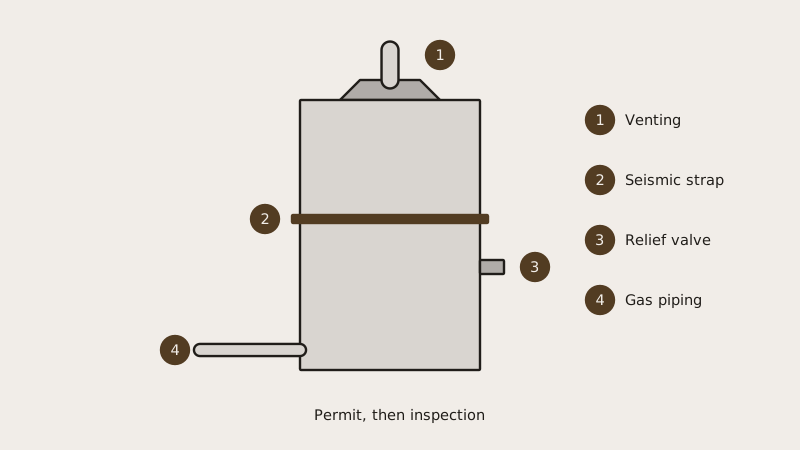
Yes. The city's water heater handout says new and replacement heaters need a permit under the Uniform Plumbing Code, and the Building Division issues building, plumbing, electrical and mechanical permits through its online portal. Inspection afterwards checks venting, seismic strapping, the pressure relief valve, gas piping and energy compliance.
The same handout lists the installation limits. A heater cannot sit in a sleeping room, a bathroom, or a closet that opens into either, and a gas appliance connector can be no longer than 3 feet. It also asks for R-4 insulation on the first 5 feet of hot and cold pipe in unconditioned space. Fees are on the city's published schedule, so ask the Building Division what applies to a simple swap.
A permit is part of why this is a contractor's job. Compare typical outlay on the water heater price guide, and see how often water heaters are replaced for timing.
What do plumbing jobs usually cost around Azusa?
Southern California price guides show daytime plumbing labor at about $150 to $250 an hour, with a tank heater swap often $900 to $1,800 and a toilet replacement $150 to $700. Whole-house repipes run into the thousands. Take those as a guide, because only the written estimate after a look is a price.
Local drivers: foothill pressure, older lots with root-invaded clay laterals, and the permit and inspection that a heater swap triggers. Apartments near the university add shared stacks, where a plumber may need building management to open a wall. Tell us what kind of building you have when you call.
How do I arrange a plumber in Azusa?
Call on a weekday between nine and five, or fill out the quote form with your street, the problem and a photo. Someone local visits, inspects and writes up a price, and you decide afterward. How the steps run is on how it works, and the home page lists the full range of jobs.
If you catch a gas odor, walk out before anything else; the SoCalGas line is 1-800-427-2200, and real danger is a 911 matter. Past $1,000 with parts, a state contractor license is a legal requirement, and the licensing board posts a lookup.
Common questions
Is Azusa water hard?
Moderately. The city's 2025 report gives a range of 99 to 260 mg/L with an average of 141, around 8 grains per gallon, softer than most neighbouring cities. Scale builds slower than in El Monte or Glendora, so a softener is optional for many homes. Check your own heater for sediment before deciding.
Who issues plumbing permits in Azusa?
The city's Building Division issues plumbing permits, along with building, electrical and mechanical ones, and takes applications through an online portal. A replacement water heater needs one and is inspected afterward. Ask the division what your job needs, and give the work to someone with a verifiable California contractor license.
Why is my water pressure uneven near the foothills?
Streets near the canyon sit at different heights, and pressure at the house depends on the main, the elevation and any regulator at the meter. A drifting regulator is a common cause of weak or spiky pressure. A gauge on the outside spigot gives a reading in minutes.
Sources
- Azusa Light and Water, 2024 Drinking Water Consumer Confidence Report
- California State Water Resources Control Board, Azusa Light and Water consumer confidence report 2025
- City of Azusa, Water Heater Installation handout
- City of Azusa, Building Division
- Azusa, California (area, population, housing units, elevation)
Page updated