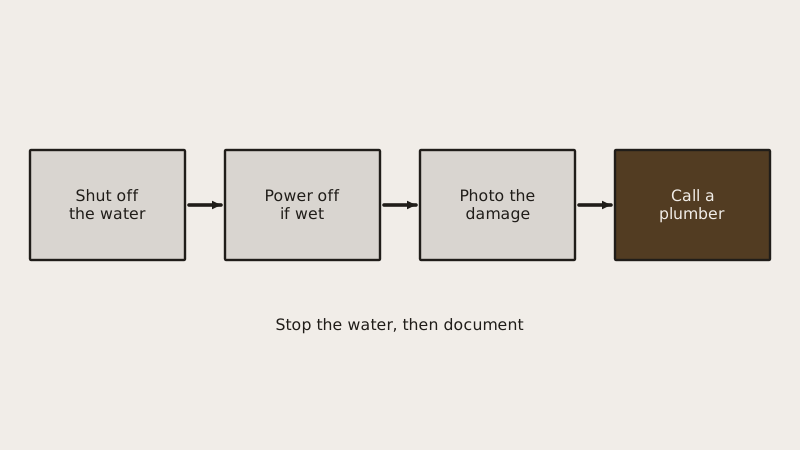
Water is spraying or pooling where it has no business being, and your one job is to stop it. Valve first, electricity second, phone third. Everything here is written for Pasadena and the San Gabriel Valley cities around it. Someone local turns up, traces the split, replaces that stretch of pipe and a written price lands in your hands. Leak work as a whole lives on the burst pipe plumber page; still doubtful that a pipe let go? Compare what you see with the tell-tale signs of a burst pipe.
Water everywhere: what comes first?
Turn the main shut-off to closed, then open whichever faucet sits lowest until the pipes stop running. Never wade through water to reach the breaker panel. Get belongings off the floor, photograph everything, and make two calls: one to a plumber, one to whoever insures the house.
Look for the main valve where the supply pipe enters the house: a wall near the front hose bib, the garage, a side yard. Pasadena Water and Power describes it the same way, and when yours is stuck, the utility handles the meter shut-off through its Water Emergency Hotline, 626-744-4138. Water streaming through a light fixture, a bowing ceiling, or a hiss together with a rotten-egg odor means get everyone out first and dial 911.
The photos matter. Adjusters ask for proof of what got wet and when, and the plumber reads the shape of the split, which often hints at the cause, before cutting it out.
What does emergency plumbing for a burst pipe cost in Pasadena?
Published guides spread widely. HomeAdvisor shows burst pipe repairs from roughly $200 to $3,000, and HomeGuide from about $400 to $2,000, averaging near $1,200. Evening and weekend visits are often priced at 1.5 to 2 times the daytime labor rate. Drying the house is billed separately.
Four things set your number: which pipe failed (a copper stub-out is a short job, a galvanized run behind plaster is not), how simple the access is, whether drywall or a ceiling has to be opened and patched afterward, and whether the plumber advises replacing the whole run rather than one spot. After a large release, drying and mold prevention can add around $1,400 to $6,400 in one national guide. Every figure here is national, so read it as a planning guide. For the line-by-line version, see what fixing a burst pipe costs.
Why would a pipe burst in a mild city like Pasadena?
Mostly age and pressure, not frost. Rust eats galvanized steel from within, thin copper pits in hard water, and a supply running high on pressure leans on every joint until the weakest quits. Cold is a minor cause here, though not a zero one.
A Craftsman from the 1920s or a ranch house from the 1950s may still have first-generation galvanized or early copper inside its walls, and foothill streets above the flats can deliver more pressure than that plumbing was built for. A cheap pressure gauge threaded onto a spigot shows what your house sees, and the pressure regulator guide explains what to do with the result.
What outdoor temperature splits a pipe?
Guidance adapted from the American Red Cross says a pipe can freeze and split once outdoor air holds around 20 degrees Fahrenheit or colder. Lines in attics, garages, crawlspaces and outside walls go first, and wind makes it worse. Splits often show up during the thaw, when water finally moves again.
Pasadena seldom stays that cold. The exceptions are exposed lines: hose bibs, sprinkler risers, a water heater in an open carport, and some foothill yards on a clear winter night. When a freeze is forecast, wrap exposed pipe and cover bibs. If a line has frozen, open the tap, warm it gently with a hair dryer or wrapped hot towels, never a flame, and call for help if it bulges. Preventing a burst pipe has the full checklist.
Where do I shut the water in a bathroom, basement, apartment or sprinkler line?
Start with the closest isolating valve and step up to the main if there is none. Bathrooms carry small stop valves beneath the vanity and on the wall by the toilet. A basement or crawlspace needs the main. An apartment needs the manager called at once. Irrigation lines have their own shut-off.
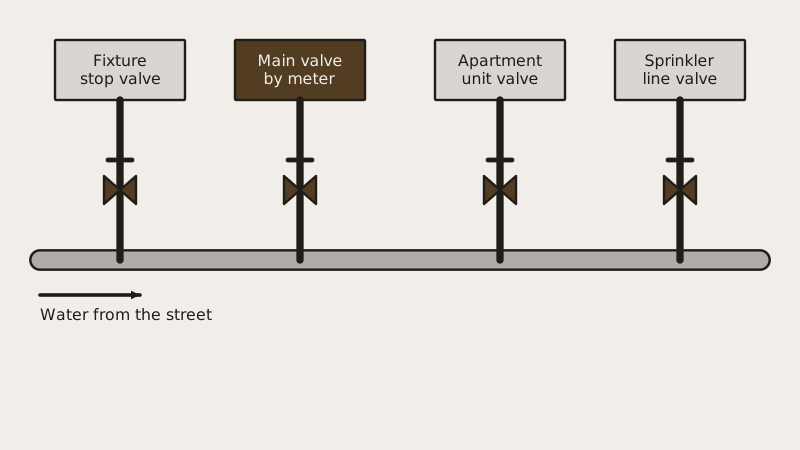
In a bathroom, turn the little oval handle clockwise; a split inside a tub wall sends you to the main. In a basement or crawlspace, water collects low, so find the drain or sump and stay out of standing water while circuits are live. In an apartment, shared risers are the landlord's, so write to the manager the same day and ask which valve isolates your unit. For a sprinkler line, close the irrigation valve and note which zone failed. A cracked sprinkler pipe is normally a smaller outdoor repair than a split inside a wall.
Whose bill is a burst water pipe?
You pay the plumber for the pipe. Your homeowners policy may cover the sudden damage the water causes, though generally not the failed pipe, and not a leak that dripped for months. A renter looks first to the landlord for the building and to a renter's policy for belongings.
Guides written by insurance agents and restorers agree on the pattern: a sudden, accidental release is the usual trigger, and waiting can turn a covered loss into an argument. So stop the water, document it, report it fast. The California Department of Insurance publishes consumer guidance on claims, including how to complain about one. What to ask your carrier is spelled out in what your policy says about burst pipes.
Is there a safe do-it-yourself fix for a split pipe?
Only a temporary one. A hardware-store pipe clamp or slip coupler can bridge a small split on a clean, straight, reachable length of copper or plastic until a plumber arrives. Gas piping, pipe hidden in walls, the main line, and anything needing a permit are plumber work.
Clamps hold poorly on corroded galvanized steel, since the pipe wall beside the split is too thin to grip. Sweating copper joints inside a wet wall, or cutting a ceiling open to chase a leak, is a bad first attempt. Plastic lines have their own stopgaps, set out in the guide to stopping a plastic pipe leak. When splits keep returning, ask whether repiping the house is the real answer.
Common questions
How fast will someone arrive?
Nobody here can name an arrival time in advance; it follows the plumber's day and your address. The desk takes calls on weekdays from nine to five. Past those hours, leave the water off and send the request anyway, so your details are waiting.
What belongs on the written quote?
The scope (cut-out, new pipe, fittings), who closes the wall, permit or no permit, and the hourly labor rate if the call is out of hours. Before work begins, check the contractor's license on the CSLB website, and keep every invoice for the insurer.
Must someone stay in the house?
At the start, an adult has to be on hand to show the shut-off and the damage and to approve the quote. After that, a trusted person can open the door and look over the finished work. Warn the plumber about pets, alarm systems or hazards before the visit.
Does every burst need new pipe?
No. One split in otherwise sound pipe can be trimmed out and bridged with a short new section, which suits a fresh copper or plastic run. If the metal is heavily corroded, or this is the second failure on that run, a longer replacement beats patching again.
Other jobs are listed from the home page, and a request starts on the quote form.
Sources
- Pasadena Water and Power, troubleshooting and water emergency hotline
- Pasadena Water and Power, contact numbers
- Texas A&M AgriLife Extension (adapted from American Red Cross), winter storms and frozen pipes
- HomeAdvisor, cost to repair a burst pipe
- HomeGuide, burst pipe repair cost
- California Department of Insurance
Page updated