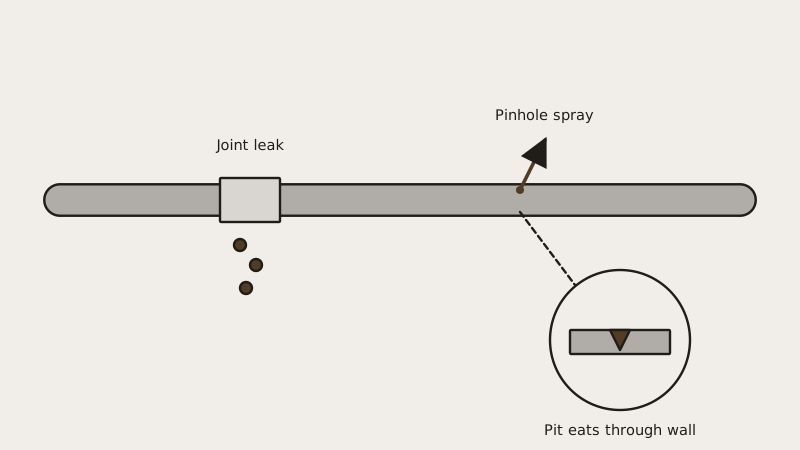
Stop the flow, empty the line, dry the tube, and choose. A pipe clamp or push-fit coupling buys quick, short-lived relief. Lasting repair means removing the damaged stretch and joining new copper in by solder or press fitting. A single joint leak is a repair. Several pinholes are a verdict on the whole system. The bigger picture of leaks lives on our leaks and burst pipes page.
How do I tell whether it is a joint leak or a pinhole?
Dry the pipe and watch. A joint leak shows at a solder or fitting seam, often with green or white crust around it. A pinhole shows as a fine spray or weep from the tube wall, sometimes with a pale pit or green stain, and it comes from corrosion that began on the inner wall of the tube.
Where you cannot see the pipe, look for stained ceilings, damp drywall, a musty smell, a running meter with all fixtures off or a hissing sound inside a wall. A meter test helps: read the dial, keep every tap closed for a couple of hours, and read it again. If a stain on the ceiling is what you found first, fixing a ceiling water leak is the place to go.
Why does copper pinhole in Southern California?
Pinholes are an extreme form of pitting corrosion, and the causes are water chemistry, flow and installation rather than age alone. A task force study of pinhole leaks links different pitting types to hard or moderately hard water, to soft cold water, and to combinations of high pH, chlorine residual and trace minerals. No single cause explains every house.
That matters here because Pasadena Water and Power supplies very hard water, around 12.9 grains per gallon, blended from local groundwater and imported water, and the mix shifts by season. Neighboring cities differ. Some houses have copper that has lasted for decades, while the house next door pinholes in a few years. Installation quality, velocity at fittings, flux residue and the type of tube all play a part, so a plumber studies the pattern around a leak and not just the hole.
Many Pasadena homes date to the Craftsman era or mid-century, and their copper is often joined to older galvanized steel or patched with whatever was handy. Dissimilar metals touching without the right fittings corrode faster.
What is a good temporary fix for a leaking copper pipe?
First close the main, drain from a low tap, and dry the tube. A rubber-padded repair clamp, or a rubber patch cinched with hose clamps, can slow a pinhole until help arrives, and epoxy putty made for wet pipes is another stopgap. Every one of them is temporary, and none suits a pipe that keeps leaking.
Temporary options and their limits:
- Repair clamp or sleeve: wraps a pinhole or small split, and sits best on a clean, round, undamaged length.
- Epoxy putty or tape: can seal a minor seep briefly if the surface is dry and clean, but yields to pressure or heat.
- Rubber pad and hose clamps: the old emergency trick, a patch and nothing more.
Plan to replace the patched section. If water is escaping with force, a pipe has burst, and the first-hour steps are in handling a burst water pipe.
How do I properly repair a leaking copper pipe?
Drain the line completely, cut out the damaged section with a tubing cutter, clean and deburr the ends, and join new copper with soldered fittings, a push-to-connect coupling or a pressed fitting. The line must be fully dry for soldering, and solder and flux for drinking water must be lead-free. A plumber also tests for leaks under pressure.
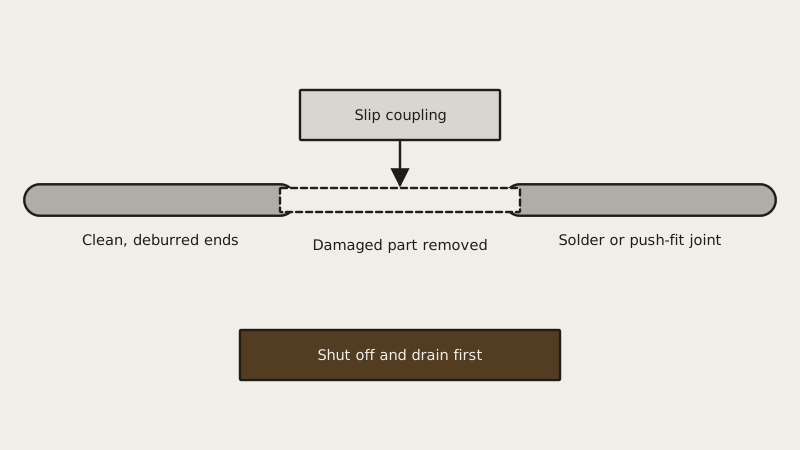
Options, in plain terms:
- Soldered coupling. The traditional repair. It needs a torch, a bone-dry pipe, cleaned surfaces and flux. An open flame near framing, insulation or gas is a fire risk, so many owners leave it to a plumber.
- Push-to-connect coupling. Pushes onto a clean, square-cut, deburred pipe with no torch. Handy for a fast repair when you follow the maker's depth and prep rules. Check that the fitting is approved for potable water and acceptable under local code.
- Pressed fitting. Uses a press tool a plumber carries. Quick and torch-free.
On lead: the EPA says the allowable lead in solder and flux is limited to 0.2 percent for drinking water systems, so use solder labeled lead-free for potable water. Pasadena Water and Power also reminds owners that they are responsible for the plumbing on their property. After any repair, run the tap for a short time to clear flux and debris.
When should I stop repairing and repipe?
When pinholes appear in more than one spot, when the pipe is thin, green and pitted along its length, when walls keep getting wet or when repairs are lasting months instead of years. Each leak means damage nobody can see, and every cut-and-fix uses up wall access. At that point a planned repipe usually beats chasing leaks.
A repipe swaps the supply lines for new copper or PEX, each with trade-offs in local hard water. See PEX versus copper for costs and lifespans, why repipe a house in Pasadena for the signs, and what a repipe costs. Leaks buried in walls or under a slab are plumber territory, and slab leak repair or a repipe is how to think that choice through.
Insurance may come into it as well, since policies often treat a sudden burst and a slow pinhole differently. Read insurance and burst pipes before cleanup, and take photographs first.
Larger repairs and repipes usually need a permit. State licensing then applies to permitted work and to jobs reaching $1,000. CSLB's website lets you confirm any license number you are given.
Need a local plumber to inspect the pipe and price the repair? The quote page is where it starts. Our wider service list is at Pasadena Pipe Works.
Common questions
Is a torch required to mend copper?
Yes, for many repairs. Push-to-connect couplings and pressed fittings join copper without a torch, and repair clamps stop small leaks temporarily. The pipe must be clean, round and undamaged where the fitting seats. For a permanent repair in an older house, a plumber may still prefer a cut-out and a proper joint.
What is the usual time for a copper pipe repair?
One reachable joint or short section commonly takes about two hours with draining, cutting, fitting and testing. Pipe inside a wall or ceiling adds time for opening and patching, and multiple leaks or a repipe stretch to days. An estimate comes once the source is found.
Is a green or blue crust on copper a leak?
Often yes. Green or blue-green deposits at a joint or along the tube are copper corrosion products, and they can mean a slow weep that evaporates before it drips. Clean the area, dry it and watch it for new moisture. If crust returns, the joint or pipe needs replacement.
Does a pinhole mean all my copper is failing?
Not always, but repeated pinholes are a warning. One pinhole on a long run can be a defect. A second and third within a few years suggests aggressive water conditions, installation problems or aging pipe. A plumber can inspect the pattern and tell you whether spot repairs still make sense.
What should I settle with a plumber before copper work starts?
Cut out or merely patched? Which fittings and solder go in, does a permit apply, and how will the line be tested? Add wall repair to the list, plus the contractor license number so you can check the state record.
Sources
- Task force study of pinhole leaks in copper plumbing
- Copper tubing, Wikipedia
- U.S. EPA, basic information about lead in drinking water (lead-free solder and flux limits)
- Pasadena Water and Power, water quality FAQs (hardness, shutting off water, owner responsibility for plumbing)
- California Contractors State License Board, hiring a contractor
Page updated