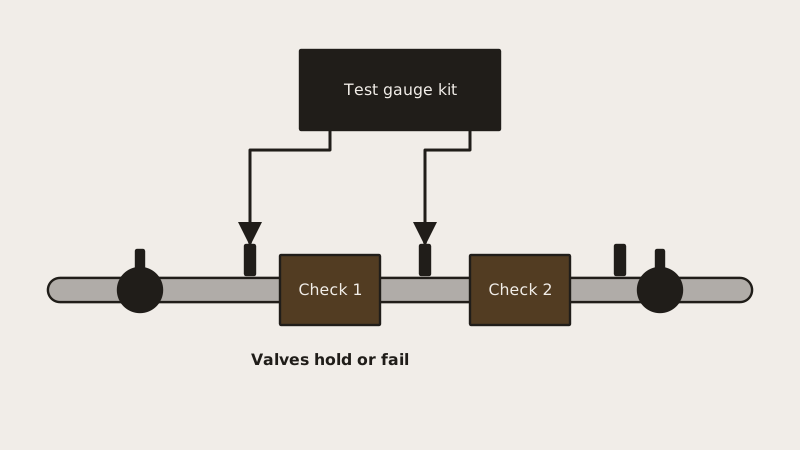
Once a year, a gauge kit gets hooked to the one-way valves that protect your drinking water, and that is a backflow test. It applies wherever an assembly sits on the water line: irrigation systems, fire sprinklers, pools, many commercial buildings and multi-story or multi-family properties. The backflow tester requirements page goes deeper on the rules, with visits requested through the quote page.
What happens during a backflow assembly test?
The tester shuts the assembly off from the line, connects a calibrated gauge kit with hoses, works the valves in a fixed sequence and reads pressure across each check valve. Those numbers show whether each valve holds, and they go onto the form your water supplier requires. For a typical home sprinkler device that passes, the whole thing is done in well under an hour.
Water to the sprinkler line or building drops out briefly, so warn anyone in the shower. Most assemblies stand outside, by the meter, along the sprinkler line or at the fire connection, which means you rarely need to be home. A pass goes straight to the report. A fail comes with an explanation, usually a fouled seat, a worn rubber disc or a tired spring.
Sewer scoping is another animal altogether: a small camera travels down a drain or sewer to show pipe condition. It plays no part in a backflow test. Flyers and notices call both an inspection, so ask which one is being offered.
Who has to test, and who is the supplier?
Your water supplier writes the rules for your address, and the property owner pays for the test. In Pasadena the supplier is Pasadena Water and Power. Its program page says each assembly must be tested at least yearly, by someone carrying the backflow credential issued by the County of Los Angeles Public Health Department. Other valley cities and water companies run programs of their own, so go by the notice you received.
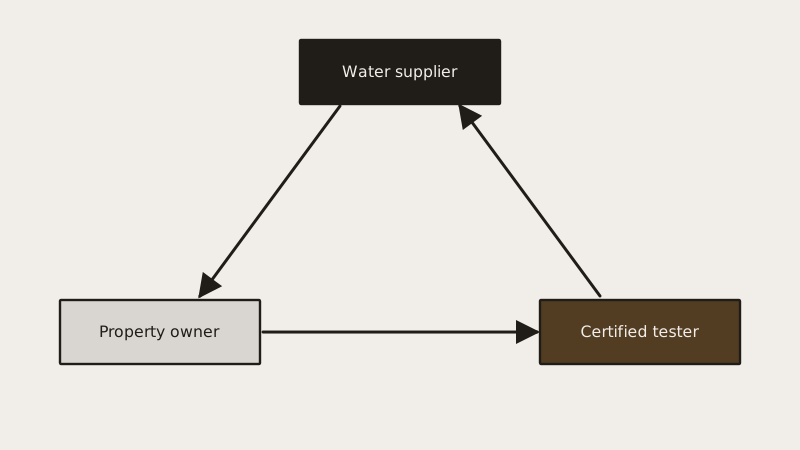
The utility mails a field test form to the property, and since June 2024 the tester files results through an online portal instead of by mail or email. The supplier's FAQ lists the portal fee at $5.45, which testers usually fold into the invoice. Questions go to the cross-connection office at (626) 744-7958. At state level, the Cross Connection Control Policy Handbook, effective July 1, 2024, has public water systems run these programs, with assemblies tested every year. County waterworks districts state the same yearly rule for their own customers.
What does a yearly backflow test cost?
Los Angeles County Public Works describes $75 to $150 per device as the usual price of an annual test. Larger assemblies, reduced-pressure types with their extra parts, and hard-to-reach ones can cost more. Consider every figure here a guide, with the tester naming the actual price.
| Item | Published range |
|---|---|
| Yearly test on one home irrigation assembly | $75 up to $150 |
| Yearly test on a larger or reduced-pressure assembly | quoted by the tester, often more |
| First test on a new or replaced assembly | quoted by the tester |
| Repair parts after a failed test | quoted after diagnosis |
Four things move the price. Several devices in one visit may earn a discount. An assembly buried in a vault costs more to reach. Repairs after a failed test are billed on top, and a retest follows the repair. And you should ask whether the portal fee is already inside the quote. The backflow testing price page breaks the bill down, while how to do backflow testing in Pasadena lays out the tester's sequence.
How do I know my property needs a backflow test?
Odds are you need one if your water supplier mailed a test form, if an automatic sprinkler system has an assembly above ground near the meter, if you have a fire sprinkler line, or if a pool or fountain fills from the house line. Commercial and multi-family buildings usually need one too. Single-family homes without irrigation often have no assembly at all.
Walk the lawn system first. A brass or bronze device standing a foot or so off the ground with a handle on each side is the classic irrigation assembly, and a pressure vacuum breaker sits at the system's high point, a few feet above the highest sprinkler. Still unsure? Phone the supplier, or add a photo when you send your quote request, and we will line up someone to confirm.
What happens if the test fails, or I miss the deadline?
A failing assembly gets repaired or replaced, then retested. Pasadena Water and Power tells owners to file the failed test form, fix the device promptly and retest, and to replace it if it keeps failing. Missing the deadline can bring a notice, and some suppliers, county waterworks districts among them, say service can be shut off until the paperwork is in.
Never leave a failed assembly running. It exists to stop dirty water from being drawn backward into the public line, and a failed one cannot. A local plumber can usually repair or replace a residential assembly during the same visit. A new installation may need a permit from your city's building department. Any job that reaches $1,000 in labor plus parts also has to go to a contractor who holds a California license.
Common questions
What is the testing interval?
Yearly at the least, and again after a repair, move or replacement. The due date is printed on your supplier's notice, and the report must be in by then. Properties with higher hazards, such as chemical use or medical operations, may be told to test more often, so follow whatever schedule your supplier sets.
Must someone be present while it is done?
Frequently not. Many assemblies are outside, and the tester reaches them through the yard or an agreed gate. Someone does need to open up if the assembly is indoors, behind a lock or on a fire line inside the building. Expect the water off briefly while the gauges are on.
Who is allowed to run the test in Pasadena?
Pasadena Water and Power accepts reports only from testers holding the County of Los Angeles Public Health Department credential, per its program page, and a report from anyone else is rejected. The county publishes its approved list. When you book through us, the plumber who comes out carries that credential.
Roughly how long is the visit?
Allow 20 to 45 minutes for a home irrigation assembly, a bit longer if it is awkward to reach, and more for buildings with several assemblies. A failure adds repair work and a retest, plus a second trip when a part must be ordered.
Is it the same thing as scoping a sewer line?
No. A backflow test reads gauges on the drinking-water line, while a sewer camera inspection looks inside drain pipes. Each answers a different question, so neither can substitute for the other. Read your notice closely to see which service it actually names.
Pasadena Pipe Works lists everything else we arrange on its home page.
Sources
Page updated