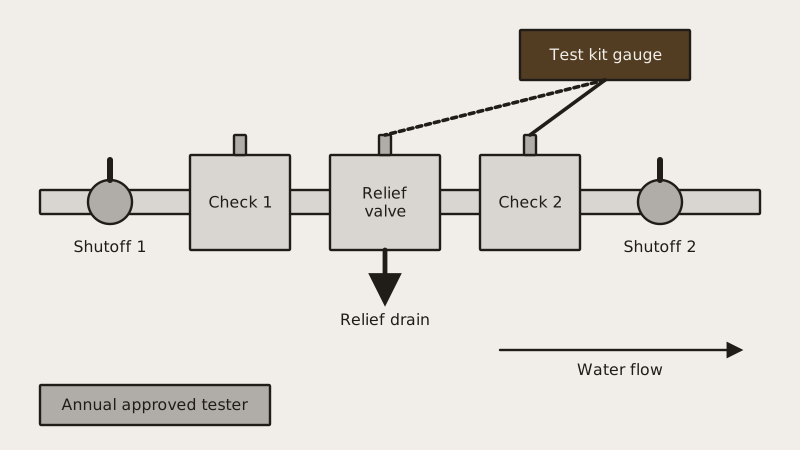
You do not do a backflow test yourself in Pasadena. Pasadena Water and Power requires the yearly field test to come from a tester holding a county Public Health Department certification, and only that tester can file the result. What you do is receive the reminder, hire the tester, and keep the device clear and reachable. Our page on backflow testing explains how we arrange the visit.
Below: what a backflow device protects, what the tester actually does on site, what to do when a test fails, and, since many readers arrive here asking about it, how a plumbing permit is pulled from the City of Pasadena.
Can a homeowner test their own backflow preventer?
No. Pasadena Water and Power says a test report from anyone without the county certification is rejected, and customers cannot submit the report themselves. The tester files it through the utility's online portal. The only part you can do alone is the groundwork: find the device, keep it accessible, and answer the reminder notice.
The reason is that a backflow assembly is a safety device between your plumbing and the public water main. If the check valves inside fail, water from irrigation lines, fire sprinklers or a building can flow backward into the system. A tester uses calibrated gauges, and the county credential shows they know how to read them.
Pasadena's utility sends a reminder before the test is due, by email if it has your address and by paper otherwise. Look at which department manages your device, Pasadena Public Health or the utility, and show the notice to the tester. Check spam, because the email can land there.
What does a backflow test involve?
Gauges are hooked to the little brass test ports on the device, its shutoff valves are closed in a set order, and the tester notes the pressure readings across each check valve and, on some models, the relief valve. Each part must hold or open at the right pressure. The visit usually takes a short time, but the water to that line is off while it runs.
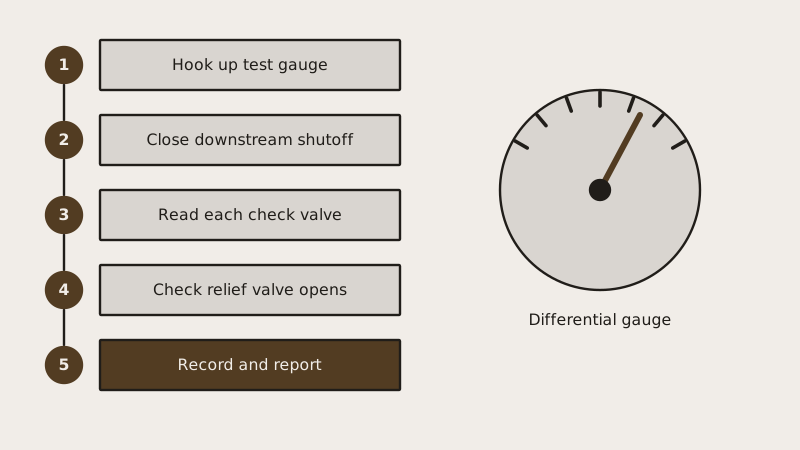
In broad terms, the visit goes like this:
- The tester looks at the device, its model and its location, and notes any replacement since the last test.
- Water is shut off to the protected line, such as the irrigation system, so expect no sprinklers or fire line flow for the duration.
- Gauges are attached and readings taken. Different devices are tested differently: a double check assembly, a reduced pressure principle assembly and a pressure vacuum breaker each have their own procedure.
- The result is written up and submitted to the utility through its portal. The report fee, which the utility says is $5.45, is usually included in the tester's invoice.
- If it passes, you are done until the next notice.
Types of device you may meet include the reduced pressure zone assembly, the double check valve assembly and the pressure vacuum breaker. Which one you have depends on the hazard it guards against. The tester will know on sight.
Do I even need a backflow device at my property?
Often only when your water use could create a hazard. Pasadena Water and Power lists fire and irrigation services, commercial and industrial connections, medical and food facilities, schools, hotels, multi-story buildings and multi-family domestic services. Its page does not spell out single-family homes, so ring the Cross-Connection Program on (626) 744-7958 if in doubt.
Some practical pointers for owners:
- With a lawn irrigation system or a fire sprinkler line, look for a bronze assembly with shutoff handles and test ports, frequently standing above ground beside the meter or along an outside wall.
- Multi-family and commercial properties most often get a notice. If you manage one, see our page on commercial plumbing services.
- A device installed in a new water service has to follow the utility's own rules for new or upgraded services.
Other San Gabriel Valley cities are served by different water agencies with their own programs. We cover each on where we work, but check your own supplier for the rules.
What happens if the backflow test fails?
A failed test means the device is leaking back or not sealing, and it must be repaired and retested. Pasadena Water and Power says to submit the failed test form, fix the assembly promptly and retest. If it keeps failing, the assembly has to be replaced and tested again. Repair work is a plumbing job, so this is where a plumber comes in.
Common causes include a fouled check valve seat, a worn rubber part, or a cracked body after a freeze or a hard knock. A repair kit often does the job. A device that is old or corroded can be cheaper to replace. See our guide to backflow testing price for what these visits can cost.
If the device is replaced, tell the tester, because the replacement can be noted on the report and the utility's coordinator reviews it.
What does getting a plumbing permit in Pasadena involve?
Apply with the Permit Center at 175 North Garfield Avenue, or online through the city's permit portal. Simple plumbing permits are often issued over the counter, and the city accepts electronic applications through its portals. Property owners doing their own work can get permits without the contractor requirements, while contractors need a license, a Pasadena business license and workers' compensation insurance.
The steps for a typical job:
- Decide whether you need one. The city's list says no plumbing permit is needed for stopping leaks or clearing stoppages that do not involve replacing or rearranging valves, pipes or fixtures. New or replaced concealed pipe counts as new work and needs a permit. A new water heater always requires one.
- Gather the facts the counter asks for: the address, the scope of work, and for equipment such as a water heater the make, model and rating.
- For larger jobs, prepare plans. Remodels that move pipes may need drawings. The Permit Center tells you at the counter what to bring. Do not guess.
- Pay the fee and book inspections through the portal or at the counter.
- Keep the permit visible and have the work inspected before you close walls.
Phone Building and Safety at (626) 744-4200 for questions before you go. If the work is gas, water heaters or repiping, it is usually simplest to let the contractor, who must hold a California license, pull the permit. Our plumbing services page lists what we can arrange.
Does backflow testing include a sewer camera?
No. Backflow testing is a pressure check on one device. A camera inspection is another job entirely: a lens on a flexible cable pushed down a sewer line to spot roots, cracks and sags. Older Pasadena houses with clay or cast-iron drains often get the camera before a repair or a sale, but it has no part in a backflow visit.
Which backflow problems need a plumber?
A failed test, an assembly that leaks or spits water, damage from a knock or a hard freeze, or a wish to fit a new device before the utility asks: all of these are plumber jobs. Because the public supply is involved, the work follows the utility's rules and, where needed, a permit. Start on the quote page. Every service is listed on the home page too.
Common questions
What is the testing schedule?
Pasadena Water and Power says the field test must be done by the due date on the notice and at least once a year. The consumer pays for it. If you replaced the device since the last test, mention it so it is recorded. If a reminder never reached you, you can still hire a tester, who can look the device up.
Who covers the cost of the test?
The customer pays the tester, according to Pasadena Water and Power. The utility says its $5.45 fee for filing a report through the online portal is normally included in the tester's invoice, and that customers do not file reports themselves. Ask for the full price before you agree, because testers set their own rates.
Does any plumber qualify to run the test?
Only if that person holds the county Public Health certification the utility requires. A plumber without it can repair or replace the assembly, but the test report would be rejected. When you request a quote, ask whether the tester holds the county certification and whether they will file the report for you.
Can I ignore the test if no notice arrived?
You are still responsible if you have a device. Pasadena Water and Power mails a paper reminder, or an email if it has your address on file. Check spam, and call the Cross-Connection Program at (626) 744-7958 or write to [email protected] to verify what is on record for your property.
Sources
Page updated