Published prices for putting an earthquake valve on a house gas line cluster around $250 to $800 installed, and a new run of gas pipe is usually quoted per foot, with a short appliance hookup far cheaper than a long underground line. Everything below is a guide, since the access to your meter and the length of pipe decide the real number. For the wider picture of pipe types, materials and gas appliance connections, start at natural gas piping in Pasadena. For a written price on your own house, send the quote form.
What will a seismic gas valve cost me, installed?
Most published figures for a homeowner-side seismic valve are $250 to $800 installed, with the valve itself about $100 to $300. A Southern California retrofitter lists a flat $450 that includes a bracket, plumbing and paint, and Los Angeles installers quote about $300 to $800 with the permit usually in the price.
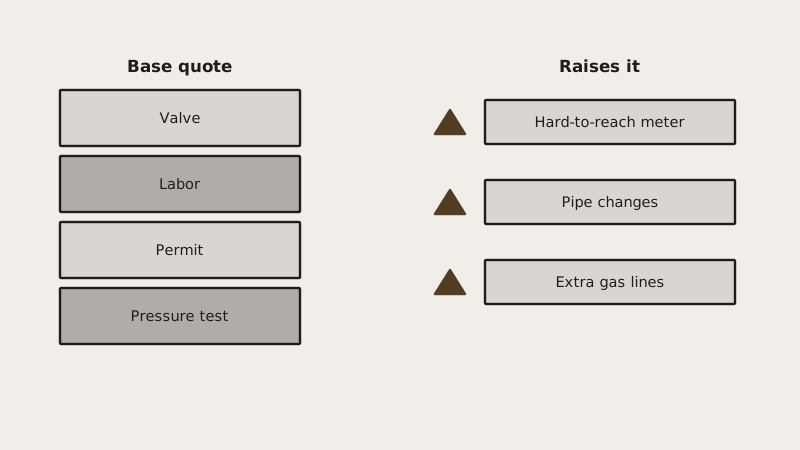
The spread comes from the job, not the part. A meter that sits against the garage wall with clear pipe above it is the cheap end. A meter tucked behind a fence, a cramped side yard, or pipe that has to be cut and rebuilt with fresh fittings pushes toward the top. Commercial valves cost more, often $750 to $3,000 and up, because pipe is larger and the work more complex.
What should the quote cover, and what raises it?
A complete quote should cover the valve, the stabilizing bracket, fittings, labor, a leak test and the permit or inspection where your city asks for one. Extras include repainting or protecting exposed pipe, a seismic valve bracket where the utility asks for one, relocating a shut-off, or replacing corroded pipe nearby.
Ask the plumber three questions: is the permit in the number, is a bracket included, and does the valve carry the California State Architect's approval. Seismic valves sold in California must be on the State Architect's approved list, and the state expects installation by a contractor who holds a plumbing license, per manufacturer instructions. A price far below the range may leave out the bracket, the test or the paperwork.
Is the valve required in Pasadena, and who installs it?
Requirements depend on the city and the type of work, and usually attach to new construction or major alterations. Your insurer or building department may ask for one, according to SoCalGas. We could not confirm a blanket rule for existing Pasadena homes, so ask the Building and Safety Division on (626) 744-4200 before you assume either way.
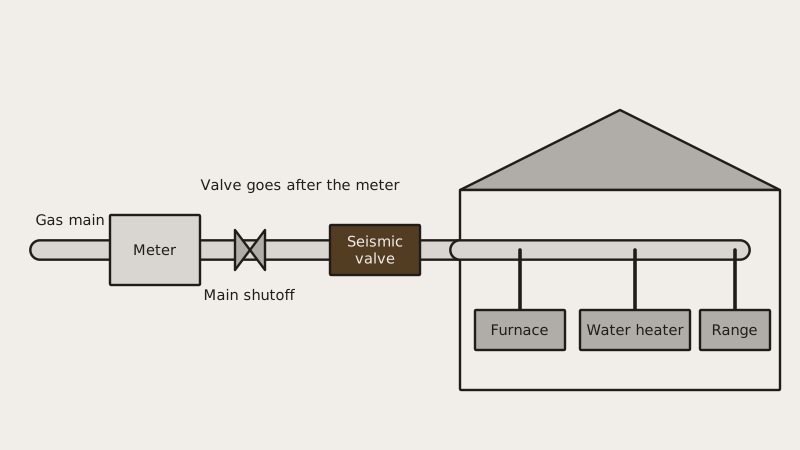
On who does the work, SoCalGas does not install earthquake valves. A plumber you hire fits it downstream of the meter, on the building's own pipe. Since February 10, 2002, valves may not be put on SoCalGas equipment, and the utility will remove unauthorized ones. If you want the practical details of the job itself, the step-by-step in how the shut-off valve gets installed covers the job, and emergency gas shut-off after an earthquake covers the moment itself.
How much does a new gas line cost?
Guides for 2026 mostly price new gas pipe at $15 to $25 per foot of run. Los Angeles guides quote $17 to $30 inside the house and more underground. A short dryer or range hookup is often $300 to $800, while a California job as a whole commonly totals $500 to $2,000, depending on length.
Three things drive that number. Distance from the meter is first. Trenching or cutting through a slab is second, with trenching adding several dollars a foot. Pipe type is third: black iron and corrugated stainless steel tubing price differently. Permit fees in Los Angeles County cities are quoted at roughly $50 to $350 and a pressure test at $100 to $175, often rolled into the installation price. Pasadena's own fee schedule governs a Pasadena permit.
Gas piping is regulated work. It needs a permit, an inspection and a plumber who holds the proper California contractor license, a requirement on every permitted job and on work that reaches $1,000.
What is the hourly rate for gas work?
California plumbing guides show $100 to $200 hourly, and Los Angeles guides give about $80 to $225 for a gas specialist. Many gas jobs get one price instead of an hourly bill, so ask for the total. Minimum visit fees and emergency surcharges are covered in the cheap plumber near me guide.
If a plumber is quoted far under the hourly guides above, ask about the license, the permit and the pressure test. Gas work done wrong does not just fail: it can leak. That is the reason this is the job where a bargain deserves the most suspicion, and the reason SoCalGas and building departments insist on permits and inspections.
What does a seismic valve do, and what does it not do?
It closes the gas line when ground motion crosses a preset level, once shaking is strong enough, even if no pipe is broken. It does not detect a leak from a failed connector at night, a cracked appliance line or a leak from a faulty appliance. An excess flow valve, installed by the utility on the underground line, reacts to a rupture, not to shaking.
After a trip, the valve stays shut until it is reset. SoCalGas and qualified professionals recommend having a pro do that, and it can check appliances and relight pilots, because after a large quake help may take days. A valve that trips for some reason other than an earthquake brings a reset fee from SoCalGas. Smelling gas after any event means getting out, then phoning SoCalGas from the street.
Common questions
Will it catch every gas leak in the house?
No. It answers to strong shaking, not to a corroded fitting or a faulty appliance, so treat it as one layer of protection. Keep appliance connectors in good shape, have old flexible ones checked, and learn where your gas shut-off sits. If gas ever smells, leave first.
Can a homeowner fit one personally?
The state expects approved seismic valves to go in through a plumbing contractor, following the maker's instructions. Gas piping is regulated, can need a permit and, done badly, leaks. Fitting a mail-order valve yourself risks safety and an insurance dispute. A plumber also adds the bracket that stops a stray bump from tripping it.
How do I reset the valve after it closes?
The maker's instructions apply, yet SoCalGas and qualified professionals advise leaving the reset to a trained person who can check the lines and relight pilots. A non-earthquake trip carries a SoCalGas reset fee. With any gas odor, do not relight anything; get outside and ring the SoCalGas emergency line.
Is a seismic valve the same as an excess flow valve?
No. The seismic type is mounted after the meter and reacts to ground motion. An excess flow valve is put underground by the utility and reacts to a surge from a ruptured line. SoCalGas puts that utility-side work at $2,500 to $5,000 or more. Some homes have both.
Does the plumbing near a gas line count toward the price?
It can. Corroded or awkward pipe near the meter may need a section replaced, which adds parts and time. Take photos of the meter area and attach them to your quote form request, and the plumber sees the access before naming a figure.
Our other plumbing services are on the Pasadena Pipe Works home page.
Sources
- SoCalGas, earthquake and excess flow valves
- SoCalGas, natural gas leaks
- Building America Solution Center, automatic gas shutoff valves
- City of Pasadena Permit Center, apply for a permit
- California Contractors State License Board, what kind of contractor do you need
- Published installed prices for seismic gas valves and gas line work in Los Angeles County and California, checked November 2026
Page updated