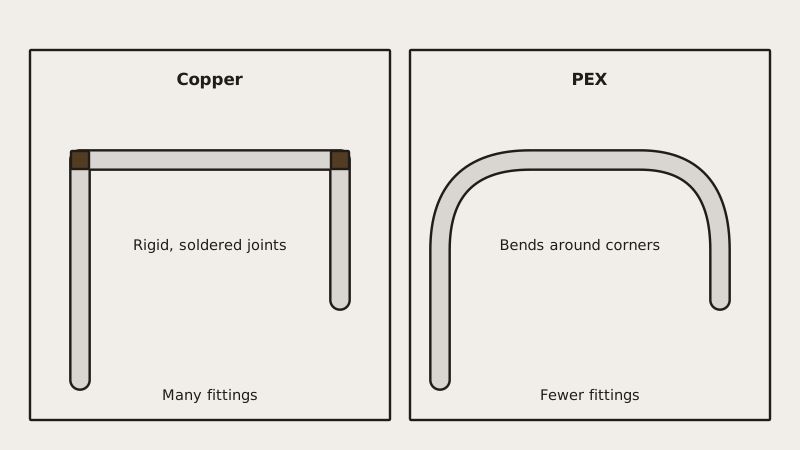
Choose PEX when budget, speed and fewer wall openings matter most. Choose copper when you want a rigid, sunlight-proof pipe with a long record and you can pay about twice as much. Neither is wrong for a Southern California house. If your home still has galvanized steel or polybutylene, the real decision is repipe now or repair later: our polybutylene and repiping overview explains that side.
What is the cost difference between PEX and copper?
Cost guides in 2026 put PEX at $4,000-$10,000 for the whole house and copper at $8,000-$18,000, for a standard two-bath house. That makes PEX about a third to a half cheaper, and labor accounts for most of the gap. Use these as a rough yardstick only: your access and floor plan move the real number.
Pipe by itself costs about 40 cents to $2 a foot in PEX against $2 to $8 in copper. Once labor is in, guides quote PEX at roughly $3 to $7 a foot and copper at $6 to $14. Time on site differs as well: a PEX crew may finish in a day or three, while copper often stretches toward a week.
In Pasadena the house shapes the bill more than the pipe. A single-story ranch on a slab is a different job from a two-story Craftsman with plaster walls, a basement stair and a detached garage line. Each opened and patched wall adds labor. Copper tends to need extra openings, since rigid tube cannot snake through framing the way coiled PEX can. For a broader price view, see what repiping a house costs and the cost of repiping with PEX.
How long does each one last?
Cost sites usually credit PEX with four to five decades and copper with five to seven, occasionally a century in gentle water. Those are estimates, never promises. Installation quality, heat and what the water carries decide the outcome, and copper is the material most sensitive to the water.
That second point matters in the San Gabriel Valley. Pasadena Water and Power describes its supply as very hard, averaging about 13 grains per gallon in 2025, from a blend of roughly half local groundwater and half imported Metropolitan Water District water. A task force study of pinhole leaks calls them an extreme form of pitting corrosion and ties one pitting type to hard or moderately hard water in a middle pH band. Chlorine and trace minerals appear in the research too. The takeaway: copper in Southern California can pinhole in some houses and not in others, and age alone does not predict it. PEX does not corrode that way, though it has its own weaknesses, listed below.
Which flows better, PEX or copper?
Copper of a given nominal size has a slightly larger inside diameter than PEX of the same size, so a 1/2 inch copper line moves a little more water than a 1/2 inch PEX line. In real houses the gap rarely shows, because PEX uses fewer fittings and gentle bends, and installers often step up to a larger size.
Pressure loss comes from three things: inside diameter, length and the number of elbows and fittings. PEX run in long continuous coils from a manifold has few joints. Copper needs a fitting at every turn. A good plumber sizes the main trunk generously and lets the branches be 1/2 inch. Weak pressure in your house today may trace to a tired regulator or scale, not the pipe material. Low water pressure in Pasadena homes lists the usual suspects.
How do PEX, copper and PVC compare?
Hot lines rule out PVC, which is not made for heated water, so inside the house it comes down to PEX against copper, with CPVC a distant third. PVC shows up in drains and some cold-only outdoor runs. PEX is flexible, quiet and cheap but breaks down in sunlight. Copper is rigid, fire-resistant and sun-proof but pricier and prone to corrosion in certain water.
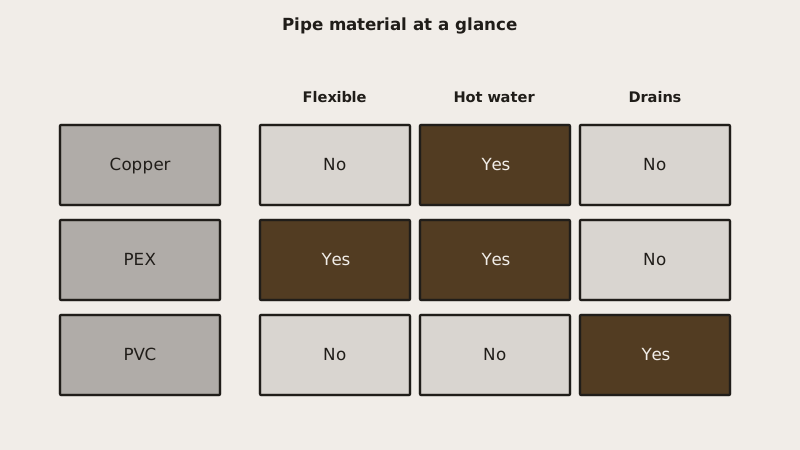
Quick comparison:
| PEX | Copper | |
|---|---|---|
| Typical whole-house range (guide) | $4,000 to $10,000 | $8,000 to $18,000 |
| Joints | Few, crimp or expansion | Many, soldered or pressed |
| Sunlight | Damaged by UV: keep covered | Unaffected |
| Corrosion | Does not pit | Can pinhole in some water |
| Freeze tolerance | Expands without splitting as readily | Splits when frozen |
| Fire | Burns and softens | Does not burn |
| Install time | Often one to three days | Often three to seven days |
Southern California homes also deal with earthquakes. Flexible PEX tolerates ground movement and house shifts better than rigid soldered joints, though no pipe survives a major rupture, and your gas lines and water heater connections need their own attention. Gas is a separate subject: earthquake gas shutoff valves are worth reading about.
What about cold weather and the cost of PEX in the attic?
PEX copes with a light freeze better than copper because it can expand, but it is not freeze-proof, and Pasadena sees hard frost mostly in the foothills and Altadena and Sierra Madre edges. The bigger local issue is heat: attic runs reach high temperatures in summer, and PEX has to be kept shaded and clear of hot flues.
If your plumbing runs through an attic or crawlspace, the installer should insulate and shield it. Our guide to plumbing in attics and crawlspaces covers what to expect. Repiping uses wall and ceiling access, and leaks left too long can set up mold in framing and insulation, so older homes with a history of slow leaks deserve a camera and a moisture check before anything is closed up.
When does a Pasadena house need a repipe?
A repipe makes sense when you see repeated pinhole leaks, rusty or brown water from galvanized lines, low flow that scale or corrosion has choked, or known polybutylene (gray plastic) pipe. One leak is a repair. Three in a few years, or one in each of several walls, points to a failing system. Old homes from the Craftsman and 1950s eras often have a mix of galvanized, copper and patched sections.
Expect a repipe to be permitted. In Pasadena that runs through the Building and Safety division at the Permit Center. On the state side, CSLB sets a $1,000 line for unlicensed work, and work that needs a permit requires a license at any price. Its C-36 plumbing classification covers water supply piping, which is the license to look for. Collect the license number, then check it against the state record before anyone opens a wall. Related reading: why repipe a house in Pasadena and slab leaks, repair or repipe.
One of the local plumbers we arrange visits, walks every room, tests pressure, and writes up both options next to each other. Start with the quote page.
Common questions
Does PEX affect the taste of drinking water?
California plumbing code permits PEX for drinking water lines, and it is in wide use nationwide. A faint plastic taste is sometimes reported in the first weeks. Running the taps and flushing the lines after installation usually clears it. You can also ask the installer which PEX type goes in and read the standard markings printed along the pipe.
Does copper add value to a home compared with PEX?
Some buyers like copper, so it can help marketing a house, but appraisers rarely price the pipe itself. A clean, permitted repipe in any approved material usually matters more than the metal. If you plan to sell soon, a documented repipe with a permit is worth keeping on file.
Can a house have both PEX and copper?
Yes, joined with approved transition fittings. Repairs on old copper often add a short PEX section, and some repipes keep copper right at the heater, where heat is a factor. Careless pairing of dissimilar metals can corrode, so leave fitting choice to the installer.
What does a repipe do to my week?
Plan for dry taps during part of each working day. PEX in a typical home tends to be done within one to three days, copper in three to seven. Wall patching may come after. Larger or two-story houses with plaster walls take longer.
Which details belong in a repipe quote?
Insist on the pipe type and sizes, how many wall openings and how much patching, who pulls the permit, and a final pressure test. Ask how PEX will be shielded from sun and heat, and request the schedule on paper along with the license number.
For the main service list, go to Pasadena Pipe Works.
Sources
- Cross-linked polyethylene (PEX), Wikipedia
- Copper tubing, Wikipedia
- Angi, cost to repipe a house (PEX and copper ranges, 2026)
- Pasadena Water and Power, 2026 Annual Drinking Water Quality Report
- Pasadena Water and Power, water quality FAQs
- Task force study of pinhole leaks in copper plumbing
- California Contractors State License Board, C-36 plumbing classification
Page updated