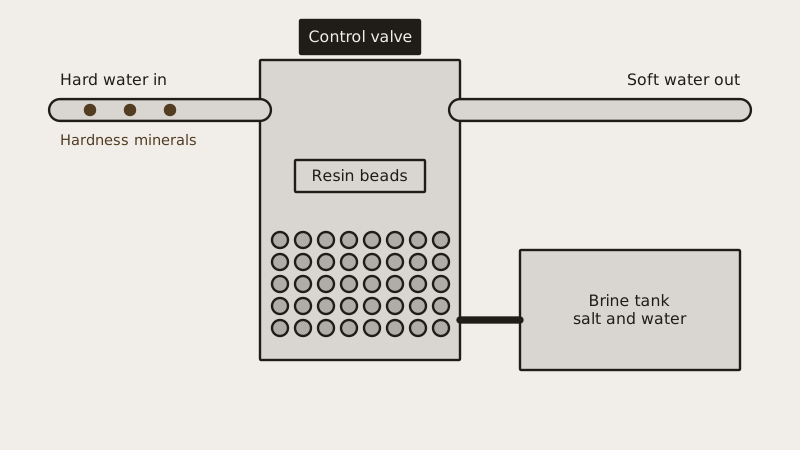
A water softener removes the calcium and magnesium that make Pasadena water hard, using a resin tank that swaps those minerals for sodium or potassium. Installation means plumbing the unit into the main water line with a bypass, running a drain for its regeneration cycle, and giving it an outlet and floor space. A plumber doing the plumbing usually bills about $200 to $1,000 in labor, with the equipment extra.
Pasadena Pipe Works arranges that work across Pasadena and the San Gabriel Valley. The sections below cover how hard the water really is, whether it matters, and the choices that affect the job.
Is 250 water hardness bad?
By the federal U.S. Geological Survey scale, 250 mg/L is very hard, with 180 as the lower edge of that band. It is not a health problem. It is a scale, soap and appliance problem. For reference, 250 mg/L equals roughly 14.6 grains per gallon, a bit above what Pasadena Water and Power typically delivers.
Local numbers: the utility's 2026 water quality report, covering 2025 samples, shows hardness between 202 and 256 mg/L, with an average near 222 mg/L, or about 13 grains per gallon. The utility's FAQ page gives an older average of 12.9 grains per gallon. Hardness swings through the year, because the city blends local Raymond Basin groundwater (about half) with imported Metropolitan Water District supply (the other half), and the mix changes.
Your neighborhood can differ a little. The water hardness by zip code page goes into that.
Is hard water bad for you, your skin, and your pipes?
Hardness poses no health hazard. The calcium and magnesium behind it are harmless to drink, and Pasadena Water and Power says they have no known health effect. The trouble shows up on surfaces and equipment: spotted glass, soap that won't lather, chalky shower doors, and scale inside heaters and pipes. Skin complaints exist but are a comfort issue.
Many people notice dry skin or a film after bathing and blame the minerals. Soap reacts with calcium to form scum that can cling to skin, and a softener removes that reaction. Research on a direct skin effect is mixed, so we won't promise a cure for eczema or similar conditions. A doctor handles those. Hair gets the same treatment in our page on signs of hard water on hair.
Scale has measurable consequences. The USGS points out that warming hard water drops calcium carbonate onto surfaces, which can wear out equipment sooner, push up heating bills and, given years, squeeze pipes narrower. In a house with older galvanized or copper lines, that buildup is part of why pressure falls. Cleanup methods are in our piece on removing scale.
Does hard water affect soap?
Yes. Calcium and magnesium react with soap to form a sticky scum instead of suds, so you use more soap and detergent for the same result, and a film stays on skin, dishes and laundry. The USGS describes this directly. Softened water lathers easily, which is the effect most people notice first.
Dishwashers and washing machines show it too: cloudy glasses, stiff towels, and detergent doing less. Softer water lets you cut back on soap, though how much you save depends on the product. Some dishwasher detergents and rinse aids are designed to cope with hardness, which masks the symptom without treating the cause.
Which state has the worst hard water?
No official ranking names one state. The U.S. Geological Survey says hard water is common across the east-central and western United States, where limestone aquifers and mineral-rich groundwater are widespread, and it points readers to their local utility for actual numbers. Within California, hardness varies by water source, so one city's reading says little about the next one.
That is why a Pasadena homeowner should read the Pasadena report, not a national map. The 2025 figures above put the city in the very hard band. If you live in Altadena, Sierra Madre or another nearby community, your supplier may be a different agency with different numbers.
What does water softener installation involve?
The softener sits on the cold supply right after the point of entry, upstream of the water heater so the heater receives softened water. The plumber adds a bypass valve set, connects inlet and outlet, ties a drain line to a standpipe or laundry drain with an air gap, and arranges an electrical outlet. Outdoor spigots usually stay on unsoftened water.
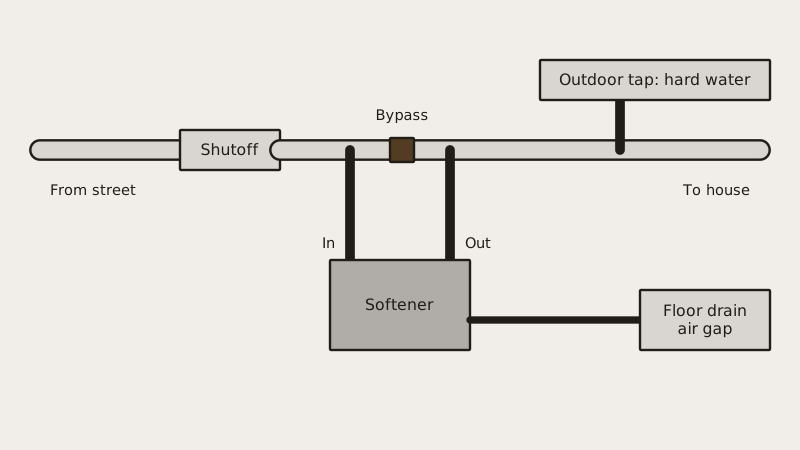
Things worth settling before anyone cuts pipe:
- Where the water enters. Garage, side yard or utility closet. The tank and brine bin need level floor and room to refill salt.
- A drain for brine. The regeneration cycle flushes salty water out. It must run to a legal drain with an air gap, not to the street or yard.
- A bypass loop. Often called a water softener loop, it is a set of valves and fittings that cuts the unit out of the circuit for servicing while the house keeps its water.
- Outdoor lines. A tee ahead of the softener keeps lawn and hose bibs on hard water, saving salt.
- Pipe condition. Corroded galvanized pipe is hard to tie into, and some homes need that section replaced first. See repiping options.
Gas, electrical and permit questions are rare for a softener, but ask the contractor whether the city wants a permit for your setup. Once labor and materials pass roughly $1,000, California expects a contractor with a license to do the plumbing.
Are there rules on softener brine discharge in California?
Yes, and they vary by location. The state's Health and Safety Code (section 116775 onward) lets local agencies restrict home softeners only after specific findings tied to salt in sewage and recycled water. Some Southern California agencies, such as one in the Santa Clarita Valley, have acted on that. We have not confirmed a ban in the San Gabriel Valley.
Pasadena Water and Power's own FAQ says some cities have banned softeners because the discharge carries a lot of chloride. Before you buy, ask your sanitation district or city whether your area limits self-regenerating softeners. A portable exchange tank, where a service swaps the resin, is another route in places that do.
What do brands like Culligan, Kinetico, Whirlpool or Rheem change?
The plumbing is similar across brands: inlet, outlet, bypass and drain. What changes is the control valve, how the unit regenerates, and who is expected to install it. Some brands sell through dealers who install, while others sell through stores where the buyer arranges the plumbing. Follow the maker's manual and the dealer's warranty terms.
For any model, look for a listing to the NSF standard for softeners, which Pasadena Water and Power also recommends checking. Efficient units regenerate by demand rather than a fixed schedule and waste less salt and water. Sodium matters if someone in the house follows a restricted-sodium diet, and the utility also warns that overly soft water can corrode pipes, so don't set hardness to zero without advice.
A shower head filter is a different product. Cartridge filters may improve chlorine taste or smell, but we would not count on one to remove hardness for a whole house. For scale across the house, a softener is the established tool.
How much does a water softener installation cost?
For a standard whole-house unit, expect plumber labor in the neighborhood of $200 to $1,000 over a few hours. A fully installed system, equipment included, commonly lands between $1,200 and $3,800 in national price guides, higher for twin tanks. Take those as a rough guide: access, pipe condition and the unit you pick shape the written quote.
For a line-by-line breakdown, go to water softener installation cost. If you are weighing a self-install, doing it yourself lays out what is realistic. The quote page takes the details.
Common questions
How many hours should softener installation take?
With open access and sound pipe, a whole-house softener typically takes two to four hours. Rusted pipe, a long drain run or cramped quarters can stretch it to most of a day. Water is off for a stretch; once it returns come control-valve setup and a leak check.
Is a softener worth it with Pasadena water?
With hardness near 13 grains per gallon, scale and soap scum are a daily nuisance, so many homeowners find it worthwhile. The calculation is personal: add the unit, salt, water used in regeneration and maintenance against the appliance wear and soap you save. Check the brine rules for your area before buying.
Will a softener drop my water pressure?
A correctly sized unit should cost little pressure, but a small unit on a big house, a clogged resin bed or narrow old pipes can throttle flow. If pressure drops after installation, have the plumber check the bypass, the valve and the pipe size. Our low water pressure guide lists the other usual suspects.
Does a Pasadena softener job require a permit?
We could not confirm a permit rule for softeners in the city sources we read, so check with the city's building office first. A water heater swap, by contrast, does require a plumbing permit in Pasadena. A contractor with state credentials normally knows what the local office expects.
Will a softener fix scale in my existing pipes?
It prevents new scale from forming, but it won't reopen pipe that is already badly narrowed. Heavy buildup in old galvanized or copper lines may mean descaling or replacement. A plumber can check flow and pressure at the main. Our scale removal guide sorts what can be cleaned out from what can't.
More in this guide
- Hard water scale removal
Pasadena water is very hard. How to remove scale from faucets, showerheads and heaters, what dissolves it safely, and when a softener or a…
- Water hardness by zip
How hard is the water in Pasadena, South Pasadena, Altadena and Arcadia?
- Costs
What a whole-house water softener costs to install in Pasadena, from unit price to labor, drain and permit extras, plus brand price ranges…
- Water softeners and treatment
Thinking of installing a water softener yourself in Pasadena?
- Signs of hard water
Dull, tangled hair, dry skin and white crust on fixtures can all point to hard water.
Sources
- Pasadena Water and Power, water quality FAQs
- Pasadena Water and Power, 2026 annual drinking water quality report
- U.S. Geological Survey, Hardness of Water
- California Health and Safety Code sections 116775 and following, residential water softeners
- Published installed-price guides for water softeners from national cost sites (Angi and others), checked November 2026
Page updated