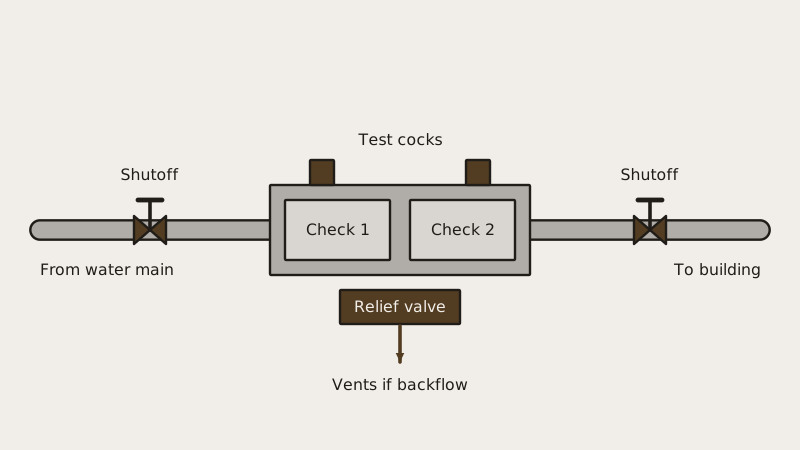
Think of a backflow assembly as a one-way gate on your pipe: it keeps used or contaminated water from sneaking back toward the public supply. Pasadena Water and Power wants each assembly in its territory checked in the field every year, and it only takes results from testers holding an L.A. County Public Health Department certificate. We arrange that visit across Pasadena and the San Gabriel Valley. For more depth, see the pages on backflow testing, how a test is done and what a test costs.
Which Pasadena properties need a backflow test?
Any property with an assembly installed on its water line. In practice that means commercial buildings, fire sprinkler lines, irrigation systems, medical and food businesses, schools, hotels and multi-family buildings. A Field Test Form from the utility in your mailbox means your property has a device on record and a yearly test is due.
Pasadena Water and Power names those categories on its Cross-Connection Program page and says the customer arranges and pays for the test. A single-family house on a plain domestic line often has no assembly, but a lawn irrigation system or an outdoor fire sprinkler can add one. Look for a bronze or steel valve group with test cocks, usually near the meter, along the front wall, or beside the irrigation zone valves. If the notice reached you and you are not sure which device it means, the program desk at the utility can tell you which assembly is on its register: 626-744-7958.
What happens at a backflow test visit?
A tester closes the supply, hooks a differential pressure gauge onto the small test ports of the assembly, and measures whether its internal check valves and relief valve resist reverse flow. One standard assembly usually takes about half an hour. The readings go into a report that the tester sends to the utility.
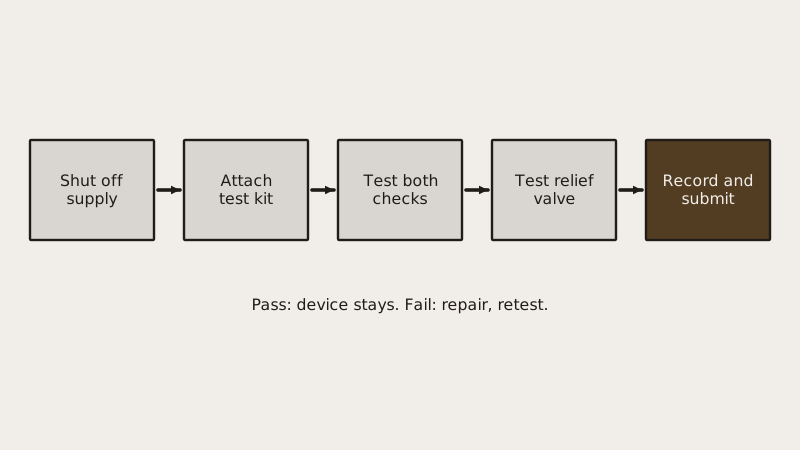
Reduced pressure principle, double check and pressure vacuum breaker assemblies each have their own test sequence. The tester works the shutoff valves in order, bleeds the gauge hoses, reads how pressure falls across each check, and watches for the relief port to open on cue. Water to the building or the irrigation zone stays off meanwhile, which is worth planning around. If the device passes, nothing else is needed. If a seal or spring fails, the tester can often repair it on the spot and retest.
Which testers will Pasadena Water and Power accept?
Only a tester with a current certificate from the Los Angeles County Public Health Department. Pasadena Water and Power links the county's list and tells customers to check the certification before hiring. Since June 2024, the tester files each report through the utility's online portal; mailed and emailed reports no longer count.
So a company name counts for less than the individual tester's credentials. Names that sound official, whether American, AAA or Accurate, prove nothing; look up the person. The utility rejects reports from anyone off the county list. If a notice goes unanswered, a second one follows, and the utility's policy allows it to bill testing and repair costs and, as a last resort, to remove the meter. The portal charges the tester $5.45 a report, which usually appears as a line on the invoice. Results from a search for out-of-state testers, a Killeen company for example, do not apply here, because the rules are Pasadena's and the county's.
How much should a backflow test run?
Prices published by California testers mostly fall between about $50 and $150 a device, with $90 a frequent figure in Los Angeles County, often with report filing included. Big devices, awkward access and several assemblies on a site push the figure up. A repair after a failed test is billed separately, commonly $150 to $500.
Those are figures from testers' own websites, a guide and not a quote for your property. Ask if the report fee, travel and one retest are included, and how many devices the price covers. A domestic assembly plus an irrigation assembly means two tests. The backflow testing price page goes further, and the quote is written out before work begins.
What if my backflow device fails the test or is stolen?
Repair it quickly, retest it, and send the failed test form to the utility. An assembly that keeps failing gets replaced and then tested. Thieves target brass assemblies, so if yours vanishes, report it on the Pasadena police non-emergency line first and tell the utility next.
Typical repairs replace rubber seats, springs or a whole check module, and either the tester or a plumber can do them. With a stolen assembly, the building has no protection, so replacement and a test should follow fast. The utility's backflow page lists the police non-emergency line, 626-744-4241. Any new assembly is registered and joins the annual testing list. The install itself may call for a permit and inspection, which depends on the city.
Is this a gas plumber's job or a backflow tester's job?
Different trades. Backflow testing is water-side work by someone on the county's list. Gas work, meaning new gas lines, appliance hookups and earthquake shutoff valves, goes to a contractor who holds a state contractor license, usually with a permit and city inspection.
Need a gas plumber nearby? Check the contractor on the state board's lookup, ask for a written price, and keep your hands off gas pipe. Smelling gas means going outdoors before you phone SoCalGas; 911 is for anyone at risk. Related reading: natural gas pipe and earthquake gas shutoff valves. Drain lines are a third trade. A camera inspection feeds a small lens down the sewer line and shows cracks, roots and sags, and it is often the first step before a repair. Commercial sites needing several of these at once can look at commercial plumbing services.
Common questions
Is it a quick visit or an all-day job?
Expect 30 to 60 minutes for one ordinary assembly, longer for big devices or a site with several. The water serving that building or zone is off during the test. A failure adds repair and retest time, and the tester explains what is required before starting.
What do I confirm with a tester before the visit?
Request the tester's L.A. County certificate number, and learn whether the price covers the report fee and one retest, how many devices it includes, and how failed tests are billed. Confirm filing goes through the utility's portal, since paper reports are refused. Get all of it in a written quote.
Does someone have to let the tester in?
Yes, a person needs to open any gate or enclosure and approve a repair quote if one comes up. At a business, a building manager can do that. The path to the device must be clear, and many sit in locked cages or planted beds.
Is backflow testing the same as a plumbing inspection?
No. A backflow test examines a single safety device. A plumbing inspection, by the city or a plumber, looks at a wider job such as a permitted install. They overlap only when a new assembly goes in, when the city may inspect the install and the utility registers and tests it.
A request starts on the quote form. Towns we cover are listed under where we work, and the home page leads to the other services.
More in this guide
- Costs
What plumbing inspections, sewer camera scopes and backflow tests cost in Pasadena, plus permit basics and how to compare quotes without…
- Permits, codes and inspections
Backflow testing for Pasadena and San Gabriel Valley properties: who must test, how often, what a visit involves, what it costs and what a…
- Permits, codes and inspections
In Pasadena you cannot test your own backflow preventer.
Sources
- Pasadena Water and Power, Cross-Connection Program
- Pasadena Water and Power, Syncta tester portal FAQ
- Pasadena Water and Power, Cross Connection Policy
- SoCalGas, natural gas safety
- Contractors State License Board
- Published backflow test prices from California testing businesses, checked November 2026
Page updated