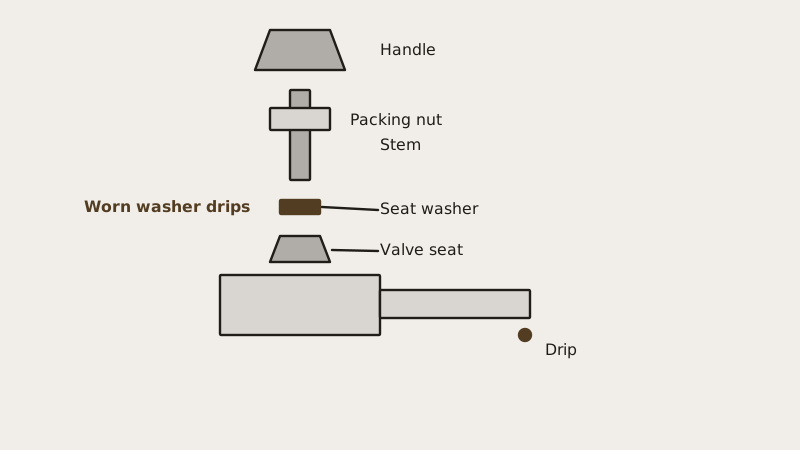
Inside one handle of a dripping two-handle faucet, a rubber washer, an O-ring or a cartridge has worn out. Close the water, take that handle apart and fit an exact match. Which part depends on the valve: washer and O-ring on older compression faucets, a cartridge on many newer ones, seals on ceramic discs. When the shutoffs refuse to close, stop there and call a plumber. Related jobs live under shower, faucet and sink repair.
At Pasadena Pipe Works, each valve type gets its turn below, in the order you will meet it: finding the leaking side, opening the handle, the part to replace, and reassembly that stays dry. Hard water gets a mention too, because in Pasadena it shortens the life of these parts.
Which handle is leaking, and what kind of faucet is it?
Feel the drip: warm water means the hot handle, cool means the cold one. Then notice how the handle turns. Several full turns that tighten against a stop usually mean a compression faucet, while a quarter or half turn suggests a cartridge or ceramic disc valve. Taking the handle off confirms it.
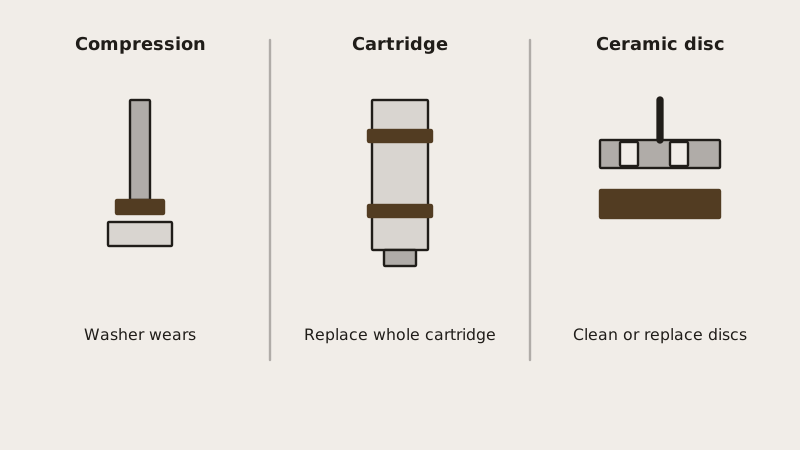
Quick identification:
- Compression: the classic design, where the handle screws a stem down onto a rubber seat washer. A worn washer drips from the spout, a worn O-ring seeps around the handle.
- Cartridge: a plastic or brass cartridge slides into the faucet body, common on newer two-handle models.
- Ceramic disc: a short quarter-turn handle over a cylinder of ceramic plates. Tough, though the rubber seals at its base can wear.
Water from the spout implicates the seat washer or cartridge. Water around the handle implicates an O-ring or packing. Dripping beneath the sink is a separate problem, covered below.
What should be on the bench before I begin?
Gather an adjustable wrench, screwdrivers, needle-nose pliers, plumber's grease, a matching replacement part, and a towel plus a small bowl for the old pieces. Take the old part to the shop so the match is exact. Turn off the valves beneath the sink, plug the drain against dropped screws, and photograph each step.
A short kit list:
- Stop valves under the sink, turned off. With none, close the main.
- Parts: seat washers and O-rings for compression faucets, a cartridge for cartridge types, or seals for ceramic disc, matched to brand and model.
- Penetrating oil for corroded fittings, a common need where water is as hard as Pasadena's.
- Plumber's grease for new O-rings.
- White vinegar and a soft brush for mineral deposits.
- A rag stuffed in the drain.
Pasadena's exemption list lets you repair leaks in pipes, valves and fixtures without a plumbing permit, provided none of those items is replaced or rearranged. A washer or cartridge swap fits. A new faucet or new stop valves is another question, so ask the Permit Center first.
How is a compression faucet's seat washer changed?
Open the tap to drain it, lever the cap off, remove the handle, back out the packing nut and lift the stem free. One screw holds the seat washer at the foot of the stem, and an O-ring rides on the stem body. Fit exact matches of both, grease the O-ring and rebuild in reverse order.
Steps:
- Run the tap briefly so pressure and water drain from the line.
- Take off the handle: lever up the cap, remove the screw, lift away.
- Loosen the packing nut and draw the stem upward.
- Change the seat washer at the bottom and the O-ring on the stem.
- Inspect the valve seat in the body. A pitted seat can be smoothed with emery cloth, or replaced with a seat wrench.
- Rebuild, restore the water gradually and test.
A drip that returns within days usually means the seat is worn, and a repair kit with a seat wrench handles that.
What is the way to swap a cartridge?
Take off the handle, remove any retaining clip or nut with needle-nose pliers, and lift the cartridge out, noting beforehand which way it faces. The new one must match the old by brand and size. Renew any O-rings on its body, set it in with the same orientation and rebuild. A stuck cartridge is where a puller tool earns its price.
Cartridges are brand-specific, so the old one goes in your pocket for the store. For a Moen or any other brand, read the model number off the faucet or its box, because cartridge styles differ between series. Our tub faucet guide covers the bathtub and shower version of this job.
How does a ceramic disc faucet differ?
The ceramic cylinder rarely fails, while the rubber inlet seals beneath it often do. Lift off the handle, unscrew the retaining nut, pull the cylinder and renew the seals, checking the discs for cracks. Dissolve mineral crust with white vinegar and a soft brush, never by scraping ceramic. Restore the supply gradually, because a hard surge can fracture a disc.
Ceramic disc valves tolerate hard water better than washers do, but scale still collects on the metal parts. Pasadena Water and Power recorded hardness of 202 to 256 ppm in 2025, about 13 grains per gallon, and that crust is what you see on aerators and handles.
What if it drips even after a repair?
Most often the valve seat is worn, the part does not truly match, or the stem or cartridge is not seated right. Mineral buildup in the body can keep a seal from closing, and an elderly faucet may just be spent. When a second repair fails, a new faucet is frequently cheaper.
Check these in order:
- The seat: a pitted seat chews a new washer. Smooth or replace it.
- The match: a washer that is slightly too big or small, or a cartridge from a different series.
- The seating: a cartridge that is not fully pushed in, or turned the wrong way.
- The body: scale or pitting that a rinse will not clear.
For a faucet that needs replacement, see faucet installation cost. Does a small drip matter? By the EPA's figure, a faucet dripping once per second loses over 3,000 gallons annually. Our guide to whether a leaky faucet raises your water bill explains how to check.
Which problems need a plumber?
Stop and phone if the stop valves refuse to close, the faucet body is corroded or cracked, a stem or cartridge will not budge, water shows up behind the wall, or a second repair fails. Valve and pipe replacement can need a permit, and in older Pasadena houses seized valves and galvanized pipe can turn a small repair into a big one.
A visit starts at the quote form. Related reading: fixing a leaky single-handle faucet and a leaking pipe under the sink.
Common questions
How long is the job per handle?
A first-timer should allow 30 to 60 minutes per handle, plus the trip for the right part. A plumber on site is often quicker. Seized parts, scale and missing stop valves add time. If both sides leak, fix both while the faucet is open.
What do I check before paying someone to do it?
Search the contractor's license number on the state board site, ask whether the part is in the price, whether a whole new faucet would be advised and at what cost, and whether any permit applies. The figure should be on paper before work starts.
Why does only the hot side drip?
Hot water wears rubber washers and O-rings faster, and heat speeds mineral buildup, so the hot valve often fails first. The cure is the same as for the cold side: replace the worn part with an exact match, and check the seat for pitting.
Is it safe to work with the water on?
No. Pressurized water sprays out of an open stem, so shut the stop valves, or the main for the house when there are none, before dismantling anything. A stubborn valve belongs to a plumber, since leaning on it can snap the stem.
Sources
- US EPA WaterSense, Fix a Leak Week (faucet and showerhead leaks)
- City of Pasadena Building and Safety Division, work exempt from permit
- Pasadena Water and Power, 2026 Annual Drinking Water Quality Report (2025 hardness)
- Published repair guides from home improvement retailers and plumbing publishers (compression, cartridge and ceramic disc faucets), checked November 2026
Page updated