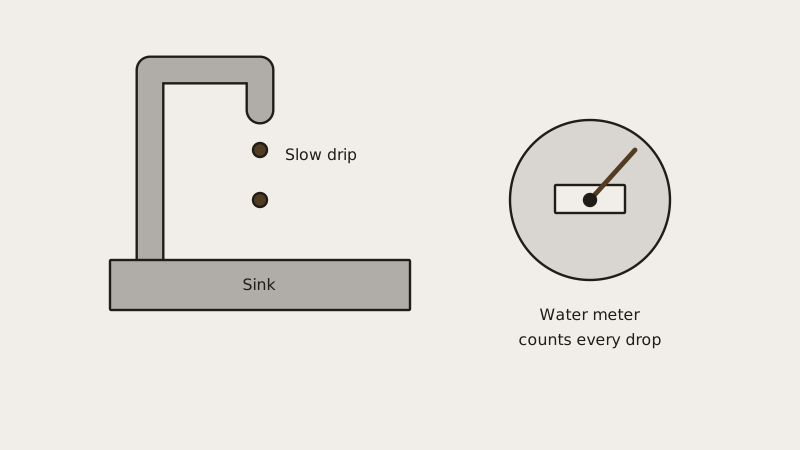
A leaking faucet does raise the bill, though one slow drip adds little. By EPA WaterSense's count, one faucet dripping every second loses over 3,000 gallons across a year. At Pasadena Water and Power's second-tier rate that comes to about $30 over twelve months. A steady thin stream is another story. If your bill jumped by a lot, look wider, and use the faucet and shower repair plumber page when a fixture needs a visit or the quote form.
How much does a dripping faucet actually add to the bill?
Take a drip every second, the benchmark EPA WaterSense uses. Pasadena Water and Power bills by units of 100 cubic feet, about 748 gallons apiece, so that drip is roughly 4 units over a year. Priced at the utility's posted second-tier single-family rate of $7.23544 a unit, it costs close to $29 a year, with the sewer charge separate.
A faster leak scales up fast. As a rough test, hold a measuring cup under the spout for one minute. One cup a minute works out to about 90 gallons a day, or roughly 33,000 gallons a year, and that is about 44 billing units, which at the second-tier rate is over $300. That is simple arithmetic from the posted rate, and your own bill shows which rate applies to you. A faucet running that fast is usually visible, not a slow drip.
What if the bill really did jump this month?
Then a drip probably did not do it. Common causes of a sudden rise include a toilet flapper leaking silently, a sprinkler timer stuck on, a break in the buried service line, a running hose or a dripping outdoor bib, a houseguest stay, a new pool fill, or an estimated reading that corrected itself. Check the bill's usage history and compare month to month.
Tiers magnify the damage. Pasadena's single-family tiers run 0 to 7 units, 7 to 29, and above 29, and the price per unit climbs from $2.74 to $7.24 to $7.87, so extra use is charged at the higher rates. A leak that pushes you past a tier boundary costs more per gallon than the baseline. Our high water bill checklist walks through the rest.
How do I prove the water is leaking and not just being used?
Your meter will answer. Close off every water user, ice maker and sprinklers included, note the reading and look again after two hours of no use. EPA WaterSense recommends this very check. If the dial creeps, water is escaping. If it holds still, the bill reflects use, not a leak.
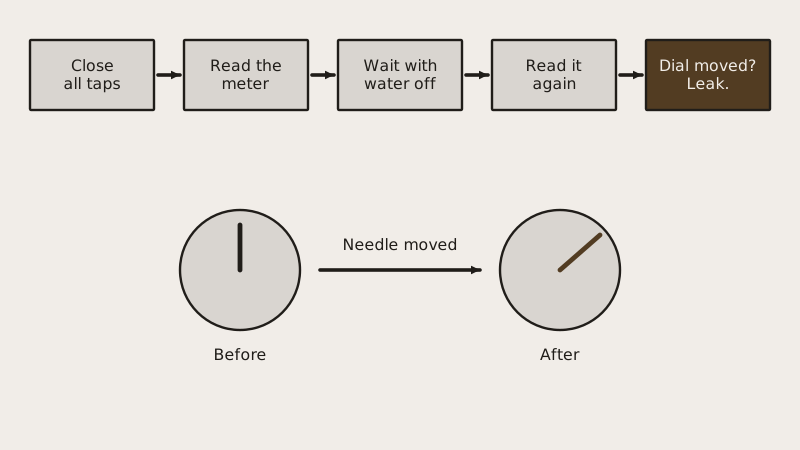
From there, work through suspects. Color each toilet tank with food coloring and leave it ten minutes untouched, since a leaking flapper is a quiet and costly culprit. If the bowl tints, see fixing a running toilet. Look over every faucet, the outdoor spigots and the shower arm. When the meter still turns with the house valve shut, the leak lives in the buried pipe ahead of it, which calls for a plumber with detection gear.
Which leaks cost more than a faucet drip?
Toilets, irrigation and hidden pipe breaks cost more. EPA estimates leaks cost a typical household over 9,300 gallons annually. A showerhead that drips ten times a minute adds over 500 gallons more. A silently running toilet or a pinhole in a pressurized line can lose far more than any faucet drip.
Hose bibs deserve a look too. A bib that drips behind the handle or a hose left connected can run constantly and go unnoticed, and the outdoor line is a frequent source in older yards. Reading about fixing a leaky outdoor faucet shows the usual parts. A sudden high bill alongside damp walls, warm floors or a hiss suggests a pipe, and how to know if a pipe burst describes that situation.
What actually stops a faucet from dripping?
Replacing the worn part inside does it, whether that is a cartridge, washer or O-ring, depending on the faucet's design. Close the supply valves first. Parts run about $5 to $40, and published plumber prices for the repair land near $100 to $400. Kitchen, bathroom, tub and outdoor versions are laid out in our faucet repair walkthrough.
Hard water makes this a recurring chore. Pasadena Water and Power measured hardness at 202 to 256 parts per million for 2025, and scale roughens valve seats so washers stop sealing. If it drips after new parts, suspect a pitted seat, and a new faucet may then be the better value. The faucet installation cost page shows typical prices.
Common questions
How many gallons does a dripping faucet waste?
About 3,000 gallons a year for one drip per second, which is close to four of the utility's billing units. Faster leaks lose far more, so catch the flow in a measuring cup for a minute instead of guessing from the sound.
Will the utility forgive a bill caused by a leak?
Possibly. Pasadena Water and Power runs a Water Leak Assistance Program that can credit up to half of the excess water charge, capped at $3,000, once the leak is repaired and documented. Eligibility rules, a 30-day application window and a first-come annual funding limit apply, so check the program page and keep the plumber's invoice. Other suppliers across the valley set their own rules.
Could a bad meter cause a high bill?
Possible, though a leak or a shift in your habits is likelier. Do the two-hour meter check, then compare the units billed against the dial. If the meter runs while everything is off, you have a leak, and if it stays still, ask the utility to review the reading.
Is a drip worth fixing if it only costs about $30 a year?
Yes, because the cost does not stay small. Worn seats wear further, a faucet that drips today may run faster later, and the repair costs little. Water also stains sinks and tubs over time. Fixing it takes under an hour for many owners, and the water you save is free.
How can I avoid leaks in a hard-water home?
Replace washers and cartridges when they first weep, clean aerators of scale, and have old angle stops and supply lines replaced before they fail. Some owners also look at a whole-house softener. A plumber can check pressure too, since high pressure wears fixtures faster.
Find our full list of plumbing services on the Pasadena Pipe Works home page.
Sources
- U.S. EPA WaterSense, Fix a Leak Week (drip and leak figures, meter test)
- Pasadena Water and Power, water and electric rates (single-family tiers, per 100 cubic feet)
- Pasadena Water and Power, water leak assistance program
- Pasadena Water and Power, 2026 annual drinking water quality report
- Published faucet repair prices from national and Southern California cost guides, checked November 2026
Page updated