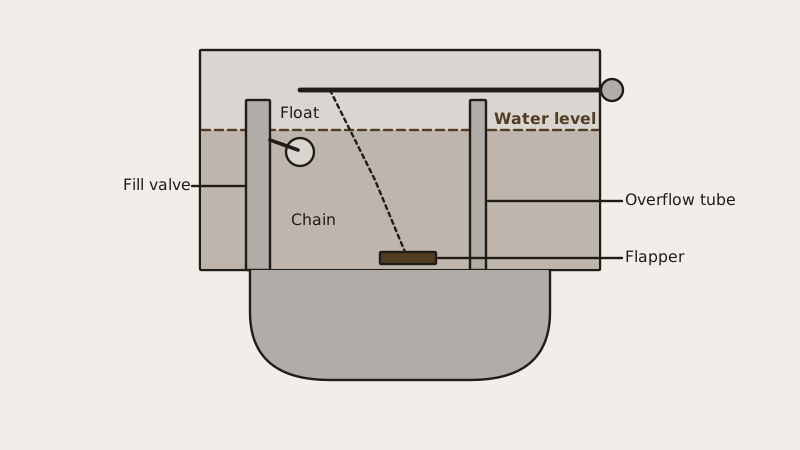
Slide the tank lid aside and watch where the water ends up. A trickle past the rubber seal into the bowl points at the flapper. Water pouring over the tall pipe in the middle means the setting is too generous, or the fill valve cannot close. Both are ten-minute repairs. Bigger faults are on our toilet repair page.
The order below wastes the least time: a dye test, the flapper, the level, then the fill valve. We also cover the odd patterns, like a toilet that starts up by itself at 3am, and the part Pasadena's hard water plays.
Which part of the toilet is the culprit?
Add a few drops of dark food dye to the tank water and give it a ten-minute rest. Color creeping into the bowl means the flapper leaks. If the bowl stays clear while water still enters the tank, suspect the fill valve or the level. Flush as soon as you finish, or the dye can mark the porcelain.
The dye trick is the EPA's own, from its WaterSense program, which adds that a flapper deserves replacing every five years or sooner. Because the leak makes no noise, many people learn about it only from the bill. If yours jumped, this look at a high water bill lists other suspects.
Before any repair, find the small oval-handled valve where the supply pipe meets the wall or floor and turn it right until it will not move. Once it is shut, the tank stays dry while you work and nothing can flood if a part fails.
How do I swap a worn flapper?
Buy a replacement and fit it. The flapper caps the big outlet at the bottom of the tank, and with age it softens, warps or collects crust, so water seeps out and the valve refills over and over. The part is cheap and the swap is quick. Take the worn one along, or a picture of it, so the size and style match.
Steps:
- Close the wall valve, then flush once to drain the tank.
- Lift the two little ears of the flapper off their posts on the overflow pipe, and release the chain from the flush lever.
- Run a fingertip around the ring the flapper sat on. Wipe away any grit with a rag.
- Clip on the new part and set the chain with one or two links of slack. Too tight and the flapper hangs open, too loose and it snags underneath.
- Reopen the valve, let the tank refill, and repeat the dye test.
Kohler's troubleshooting page agrees about chain slack. Many Kohler toilets have a canister seal instead of a flapper: if you see a wide plastic cylinder where a flapper should be, you need that seal for your model. Parts are found by model number, normally molded or stamped somewhere in the tank.
Local water matters here. In 2025 Pasadena Water and Power measured hardness from 202 to 256 ppm, roughly 13 grains per gallon (about 222 ppm) as the average, and says it causes buildup in water heaters. The same dissolved calcium and magnesium can coat a flapper seat, so in a Pasadena tank a flapper may give out earlier than the EPA's five years. More detail is in our flapper repair guide.
What if the water level is set too high?
A tank that is set correctly stops filling about an inch short of the overflow pipe's rim. Above that, it spills down the pipe forever, because the fill valve never sees the float lift high enough to close. Lower the setting with the screw or sliding clip on the fill valve, flush, and watch where the new level lands.
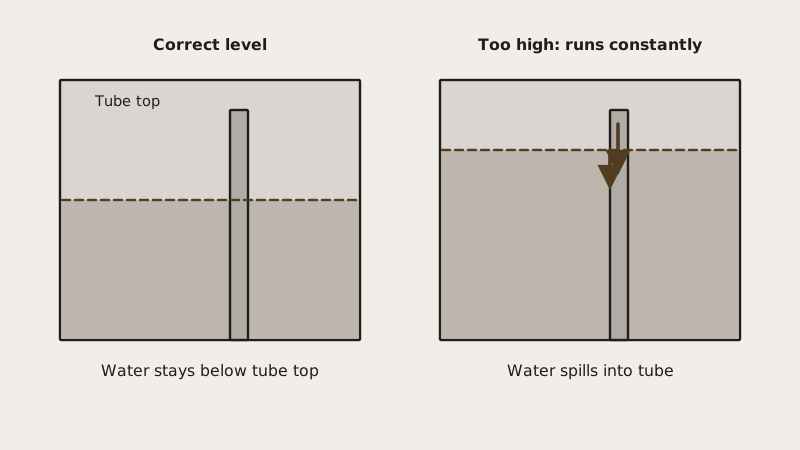
Kohler gives identical advice for water spilling into the overflow. On the fill valve you will find either a small plastic screw on top or a float cup riding on the stem. Back the screw out a few turns, or slide the cup down a notch or two.
Two small checks catch most of the rest:
- The refill hose. The slim hose coming off the fill valve must end above the open top of that pipe. Shoved down inside, it can pull water out by siphon.
- The lid. A toilet that only misbehaves with the lid on may have a float arm pressing against it. Drop the float slightly.
What if the fill valve will not shut off?
Clean it, and if that fails, replace it. Grit caught under the cap can hold the valve open. With the wall valve closed, twist the cap off, hold a cup over the stem, crack the supply open for a moment to blow the debris out, and put it back together. A toilet that still runs after that needs a new fill valve, which is inexpensive and fits most standard tanks.
Some older Pasadena bathrooms still have a ballcock, the brass arm with a ball float on the end. Replace it with a modern fill valve instead of adjusting it yet again, since the arm bends, the washers perish and scale clogs the seat. The swap means undoing the supply nut under the tank, so keep a towel nearby, and check whether the wall valve is seized or weeping too. We cover that part in a guide to the toilet shut-off valve.
Why does my toilet run on its own at random?
Short bursts with nobody near the bathroom usually come from a flapper that seeps. The tank level drops a touch, the fill valve wakes to restore it, and minutes later the cycle repeats. Some call this a ghost flush. After bedtime, you hear it as a brief refill now and again.
Match the symptom to the fix:
- A few seconds of refilling, repeating. Slow flapper leak. Dye test, then a new flapper.
- Never stops. The fill valve cannot close, or water is escaping over the overflow. Check the level, then clean or replace the valve.
- Keeps going after each flush. A chain snagging, or a flapper that lands crooked. Fix the slack.
- A hiss with nothing visibly moving. A tired seal in the fill valve, so replace the valve.
- Only when the lid sits on. The float arm is touching it.
On a Kohler the sequence barely changes. Its support page starts with flushing sediment out of the fill valve, moves on to chain slack, then the tank level.
Should I just buy a new toilet?
Not for a running problem alone. A solid fixture with no cracks, no rocking and no seepage at the base is worth a cheap part, not a new one. Start shopping when the porcelain is cracked, the tank bolts are corroded and dripping, or the old model uses far more water per flush than a current one.
A new toilet needs a fresh wax ring, evenly tightened closet bolts and a new supply line, and a cracked or rusted floor flange can enlarge the job. Porcelain is heavy, so many owners hand this over. See toilet installation costs first. Visit our home page for the rest of the plumbing we line up around the San Gabriel Valley.
When is a plumber the right call?
Ring a plumber when the toilet carries on even with a new flapper and a new fill valve, when water creeps out around the base, or when the supply valve refuses to close and the flow will not stop. Someone on site can also trace faults you cannot see, like a hairline tank crack or a failed flange seal.
Other signs it is time:
- A wall valve so crusty it squeals or will not turn.
- Damp flooring, a stain on the ceiling underneath, or a spongy patch near the bowl.
- Gurgling drains, which sometimes hint at a blocked vent or sewer line. If a smell comes with it, read plumber for sewer smell.
The quote form is open whenever you need it: the plumber who visits gives a written price first. If the fault is weak flushing rather than running, look at toilet flush repair.
Common questions
Is a leaking toilet really a big water waster?
More than most people guess. WaterSense says leaks in the average home lose more than 9,300 gallons in a year, and toilets sit near the top of the causes. One that runs nonstop can far outstrip that figure. Since there is no noise to give it away, the water bill is often the first clue, and a repair is among the cheapest savings in the house.
Can I repair the tank with the water still on?
Chain and float tweaks are fine with it on. For a new flapper or fill valve, or anything deeper, shut the wall valve with a clockwise turn. If it is seized, stop pushing: close the main for the house instead and have a plumber deal with the valve itself.
Why would a Kohler toilet keep running?
For the same reasons as any other brand: grit in the fill valve, a level above the overflow, a chain snagging, or a tired seal. Kohler's advice is to flush the fill valve first, then check for one or two links of chain slack. Read the model number inside the tank before ordering a replacement part.
What will the repair cost me?
The parts themselves are cheap, so doing it yourself costs mostly your time. A plumber adds a visit charge and labor, which can dwarf the price of a flapper. The plumber sets the real figure, and it is sensible to have it written down before the job starts.
Sources
Page updated