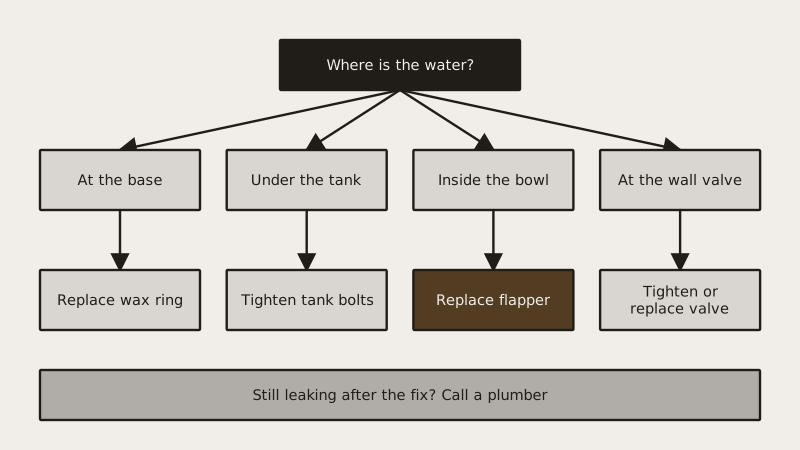
Start with a dry toilet and a closed wall valve. Towel off the porcelain, the hose and the floor around it, then watch for the very first wet spot. Wetness around the foot points down to the wax seal. A drip under the tank blames the tank gasket or its bolts. A bowl that tops itself off by itself is a flapper or fill valve story. The general picture of this work sits on our toilet repair page.
How do I work out where the toilet is leaking?
Dry everything, close the wall valve and note where the first bead appears. Next try the dye test: squeeze a few drops of food dye into the tank, let it sit for ten minutes, then check the bowl. Color showing up there, with no flush, proves the flapper is letting water through.
WaterSense, the EPA's water efficiency program, recommends exactly that test, and adds a second one for the whole house: note the meter, avoid using water for two hours, and read it again. Any movement means a leak somewhere. After the dye test, flush promptly to keep the tank from staining.
Match what you saw to a likely culprit:
| Clue | Probable cause |
|---|---|
| Pool at the foot, floor stained or soft | Wax ring failing, or loose base bolts |
| Drip where tank meets bowl | Tank gasket or tank bolts |
| Dampness at the stop valve or hose | Supply line or valve packing |
| Bowl refills unprompted, faint hiss | Flapper not sealing |
| Water pouring down the overflow standpipe | Fill valve set too high or worn out |
| Beads on the tank's outer wall | Condensation, no leak at all |
What fixes a leak at the foot of the toilet?
A wet floor at the foot normally traces to a failed wax ring or gasket on the floor flange, or to a bowl that has rocked loose. Snug the base nuts a touch first. If the seepage returns, the toilet comes up, the old wax gets scraped off, and a fresh ring goes in before the bowl is reseated.
If you tackle it yourself:
- Close the wall valve, flush, sponge out what is left.
- Detach the supply hose over a towel and bucket.
- Pop off the bolt caps, undo the nuts, rock the bowl free and raise it vertically. Bowls are heavy, so recruit a helper.
- Scrape the flange clean, look for cracks, press on a new ring.
- Settle the bowl over the bolts, press down, and tighten each nut in small turns, swapping sides as you go. Cranking too hard splits the porcelain.
- Reconnect, open the valve, flush a few times and look for drips.
A spongy or stained floor changes the plan. Many Pasadena bathrooms in houses from the Craftsman years to the fifties have lived through decades of slow seepage, and rotten subfloor costs far more to fix than a wax ring. A broken flange, a corroded cast iron stub or a cracked bowl also belong to a plumber.
What cures water dripping from the tank joint?
A drip under the tank edge means the rubber gasket, bolts or washers have worn. Close the valve, empty the tank, fit a replacement kit, and tighten the bolts evenly while the tank sits level. Porcelain breaks easily, so go slowly and stop when the gasket is snug.
Local water adds to the wear. Pasadena Water and Power lists its supply as very hard, and mineral scale collects on washers, valve seats and bolts. Old metal bolts can seize. If one refuses to turn, stop and bring in help instead of twisting the tank.
How do I deal with a bad flapper or fill valve?
Think of the flapper as the rubber plug that holds the tank full until you flush; the EPA warns that a tired one can quietly lose thousands of gallons in a year. Buy one that matches the old width, clean the seat, and fit it. A fill valve that spills into the overflow tube needs adjusting, or replacement if adjusting fails.
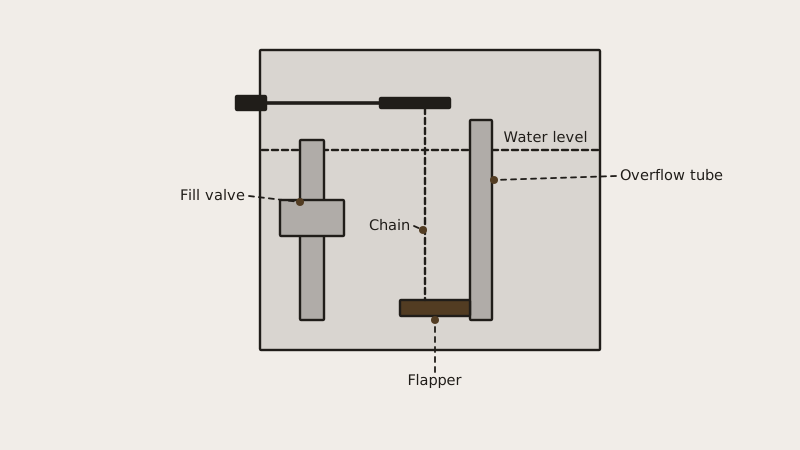
EPA advice is to replace flappers about every five years, carrying the old one or a photo to the shop. The fill valve is the standing unit that refills the tank after each flush. A steady trickle into the overflow pipe tells you the float sits too high, so bring it down. If the trickle continues, change the valve. Detailed walk-throughs are in fixing a running toilet and flapper repair.
The EPA's national estimates show the stakes: household leaks add up to close to a trillion gallons a year, with the typical home losing over 9,300 gallons, and about nine homes in a hundred lose 50 gallons or more daily. A bill that suddenly climbs has other suspects, covered in a surprisingly high water bill.
Is a damp stop valve or hose something I can fix?
Often yes. A quarter turn on the nut, or a fresh braided stainless hose, usually cures it in minutes with the valve closed. A dripping stem, or a valve stuck open, means replacement, and on older galvanized or corroded lines that belongs to a plumber.
Old multi-turn valves seize and snap when forced. The page on toilet shutoff valve repair explains how they fail and what replacing one involves. Find the main shutoff for the whole house too: Pasadena Water and Power suggests locating it ahead of time and marking it.
At what point does a leaking toilet need a plumber?
Once the leak outlasts the easy fixes, the floor feels soft, the bowl or tank is cracked, the flange is broken, or the stop valve cannot shut the water off. A cracked tank or bowl is replaced, not mended. If a new toilet makes more sense, toilet installation pricing covers what that costs.
Prefer a professional opinion? The quote page takes the location of the water and the toilet's age. Plumbers for a toilet leak explains the visit. A permit or a job over $1,000 triggers the state's contractor license rule, which a simple toilet repair rarely meets, though flooring work may, so ask which license number applies and see it at CSLB. Our other services are listed at Pasadena Pipe Works.
Common questions
What does a silent toilet leak cost in water?
A flapper that seeps without a sound can lose thousands of gallons across a year, the EPA says. Fixing the easy leaks around a home can trim the bill by about a tenth. A dye test costs pennies and needs ten minutes, which makes it the cheapest check in the house.
Will caulk or putty stop a leak at the base?
Not for long. The seal that matters is the wax ring or gasket under the bowl, and a bead of caulk around the outside does not replace it. Caulk can also trap a slow leak and hide rot under the flooring. Replace the ring, then inspect the flange and floor.
What is the usual time for a toilet leak repair?
A flapper or supply line often takes ten to thirty minutes. A fill valve or tank gasket might need an hour. For a new wax ring the plumber lifts the bowl, which takes an hour or two and longer with flange or floor damage.
Why does the leak appear only when I flush?
A flush pushes water through the bowl and tank joints under pressure, so a weak base seal, tank gasket or hairline crack shows up then. Dry everything, flush, and watch for the first wet spot. If it stays elusive, a plumber can trace it.
What should the plumber's estimate for this repair list?
Parts such as the wax ring, bolts and supply line; whether the flange and floor get inspected; what the plan is if rot turns up. The contractor license number belongs there too, so the state record can be checked first.
Sources
Page updated