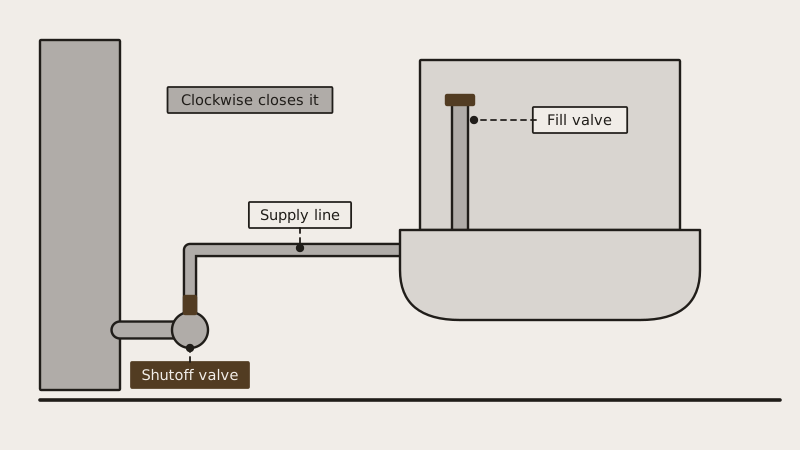
Behind every toilet sits a small valve, the angle stop, that controls water reaching the tank. When it weeps, sweats, jams or fails to seal, the cure is often a quarter-turn on the packing nut, a fresh supply line, or a new valve. For fixture trouble in general, start at toilet repair.
What follows: how to find the valve, how to read the leak, what to do when the handle will not budge, where DIY ends, and what Pasadena's permit sheet says about swapping valves.
What is the valve behind my toilet and where do I find it?
It is a compact brass or plastic valve poking from the wall or floor, with a thin tube rising to the tank. Its one job is isolating that single toilet. Turn the handle clockwise to shut, counterclockwise to open. Anyone with a leaking tank, a failing fill valve or an overflow should reach for it first.
Overflowing bowl? Close the stop at once. The tank keeps refilling until water is cut, so this one move often saves the floor. If the valve is out of reach, lift the tank lid and hold the float up with your hand.
Two styles turn up in Pasadena homes. Craftsman bungalows and mid-century houses commonly still have multi-turn valves with a rubber washer on a threaded stem. Remodels more often get quarter-turn ball valves, which close with a half rotation and tend to seize less. When an old valve starts failing, a quarter-turn replacement is the usual upgrade.
Learn the whole-house shutoff as well. Pasadena Water and Power notes that the main valve generally sits where supply enters the house, and its water emergency line is 626-744-4138. If a toilet valve fails mid-flood, the main is your backup.
Which kind of leak is it?
Leaks come from three places: the stem beneath the handle, the nut that joins the supply tube to the valve, and the joint where the valve joins the wall pipe. Dampness at the stem points to tired packing. A wet tube nut means a loose fitting or a bad seal. Water at the wall points to a failing joint behind it.
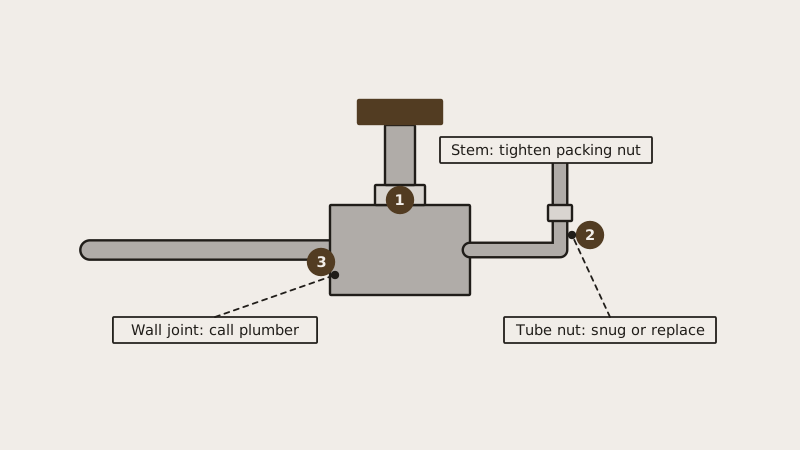
Pin it down by drying every joint, then hugging each one with a thin strip of tissue. Whichever strip darkens first is your leak. Then work from cheapest to costliest:
- Stem seep. Shut the valve, then tighten the packing nut beneath the handle by about a quarter turn. Overdoing it makes the handle stiff.
- Tube nut seep. Snug the nut gently. If it keeps weeping, replace the braided supply line, a low-cost part that wears out.
- Wall joint seep. Leave this to a plumber, because the repair means working on soldered or compression pipe inside the wall.
Hard water speeds up the aging. Pasadena Water and Power reported 2025 hardness between 202 and 256 ppm, and that mineral crust scores washers and locks up stems. A valve nobody has touched in fifteen years is the one most likely to start dripping the day you finally close it.
Do not forget the toilet itself. The EPA's dye test is easy: tint the tank water with a little food coloring, then wait ten minutes without flushing. Tint showing up in the bowl means a leak, usually the flapper. Next steps live in flapper repair and the running toilet guide.
How should I handle a stuck valve?
Stop pushing. A seized stem is usually mineral buildup, and brute force snaps the brass or cracks the pipe behind it. If firm hand pressure does nothing, close the main shutoff and call a plumber. A handle that turns while water still flows past it means the washer or seat is worn through, so the valve needs replacing.
To test the seal, close the stop, flush, and watch the tank. If it still creeps back up, water is getting past the valve.
Never put a wrench on an old handle for leverage. If the stem breaks, nothing but the main will stop the water. Find the main before trying anything, lay towels under the valve, and keep a bucket handy, since old valves often drip once they move.
If a valve defies you while you wait for help, close the main, flush the tank empty, and leave the stop untouched. A slow weep can wait a day. Spreading water cannot.
May I swap the valve myself?
A handy owner can replace a stop on a compression fitting using a wrench, a new valve and the water off at the main. Soldered copper or old galvanized pipe raises the difficulty. Pasadena's permit sheet also treats replacing valves differently from repairing a leak, so call the city before you commit.
The city's exemption sheet waives a plumbing permit for stopping leaks and for repairing leaks in pipes, valves or fixtures, but only when the repair does not replace or rearrange valves, pipes or fixtures. A new valve may therefore need a permit, and replacing a concealed pipe counts as new work. The Building and Safety Division answers at 626-744-4200. Plenty of owners pass the job to a plumber.
For a DIY swap, the order runs like this:
- Shut the main, then open a tap somewhere to drain the line.
- Flush the toilet and sponge the tank dry.
- Unscrew the supply line, then remove the valve by its nut or cut the pipe, depending on the fitting.
- Fit the new valve with a matching sleeve, snug it, and attach a new supply line.
- Reopen the main, then ease the valve open. Look for drips at ten minutes and again an hour later.
Quit if the pipe is corroded, the wall behind the valve is wet or joints are soldered. Those belong to a plumber. State law also wants a contractor license on any job with $1,000 or more in parts and labor, or any job needing a permit.
When does a plumber make more sense?
Choose a plumber when the handle is frozen, the wall joint leaks, the pipe behind it is corroded, a stain is spreading on drywall, or tightening the nut did not stop the drip. The visit can include a new valve and line, a check of every other stop in the house, and swaps of old multi-turn valves for quarter-turn ones.
Doing every shutoff in one visit often makes sense, since valves of one era age together and a plumber on site can change several. Ask for a per-valve price and a price for the set. We publish no figure for this small job because it varies by house and access, so the number comes in a written quote. For larger fixture work, toilet installation cost shows what related jobs run.
When the leak is behind the bowl and the subfloor feels soft, you have a bigger problem than a valve. See toilet leaks and repairing a toilet leak, and read why the water bill climbs if a silent leak may have been running.
To book, use the quote request; how it works explains what follows. Requests are read Monday through Friday, nine to five, and the home page shows our other plumbing work.
Common questions
Which direction closes the valve?
Clockwise shuts it, counterclockwise opens it. A multi-turn valve takes several full rotations, a quarter-turn type stops after half a turn. Close it gently until it stops. A handle that refuses to move should be left alone, and you should use the main shutoff instead.
How tight should the supply line nut be?
Hand-tight plus a quarter to half turn with a wrench. Cranking harder crushes the compression ring and worsens the leak. If a drip persists, shut the water off, remove the line, look for a cracked ring or stripped threads, and fit a new supply line.
Is it worth replacing a valve that still works?
If it is crusty, rusty or has not moved in years, swapping it on your schedule beats swapping it in a flood. Quarter-turn valves are the common upgrade, and the best moment is when you are already replacing a toilet or vanity faucet.
Will closing the stop end an overflow?
Yes, it halts the tank refilling, which ends most overflows. If the bowl itself is blocked, closing the valve keeps new water out while you clear it. Clogged toilet help covers the next steps, and a burst supply line needs the main closed.
Does a leaking stop count as an emergency?
A slow drip can wait a day with a bucket beneath it. Spraying water, a stubborn valve, or water creeping across the floor means closing the main now and getting a plumber that day, because wet subfloor and flooring deteriorate fast.
Sources
- U.S. EPA WaterSense, Fix a Leak Week (toilet dye test, flapper replacement, leak waste)
- City of Pasadena Building and Safety Division, work exempt from permit (repairing leaks in valves versus replacing valves)
- Pasadena Water and Power, water troubleshooting (main shut-off valve, emergency line)
- Pasadena Water and Power, 2026 water quality report (2025 data)
Page updated