You want a plumber for a water heater replacement when the old tank leaks, rusts at the base, no longer keeps up, or has passed its 10 to 15 years. The work is hauling out the old unit, installing and hooking up the new one, adding the safety parts the code calls for, and getting through a city inspection. A local plumber arranged through us prices all of it. The wider decision sits on our water heater replacement page.
Read on for the visit from start to finish, the Pasadena rules behind it, how to vet a contractor, and the choices of yours that move the price.
What happens on the day of the swap?
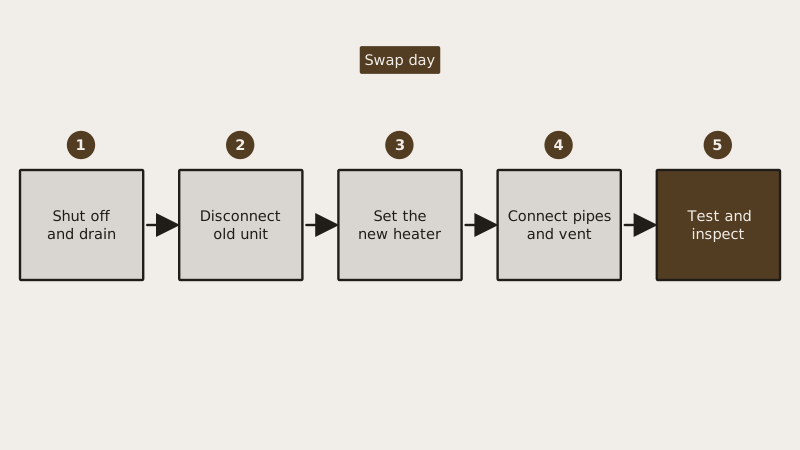
Water and fuel get shut off, the old heater is drained and taken away, and the new one is lowered onto a level base and reconnected to water and gas or electric. The plumber adds the relief valve and its drain, straps the tank, tests for leaks and gas, and explains the setup. Permit and inspection come with the job.
A typical gas swap runs in this order:
- Walk-through. Fuel, vent, gas connector, location and clearances get a look, and anything out of code is noted.
- Shutoffs and drain. Water and gas are closed, then the old tank is drained and disconnected.
- Removal. A tank full of sediment is heavy, which is why a second pair of hands often comes along.
- Placement. The new heater stands plumb on its base and is anchored to the wall framing.
- Hookup. New flexible water connectors, a safety valve with its drain pipe, a gas connection with its own shutoff, and a vent that slopes and clears combustibles.
- Testing. The plumber fills the tank, hunts for leaks, lights the burner, checks the draft and sets the temperature.
- Inspection. The city inspector examines the straps, the relief line and the vent.
An electric swap drops the gas and vent but adds an electrical review: the circuit, breaker size, wire condition and element and thermostat settings. The electric thermostat guide covers the part that often fails first.
Which local rules shape the job?
California requires strapping so a tank cannot topple in an earthquake, and Pasadena's Building and Safety Division expects a plumbing permit for the swap. The city's own sheet for gas heaters lists the relief valve drain, an expansion tank on closed systems, clearances and a raised stand in garages.
Points from the City's gas water heater sheet that show up on inspection:
- Strapping. Two restraints at minimum, placed high and low on the tank body.
- Relief valve. A temperature and pressure relief fitting whose hard-piped drain is no narrower than its outlet, ends outdoors 6 to 24 inches above grade, points down and has no trap.
- Expansion tank. Called for when a valve, backflow preventer or other normally closed device keeps pressure from easing back into the main.
- Garage placement. A heater in a garage or next-door room has to stand so the flame is 18 inches off the floor, with a crash post where a car could strike it.
- Venting. Listed vent parts, correct slope and clearance to combustibles.
Pasadena's fee schedule lists a fee of $38 per water heater for fiscal 2025, plus a base fee, so confirm the current schedule. Simple plumbing permits can be issued over the counter, and a permit stays valid for 180 days if inspections keep passing. The contractor usually files it, and your quote should say who does.
State energy rules changed this year. The Energy Commission reports that the 2025 code took effect January 1, 2026, and covers new buildings plus major alterations and additions, with single-family energy budgets that favor heat pumps for water heating. Nothing in the Commission's summary says every direct replacement in an existing home must become a heat pump. Ask the plumber whether any part of your job counts as a major alteration.
How do I confirm a plumber is properly authorized?
Before work starts, pull up the contractor's record on the CSLB site. A contractor license is a legal must when parts and labor reach a thousand dollars, or whenever a permit is involved, and a heater swap nearly always meets both. Plumbing sits under the C-36 classification.
On the record, look for three things: an active status, a classification that fits plumbing, and a bond on file. Then confirm the licensee's name appears on your quote and contract. A person who offers to skip the permit to save money is a warning sign, since the permit is what puts an inspector's eyes on the gas, vent and straps.
Also ask about:
- Insurance and workers' compensation. The City's Permit Center says an owner who hires workers without a contractor license takes on workers' compensation duties.
- The warranty. Who stands behind the tank, and who stands behind the labor, and for how long.
- Parts. Whether the quote lists the brand, model, capacity, first hour rating and warranty term.
We do not name or push any one contractor here. Send a request and the local plumber we arrange puts a quote in writing.
What should I settle ahead of time?
Pick the fuel, size and type: another gas tank, an electric tank, a heat pump model or tankless. Those choices set the scope, so decide early. Gas for gas is simplest. Changing fuel or going tankless means new gas piping, venting or wiring, which raises the price and often needs a second visit.
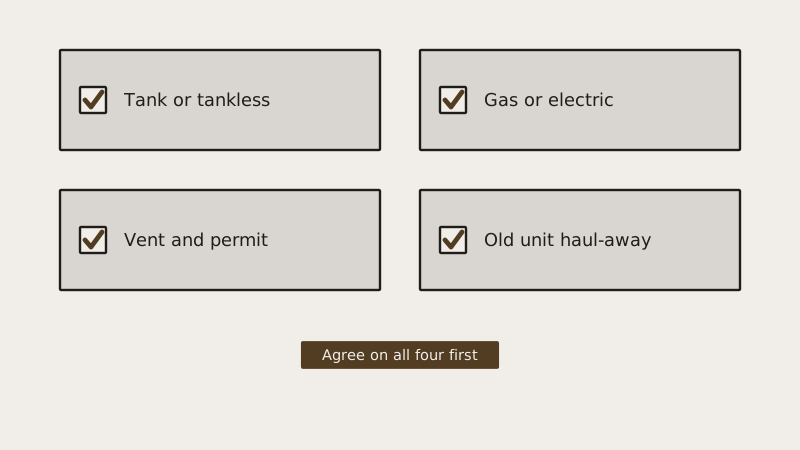
Check these in advance:
- Access. Clear a route to the heater and move stored boxes from the closet or garage corner.
- Location rules. According to the City's tankless handout, a gas appliance in a bedroom, a bathroom or a closet opening into either needs a direct-vent listing, which can rule out a swap in place.
- Size. Match the tank to the household, not to the old tank out of habit. The replacement price page has sizing guidance.
- Water hardness. Pasadena's 2025 average was about 222 ppm, or 13 grains per gallon, so ask about the anode rod and a flush schedule.
- Rebates. Pasadena Water and Power lists $500 for a new ENERGY STAR electric heat pump water heater for qualifying residential customers, applied for after installation.
For a decision between types, read tank versus tankless. If the heater already failed, emergency water heater repair covers what to shut off and what an urgent job involves.
How long does it last, and what follows?
Swapping one tank for the same kind commonly fills half a day, permit step and inspection included. Gas leak checks and a draft test come last. Afterward you should receive the permit card, the warranty papers and a short tour of the shutoffs, the relief valve and the thermostat setting.
Some jobs run longer. Tankless conversions, new gas lines, relocated heaters and wiring upgrades add hours or a second visit. Older Pasadena houses with heaters in tight closets, attics or garages sometimes need venting changes, and the plumber should explain them before starting.
Once it is in, leave the thermostat around 120 degrees Fahrenheit, the setting the Consumer Product Safety Commission recommends to limit scalding, and lift the relief valve lever briefly each year. A yearly flush of sediment helps in hard water. If gas is ever detected, leave at once and report it to the utility once outside. (SoCalGas: 1-800-427-2200).
To begin, send the quote request. How it works lists the steps, and you can browse other plumbing services from the home page.
Common questions
Is a handyman allowed to do it?
Past a thousand dollars, or if a permit is required, the law points to a plumber whose California contractor license is active, and a heater swap needs a permit in Pasadena. Gas piping and venting add safety rules. A handyman working outside those rules leaves you with no inspection and possibly no insurance cover.
Does Pasadena require paperwork for this?
Yes. Pasadena's Building and Safety Division handles the plumbing permit, and the fee schedule lists a charge per heater. Simple permits can go through the over-the-counter route. Inspectors check strapping, the relief valve drain and venting, and the installer ordinarily files for it.
Is there an age when I must replace the heater?
No rule forces it. The Department of Energy gives storage heaters 10 to 15 years, and it makes sense to plan once you pass ten. Go sooner if the tank weeps, the base rusts, the water turns brown or repair quotes climb. A tank that has sprung a leak is beyond repair.
Can I switch from gas to electric?
Yes, though it is a bigger project. Electric needs a suitable circuit, often 240 volts, and the old gas line has to be capped safely. A heat pump unit also wants space and ventilation. Have the electrical work priced on its own line, and check the utility rebate before buying.
Who takes away the old tank?
The plumber normally carries it off and recycles the steel, and haul-away should show up as a separate line in the quote. If you plan to dispose of it yourself, remember a tank is heavy and may hold sediment, so drain it first and ask your waste hauler about metal pickup.
Sources
- City of Pasadena Building and Safety Division, typical residential gas-fired water heater (permit-related code points, strapping, relief valve, expansion tank, stand)
- City of Pasadena Building and Safety Division, tankless water heaters
- City of Pasadena Permit Center, apply for a permit
- City of Pasadena, FY 2025 general fee schedule
- California Energy Commission, 2025 Energy Code update (effective January 1, 2026)
- Pasadena Water and Power, electric heat pump water heater rebate
- SoCalGas, natural gas leaks
- U.S. Department of Energy, Energy Saver guide (water heater lifespans)
- U.S. Consumer Product Safety Commission, Avoiding Tap Water Scalds
Page updated