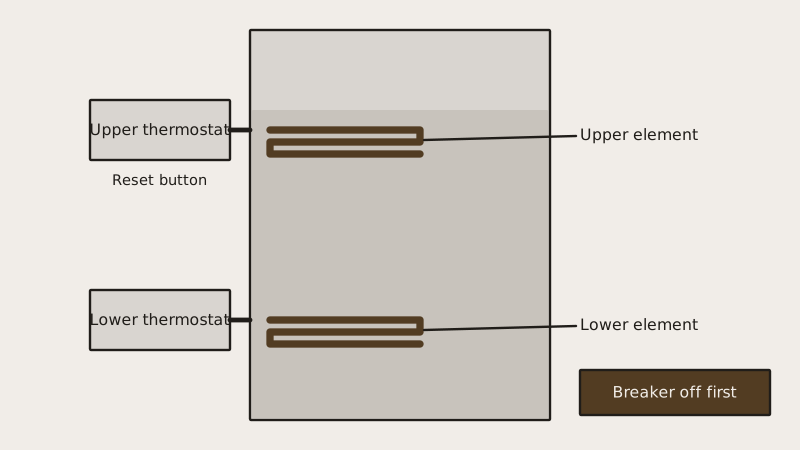
Inside an electric tank sit two heating elements, and each answers to its own thermostat, a pair mounted at different heights on the shell. When a thermostat quits, its element either stops heating or never shuts off. Swapping one is a brief job for a plumber or electrician, priced between about $100 and $350 in published guides, and it fits within our water heater replacement overview.
Next: telling a thermostat fault from an element or breaker fault, how the two-thermostat design works, which steps are safe, and when a whole new heater is the better spend.
Why does an electric tank have two thermostats?
The upper thermostat, behind the top access panel, feeds the top element first, and once the upper tank is hot it passes power down to the lower thermostat. That one then runs the bottom element until the whole tank is warm. A red reset button on the upper unit is the high-limit safety cutout.
That split explains the symptoms. Lose the lower thermostat or element and hot water runs out fast, because only the top section of the tank warms. Lose the upper thermostat and nothing heats at all. The Consumer Product Safety Commission notes that most electric heaters carry two thermostats and that both need to be set.
A setting near 120 degrees Fahrenheit is what the Department of Energy recommends, to limit scalding and save energy, and the CPSC advises the lowest setting that meets your needs, confirmed with a thermometer at the tap. A thermostat stuck high can push water well past that, a real scald risk for children and older adults.
Each thermostat is adjusted by a small screw or dial under insulation. Keep panels on until the breaker is off, because an electric heater draws 240 volts, enough to kill.
Which symptoms point at the thermostat?
Suspect it when the taps run cold, a thin supply that fades fast, lukewarm output, scalding output, a breaker that keeps tripping, or a reset button that pops again after you press it. The element or breaker may be the real culprit instead, so test before buying parts.
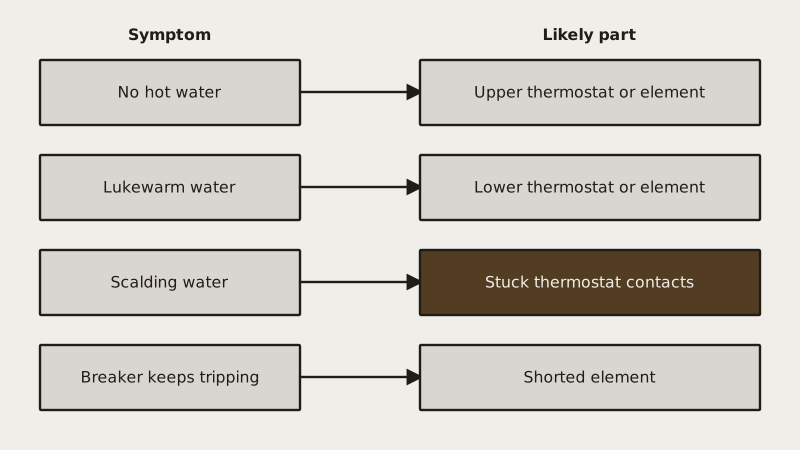
Pair each symptom with its likely cause:
- Completely cold. Check the breaker and red reset button first. A dead upper thermostat or high-limit switch is typical, as is a burnt upper element.
- Hot, then gone in minutes. Look at the bottom pair, the lower element and its thermostat.
- Scalding water or steam at the relief valve. A thermostat stuck closed. Kill the breaker and ask for help.
- Breaker trips at once. A shorted element or faulty wiring is likely, and repeated resetting only risks a fire.
- Rumbling, popping, weak heat. Scale on the elements, a frequent finding with hard water.
Pasadena water is hard. The utility's 2025 report lists 202 to 256 ppm, near 13 grains per gallon at the average, and scale settles on the elements and across the tank floor. A crusted element can overheat and trip the high-limit switch, so plumbers often inspect the elements whenever they change a thermostat. Element replacement covers that part, and an electric unit that runs cold goes through the whole diagnosis.
Can an owner swap the thermostat safely?
It can be done by someone comfortable with electrical work who follows strict steps, but one mistake can electrocute you or start a fire. If you cannot prove the power is dead, do not proceed. A plumber or electrician can finish in under an hour, and many owners should leave it to one.
If you do go ahead, the sequence is:
- Open the heater's breaker at the panel and mark it with tape so no one closes it.
- Remove the access panel and fold the insulation aside.
- Verify that power is gone using a non-contact tester or a meter. Test; never assume.
- Photograph the wiring before touching it.
- Disconnect the wires, release the old thermostat from its clip, and fit the same model flat against the tank wall, since poor contact makes it misread temperature.
- Rewire from your photo, replace the insulation and panel, and set both thermostats near 120.
- Restore power only when the tank is full. A dry element burns out in seconds.
That last step matters most. Open a hot tap first and let it run until a steady stream, not air, comes out. Never power an empty tank.
Stop and bring in a professional at the sight of melted insulation, scorch marks, water inside the panel or a leaking tank. Leaks are a separate subject, covered under water heater leakage, and a tank that has sprung a leak cannot be mended.
What will the thermostat job cost?
Published 2026 repair guides give $100 to $350 for a water heater thermostat, with some plumbers quoting $150 to $200, and $150 to $350 for a heating element. The parts are cheap, so labor and diagnosis drive the bill. Read those figures as a rough guide, because the written quote is what you pay.
The quote may include:
- The thermostat or a matched pair, since both are often replaced together.
- A check of both elements, the wiring and the breaker.
- Flushing sediment from the tank if the elements are scaled.
- A temperature check at the tap.
Money spent on an old tank can be wasted. The Department of Energy credits storage heaters with 10 to 15 years. A heater past that mark, rusting at the base or with scale-choked elements, may be better replaced. Compare options on the replacement cost page, read how often heaters need replacing, and see whether a fresh anode rod could add life (anode rod replacement).
Is the heater worth fixing?
Fix it if the tank is under roughly ten years old, dry and rust-free, and the fault is a thermostat or element. Replace it if the tank leaks, the base is rusted, repairs keep stacking up, or the quote creeps close to what a new unit costs. Pasadena's permit rules apply to replacement, not to swapping a thermostat.
A replacement in Pasadena needs a plumbing permit and strapping to the wall framing. The city's standards sheet describes the rules, including a relief valve drain piped outdoors and an expansion tank where the water system is closed. The emergency water heater page explains what to shut off if a tank starts failing, and tank versus tankless compares the options.
If you do replace, weigh a heat pump model. It uses far less electricity, and Pasadena Water and Power lists a rebate for qualifying electric customers, so check the terms before buying.
How do I arrange a visit?
Tell us the brand, tank size, what the water is doing, and whether the breaker trips. A local plumber we arrange tests power, thermostats, elements and the tank, then writes the price down. Requests are read Monday through Friday, nine to five. Start at the quote page, learn the steps in how it works, or look around the home page.
Common questions
How can I tell thermostat from element?
A meter settles it: a good element shows a steady resistance, and a good thermostat passes power when the tank is cold. Without one, the pattern helps. No hot water at all suggests the upper thermostat or element, while a short supply suggests the lower pair. A plumber can test each part in minutes.
Should both thermostats go in together?
Often yes. They are the same age and wear at the same rate, and the second part is inexpensive once the panels are open. Replacing only one can bring a second failure soon after. The plumber may also suggest checking both elements, especially where scale is present.
What setting should I choose?
About 120 degrees Fahrenheit is the Department of Energy's pick for most homes, to limit scalding and save energy. The DOE notes that people with a compromised immune system or chronic respiratory disease may want 140. That is a health decision, so ask a doctor, not a plumber.
Could a bad thermostat make the relief valve drip?
Yes. A thermostat stuck on can overheat the tank, raising pressure and temperature until the relief valve opens. Treat a spitting valve as urgent: cut the breaker, keep people away from the discharge pipe and have the heater checked. For the valve itself, see relief valve replacement.
Is a permit involved?
Changing a thermostat is a small repair, not a heater replacement, and replacement is what needs a plumbing permit in Pasadena. If other work might be involved, phone the Building and Safety Division on 626-744-4200 first. Bigger jobs, or any that need a permit, go to a contractor with a California license.
Sources
- U.S. Consumer Product Safety Commission, tap water scalds (two thermostats on most electric heaters, setting and testing)
- U.S. Department of Energy, Energy Saver guide (120 degree setting, lifespans)
- U.S. Department of Energy, renters (120 degree setting, 140 for some health conditions)
- Published 2026 water heater repair cost guides (thermostat and element ranges), checked November 2026
- Pasadena Water and Power, 2026 water quality report (2025 data)
- City of Pasadena Building and Safety Division, typical residential water heater requirements
Page updated