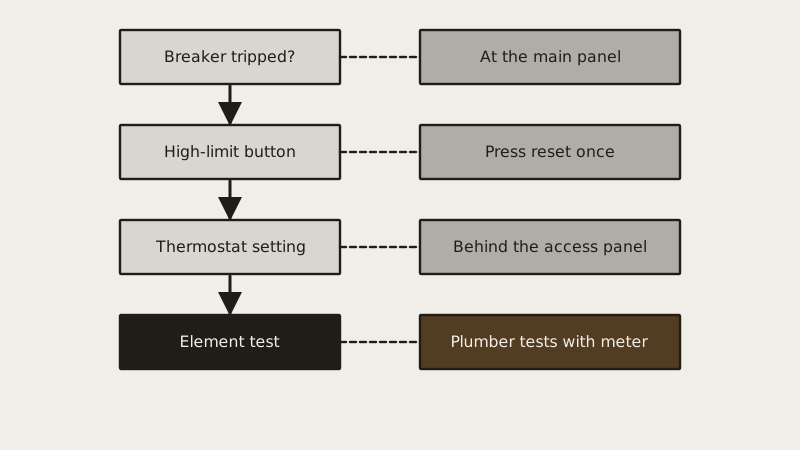
When an electric water heater stops making hot water, the culprit is nearly always a tripped circuit breaker, a popped high-limit safety button, or a burned-out element or thermostat. Two of those take a minute to check. The third calls for a meter and live wiring, so that is the point to hand the job to a plumber. Our water heater replacement hub covers the next step if the tank turns out to be finished.
Why is my electric water heater not making hot water?
Most often the heater has lost power or a part inside has failed. Manufacturers list the same short sequence: a tripped breaker first, then the red reset button, then a heating element, then a thermostat. Sediment, age and a dry-fired element are the usual reasons behind the last two.
Notice what the symptom looks like, because it narrows the cause. Water that is stone cold the whole way through points to no power, a tripped safety or both elements gone. Water that gets warm and runs out quickly points to a failed lower element. Lukewarm water that never gets hot points to a thermostat. A rumble and rust-tinted water point to scale or a tank near the end. If the problem hits only one fixture, it is likely a mixing valve and not the heater; the shower-only version of this problem is explained separately.
What should I check first when there is no hot water?
Start at the electrical panel. Find the double-pole breaker labeled for the water heater and see if it sits in the middle or off position. Push it all the way to off, then on. A breaker that flips again right away should stay off while you arrange help, since it is guarding against a short circuit.
While you are there, check that nothing else has gone out in the house, which could mean a bigger power problem. Then confirm the heater is not in a vacation or off mode, if it has electronic controls, and that the tank is full of water: open a hot tap and make sure water runs. Never power up an electric heater whose tank is empty or drained, since the elements burn out within seconds when they are not underwater. If you recently drained the tank, refill it completely and let air escape from a hot tap before turning the breaker on.
How do I reset the high-limit button on an electric water heater?
Turn the breaker off first, take off the upper access panel, peel back the insulation and find the small red button on the upper thermostat. Push until you feel a click, put the insulation and panel back, then switch power on. That click means the safety cutoff had tripped.
Do this only with the power off, since the compartment holds 240-volt wiring. If the button pops again within a day or two, stop pressing it. Manufacturers tell owners to learn why it tripped, and repeat trips usually mean a grounded element or a bad thermostat, which belongs to a plumber or an electrician. A high-limit trip is the heater telling you the water got abnormally hot, which is a safety event, so treat it seriously.
How do I know whether a heating element or thermostat has failed?
Testing takes a multimeter. With power off and the wires disconnected, a healthy element shows low resistance, roughly 9 to 30 ohms for common 240-volt elements in Bradford White's table; a reading far outside that, or a path to the tank wall, condemns the element. If the elements test fine, the upper thermostat is next.
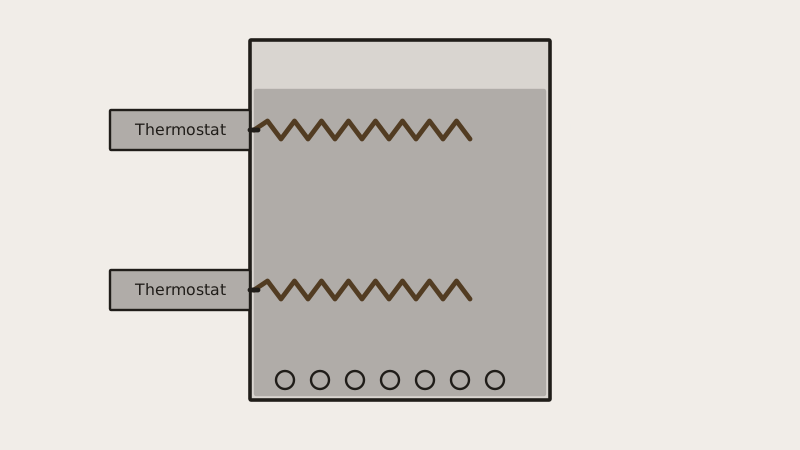
Most tanks have two elements, one high and one low, each with its own thermostat. When only the lower one dies, a small amount of hot water arrives and vanishes fast. If the upper one dies, the lower cannot take over and you get very little or no hot water. Replacing an element or thermostat costs far less than a new tank, and the individual jobs are covered in heating element replacement and thermostat replacement. Live-wire testing is why we send a local plumber for it.
Can hard water or sediment cause an electric heater to stop working?
Yes. Minerals drop to the bottom of the tank and crust over the lower element, which then overheats and burns out. Pasadena's municipal utility measured hardness from 202 to 256 ppm in 2025, around 13 grains per gallon, so scale is a believable cause locally. Rumbling or popping while the water heats is the classic sign.
A yearly flush slows the buildup, and a fresh anode rod helps too, as anode rod replacement explains. A tank with several inches of sediment and a failed element is often on its last legs, and replacing the element may buy only a short extension. On a heater older than 10 to 12 years, a new unit may be the smarter spend. How often a water heater needs replacing helps you decide, and the price of water heater replacement puts a number on it.
At what point should I hand this to a plumber?
As soon as a breaker will not stay on, the reset button keeps tripping, water collects around the tank, something smells burnt, or live wiring makes you uneasy. An old heater is another trigger, since parts are only part of the story.
Leaks are a reason to move fast. Kill the breaker, close the cold valve above the tank, and keep everyone out of standing water near electrical equipment. Renters with shared heaters may need the landlord to act; see apartment building with no hot water. For testing elements, replacing parts or swapping the tank, we line up a local plumber, and a request begins on the quote page. California law also requires new and replacement water heaters to be strapped, so a replacement should include that.
Common questions
How long will the fix take?
Checking the breaker and the reset button takes minutes. A new element or thermostat generally means an hour or two, which includes draining part of the tank. A whole heater swap runs a few hours or more. Ask for an arrival window when booking.
What should I raise with the plumber before approving the work?
Search the contractor license number on the state license board site. Learn whether the visit price covers testing and parts, how the plumber reads the age of your tank, and what a full replacement would cost, so repair and swap can be weighed side by side.
Does an adult have to be around during the visit?
Ideally yes. Someone has to make the heater reachable, point out the breaker panel and approve any parts purchase on the spot. A heater in a garage or closet should have a clear path to it before the plumber arrives.
Is it safe to flush an electric heater with no hot water?
Only with the power off. Shut the breaker, close the cold valve, then open a hot tap so the tank can drain. The breaker stays off until the tank is full again, because dry elements burn out quickly. Unsure? A plumber can do it.
For the wider picture, start with plumber in Pasadena.
Sources
Page updated