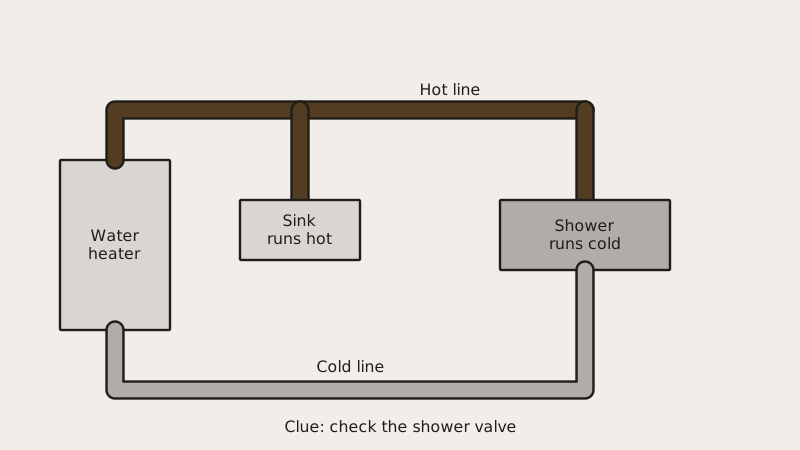
Open the hot faucet at any sink in the house and wait a minute. Cold there too? Then the water heater quit heating, emptied itself, or lost its fuel or power. Hot at the sink but cold in the shower? Then the trouble is in the shower valve, its cartridge, or a mixing fitting inside the wall. Those are two different repairs with two different bills, which is why the sink test comes first. Everything below follows from that result.
Is the heater to blame or is it the shower itself?
One or the other. A sink that is also cold blames the heater: lost power, no gas or pilot, a tripped breaker, a dead element or thermostat, or a drained tank. A sink that is hot while the shower is cold blames the shower's cartridge, its mixing valve, or else a limit stop that was set wrong.
Further clues help. If the shower starts warm and goes cold after a few minutes, the tank is simply too small for the demand, or sediment and a broken dip tube have cut its real capacity. Hot water that takes forever to show up suggests distance: many older Pasadena houses keep the heater in the garage with the bathroom a long pipe run away. Water that is hot but feeble is a pressure or scale issue, covered in weak hot water pressure.
What can I safely look at on the heater?
Electric tank: the breaker, plus the little red reset switch under the thermostat panel. Gas tank: whether the pilot flame is on and the gas control knob is set to on. Tankless: any error code on its display. Leave gas fittings and electrical panels closed, since opening them is a job for a trade.
On the electric side, a dedicated breaker may have tripped. Tanks carry an upper and a lower element, and a dead lower one leaves you a thin supply while a dead upper one leaves none. More detail sits in the piece on electric heaters that give no hot water and thermostat replacement. On the gas side, a pilot flame that has gone out is the classic cause. A lit pilot with cold water usually means a worn thermocouple or gas valve, which the pilot-lit guide explains. Smell gas, and the first move is out of the house; phone SoCalGas from a safe distance, and use 911 if a person is at risk. The heater's label gives relighting steps, but stop the moment the flame will not hold.
What explains a cold shower with hot sinks?
That puts the shower valve in the frame. A worn cartridge, a stuck balancing spool, a clogged mixing valve, or else a limit stop turned too far toward cold can each hold back hot water. The valve can be repaired, typically with a new cartridge, and the heater is fine.
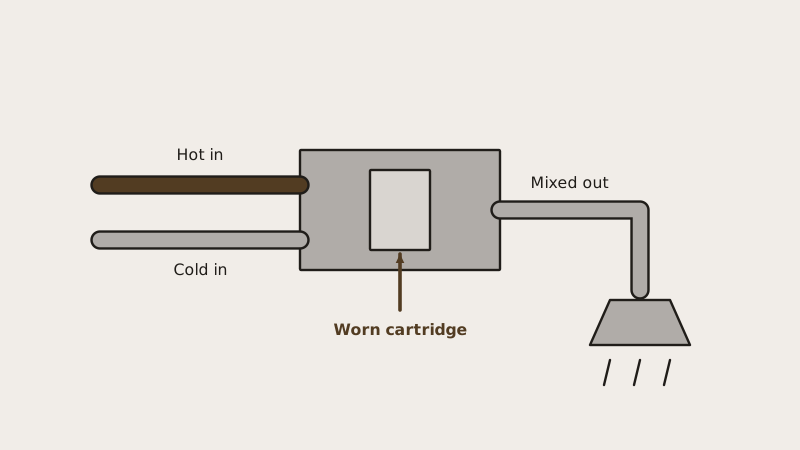
A single-handle valve hides its cartridge behind the handle and trim plate. Mineral scale jams it and furs up the tiny ports hot water passes through, and scale is a fact of life here: the city utility's 2025 water report puts hardness between 202 and 256 ppm. Many valves also contain a rotating limit stop beneath the handle that caps the hot side as scald protection. If the handle will not turn fully toward hot, the stop may have been set low during an earlier repair. A cartridge fitted backward, or supply lines swapped at the fixture, makes the handle read the opposite way. Opening a tiled wall, or sourcing a cartridge for a brand with proprietary parts, is plumber work.
What if the shower starts hot and fades to cold?
The tank holds less usable hot water than the shower is drawing. In a busy house, a 30 or 40 gallon tank can empty during a single long shower, and sediment, a worn dip tube or a weak lower element shortens it. A tankless heater never empties but can hit its flow limit.
A cracked dip tube is a sneaky cause. It lets cold supply water spill out high inside the tank instead of the bottom, so it blends with the hot and the shower turns lukewarm quickly; see dip tube replacement. Flushing the tank twice a year clears sediment, and in hard water a fresh anode rod helps. A tank that is plainly too small for the household is the topic of tank versus tankless. One more quirk: tankless units need a minimum flow before they fire, so an ultra-low-flow showerhead can leave the water cold.
Could the thermostat setting be the reason?
Possibly. A low setting gives lukewarm showers, but turning the dial up brings a scald risk. The federal Consumer Product Safety Commission recommends 120 degrees Fahrenheit and says water at 140 can burn within about six seconds, so stay near 120 unless a mixing valve is fitted.
In its tap water scald publication the CPSC lists 130 degrees as a burn within thirty seconds and says even 120 can cause serious burns after roughly five minutes, which matters most for young children and older people. If the dial has to move, nudge it in small steps and test at the tap. Thermostatic mixing and anti-scald valves let the tank run hotter while the outlet stays safe, and a plumber can fit one. Never bypass the heater's high-limit switch or relief valve to chase more heat.
When is it time to book a plumber?
Pick up the phone when the sink test points to a heater fault involving gas, a leak or the relief valve, when a failed element is beyond your comfort, or when the shower valve sits behind tile. A plumber can also judge whether an aging heater deserves repair. We send local plumbers across Pasadena and the San Gabriel Valley.
Water on the floor, a rusty tank base, a relief valve that discharges, or a heater past ten to fifteen years old with a second fault are all reasons to book rather than experiment. The water heater repair page weighs repair against replacement and lists the permit rules, and the guide to losing hot water everywhere covers the wider case. Booking starts at the quote form: note whether one shower or the whole house is cold, which fuel the heater uses or whether it is tankless, and what you have tried so far. Check your city on where we work; the home page lists other services.
Common questions
Sink hot, shower cold: what does that mean?
A hot sink clears the heater, which leaves the shower: a worn or clogged cartridge, a pressure-balancing valve, a limit stop turned too far, or swapped supply lines after a past repair. A new cartridge is the commonest cure, and a plumber can match the part to your valve brand.
Why does hot water take so long to reach the shower?
Long pipe runs keep a column of cold water that must be pushed out first, which is typical when the heater sits in the garage or in a far corner of the building. A scaled-up shower valve slows hot flow too. A recirculation pump or a relocated heater is something a plumber can price.
Does hard water play a role?
Indirectly, yes. Scale narrows pipes, clogs cartridges and valve ports, and coats elements and tank bottoms, which cuts the hot water you can actually use. Pasadena's supply is hard, ranging from 202 to 256 ppm in the utility's 2025 report, so servicing valves and flushing the tank both help.
May I turn the heater dial higher?
Only slightly, and with care. The CPSC advises 120 degrees Fahrenheit since hotter water burns quickly, above all for children and older adults. If you want hotter storage, ask a plumber about a mixing or anti-scald valve so the tap stays at a safe temperature.
Sources
Page updated