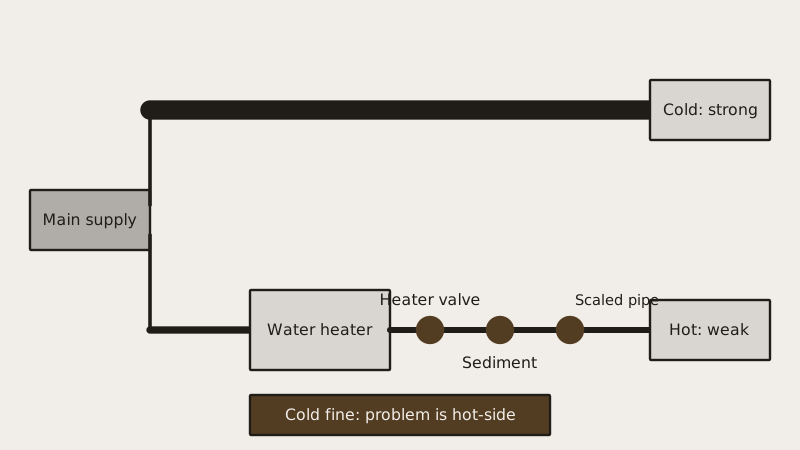
A weak hot tap beside a healthy cold one means the trouble lies at the heater or beyond it: a half-shut valve, sediment or scale clogging the tank outlet and fittings, or aging galvanized pipe that has closed up inside. When both taps are weak, look back toward the house pressure or the main valve. Do the cheap checks first, then book water heater repair or a plumber for the pipes. For the bigger heater picture, see water heater replacement.
Two local factors matter here: Pasadena water averages around 13 grains of hardness, and a lot of the housing stock dates from the early to mid 1900s with pipe to match. Each can starve a hot tap, so rule them in or out before spending anything.
Is the weakness on the hot side only, or everywhere?
Test it with a cold tap and a hot tap at one sink, then repeat at another sink and in a shower. Strong cold with weak hot everywhere places the fault in the heater or the hot lines. One weak fixture means the fault is local to it. Weakness everywhere sends you to the main shutoff, a regulator or the supply.
A quick sorting table:
| What you see | Likely area |
|---|---|
| Hot weak at every tap, cold fine | Water heater, its valves, or the hot main line |
| Hot and cold weak at one tap | Aerator, cartridge or the supply stop at that fixture |
| Everything weak, house-wide | Main shutoff, regulator or supply pressure |
| Hot weak only at upstairs fixtures | Scaled or narrowed pipe, or demand outrunning supply |
A screw-on gauge from a hardware store, fitted to an outdoor hose bib, reads actual pressure. Eighty psi is the ceiling in the plumbing code: above that a regulator is called for. A reading far under what the house normally has suggests a supply problem.
Which quick checks come first?
Open the valve above the heater all the way, clean the aerators and check the fixture stops. The supply valve above a heater is surprisingly often left half-closed after some earlier job, and that throttles hot water alone. A ball valve is open when its handle lies along the pipe. A gate valve that will not budge should be replaced.
The order that wastes the least effort:
- The valve above the heater. Wide open: lever along the pipe for a ball valve, wheel turned fully left for a gate valve.
- The aerator. Unscrew the tip, rinse out grit, soak it in vinegar. A clogged aerator reduces hot and cold alike at that tap, so it seldom explains a hot-only complaint.
- The stop valve under the sink. Check that it is fully open.
- Any mixing valve. A failing shower valve can starve one side.
- Heater age and flushing, covered next.
Can sediment and hard water make hot water pressure drop?
Yes. Minerals from hard water drop out as sediment in the tank and can block the outlet, and because heat makes minerals precipitate, scale narrows fittings and pipes on the hot side first. In 2025 Pasadena Water and Power recorded hardness from 202 to 256 ppm, near 13 grains per gallon, and says hardness builds up inside water heaters.
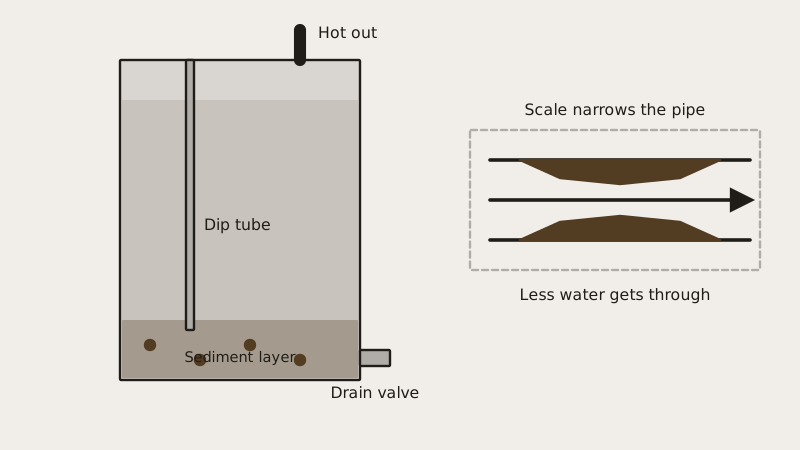
Rheem advises a yearly flush for most households and one every six months in hard water, which describes Pasadena. In its instructions you switch off power or gas and close the cold supply, run a hose from the drain valve to a safe spot, open the relief valve and then the drain, let the tank empty, then close everything, refill and only then restore power.
Two cautions. Stirring up an old tank can free scale that lodges elsewhere, and an aged drain valve may refuse to close again. Rheem names a drain valve that will not open or that leaks, heavy rust at the fittings and a heater of roughly 8 to 12 years or older as reasons to leave it to a professional.
Could old galvanized pipe be the reason?
Yes, and it is the textbook problem of older houses. Galvanized steel supply pipe pits and scales on its inner wall over decades, the bore shrinks, and flow falls, hot lines first because heat speeds the buildup. A house from the early or middle 1900s that was never repiped may still carry galvanized or very old copper.
Clues that point to the pipe, not the heater:
- Pressure has fallen slowly over years, not overnight.
- Hot water comes out rust-colored when first run.
- The flow improves a little after the lines have run a while.
- Fixtures farthest from the heater are worst.
Choked pipe has no cheap cure: the section is replaced, or the house is repiped. Our pages on why repiping makes sense in Pasadena and what repiping costs lay out the choice, and PEX against copper helps with material. Only an inspection shows how much of the line is hit.
What if both hot and cold pressure are low?
Then the heater is off the hook. Examine the main shutoff at the meter, where the line enters the house, the pressure regulator if there is one, and whether neighbors share the problem. A regulator that has gone bad can sag the pressure everywhere. Our guides on adjusting a water pressure regulator valve and where the regulator sits help you find it.
If the entire block is weak, ask the utility. Pasadena Water and Power customer service is listed at (626) 744-4005. Water pressure depends on your property's elevation and the system's zone, so hillside homes can see different numbers from those on the flats. A broader checklist is in why water pressure runs low in Pasadena.
Do tankless and electric heaters have the same problem?
Tankless units do not collect sediment the same way, but scale builds on their heat exchangers and inlet screens, and the flow drops. Rheem says tankless units need descaling instead of flushing, and Noritz recommends annual flushing and descaling and regular cleaning of inlet filters. A scaled unit may also throw a code. See our pages on tankless repair for Rheem and Noritz.
Who should take over, and when?
When a flush and a valve check fail to bring flow back, when rust or scale shows in the water, when the house is old and unrepiped, or when draining a gas or high-amp tank worries you. Pipe, valve and heater replacements need the right permit in Pasadena. The quote form gets a visit started, and our home page shows what else we handle.
Pasadena's exemption list covers clearing stoppages and repairing leaks in pipes, valves or fixtures only when none of them is replaced or rearranged. New concealed pipe counts as new work and needs a permit. Phone the Permit Center to check before work begins.
Common questions
How long will this take?
Checking a valve or cleaning an aerator is a matter of minutes. A tank flush runs an hour or two, mostly spent waiting for the drain and refill. A mixing valve or a stretch of pipe means a longer visit, and repiping a whole house runs for days. A firmer estimate comes after diagnosis.
What goes in the quote?
The contractor's license number, how the cause will be found, whether a pressure test is part of the price, and whether pipe work will bring a permit and wall patching. If someone proposes repiping, ask what evidence backs it, such as a cut-out section.
Does weak hot pressure mean the heater is dying?
Occasionally. Sediment, rusty water and rumbling noises together hint at a tired tank, and Rheem puts 8 to 12 years as the age to seek a professional view. A low-pressure complaint on its own is more often a valve, scale or pipe issue.
Will walls have to be opened?
Only if the fault is inside a wall. Valve, aerator and flushing fixes need no demolition, while replacing buried pipe can mean small openings in drywall or plaster that are patched afterward. The plumber should say so in the quote.
Sources
- Rheem, how often to flush your water heater
- Pasadena Water and Power, 2026 Annual Drinking Water Quality Report (2025 hardness)
- Pasadena Water and Power, water quality FAQs
- IAPMO, Uniform Plumbing Code chapter 6, water supply and distribution
- City of Pasadena Building and Safety Division, work exempt from permit
Page updated