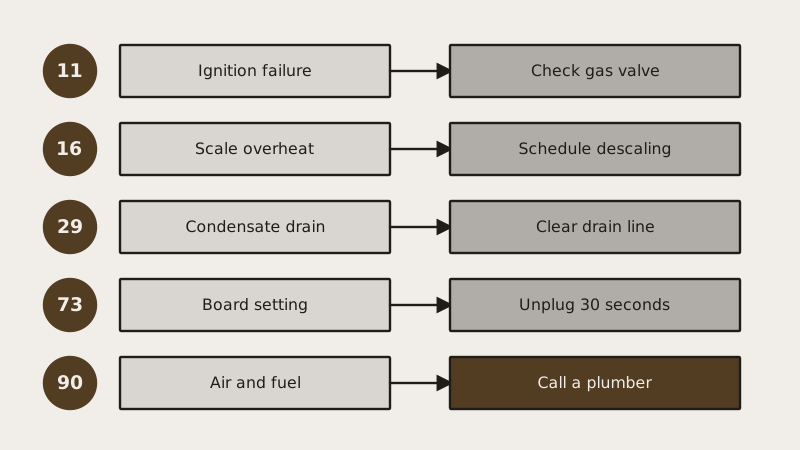
Noritz's own pages explain five common codes. Code 11 means the burner did not ignite. Code 16 points to scale in the heat exchanger. Code 29 is a condensate drain problem. Code 73 means the circuit board settings were changed. Code 90 flags a combustion abnormality. Each has a first step an owner can take, and most need a plumber after that, because water heater repair on a gas tankless unit involves gas, venting and electronics. For a wider view of heaters, see our water heater replacement guide.
Pasadena Pipe Works arranges local plumbers across Pasadena and the San Gabriel Valley. Because Noritz recommends a trained contractor for these codes, the page is mostly about knowing what you can safely do first, and what to tell the plumber.
What do the common Noritz error codes mean?
Noritz lists code 11 as ignition failure, 16 as overheat from scale, 29 as a condensate drainage problem, 73 as improper circuit board settings and 90 as a combustion abnormality. Your unit's manual has the full list for your model, and codes can differ by series. Note the code before you reset, since the same one returning tells a plumber more than a cleared screen.
| Code | What Noritz says it means | First step |
|---|---|---|
| 11 | Ignition failure: the heater cannot light, so no water is heated | Confirm the gas is on and the gas valve is open |
| 16 | Scale buildup reduces heat transfer, so the heater burns hotter | Schedule descaling |
| 29 | Blocked condensate drain or improper drain piping can flood the burner | Clear debris from the condensate container and drain line |
| 73 | A jumper or dip switch was changed while powered, or the board is misprogrammed | Unplug for 30 seconds, then plug back in |
| 90 | Improper air and fuel mixture: low gas, a blocked vent, or debris in the fan motor | Call a plumber right away |
Noritz strongly recommends that a plumbing and heating contractor handle these codes, even those with simple fixes, and says to contact one if a code persists after a reset, if you suspect a gas supply problem, if there are vent problems, if there is a leak or if the unit shuts down repeatedly.
What should I try before calling anyone?
Confirm gas, power and water, write down the code, reset the unit once as the manual allows, and look for anything obvious: a closed gas valve, an unplugged cord, a blocked outdoor vent termination or a full condensate container. Do not open the unit, change dip switches or touch gas fittings. If the code comes back, stop and book a visit.
A short, safe sequence:
- Gas. Is the gas valve to the heater open? If another gas appliance works, the supply is likely fine.
- Power. Check the cord and breaker. Noritz recommends resetting and checking supplies for any code.
- Water. Open a hot tap fully and check the inlet filter for debris. Noritz advises cleaning inlet water filters regularly.
- Vent. Look at the outdoor vent termination for nests, leaves or anything blocking it, without climbing anywhere unsafe.
- Condensate. If the unit has a condensate container or drain, look for debris. Noritz says the drain line should have no flat runs or 90-degree elbows.
- One reset. If the code returns, that signals an underlying problem.
A gas smell cancels everything else: no resets, no inspection. Leave the building, then call 1-800-427-2200 to speak to SoCalGas.
Why does scale cause code 16, and what does Pasadena water have to do with it?
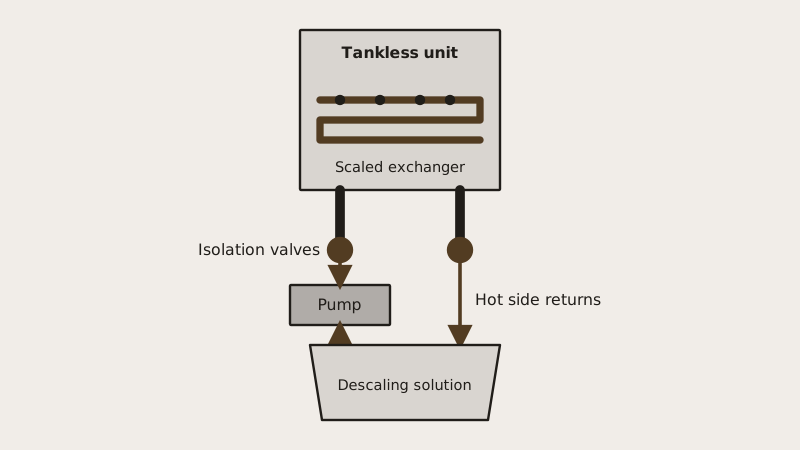
Scale on the heat exchanger acts like insulation, so the heater has to burn hotter to deliver the same temperature, which triggers the overheat warning. In 2025 Pasadena Water and Power measured hardness from 202 to 256 ppm, around 13 grains per gallon, and says hardness builds up in water heaters. Noritz recommends annual descaling or a water softener.
Practical points for a Pasadena owner:
- Descale yearly, or as your manual says. Noritz says to flush and descale annually.
- Isolation valves make descaling possible without cutting pipe. A plumber can fit them if your unit lacks them.
- A softener helps. Noritz names a water softener as a preventive option for code 16. The choices are laid out under water softener installation, and hard water scale removal covers fixtures.
- Clean the inlet filter at the same time.
Scale also wears out tank heaters sooner, a point worth weighing in tank against tankless water heaters in Pasadena.
What explains cold or lukewarm water from a Noritz?
No hot water often goes with code 11 or an interrupted supply: gas, power, a closed inlet or a blocked vent. Lukewarm water suggests scale, a clogged filter, a very low flow or demand beyond the unit's capacity. Cold water at only one fixture points to that fixture's valve or cartridge, not the heater.
How to tell them apart:
- Nothing at any tap, a code on the display: follow the code table, then call.
- Nothing at any tap, a blank display: check the power and the breaker.
- Lukewarm everywhere: descaling, filter and flow check.
- Hot, then cold, then hot: low flow may not hold ignition, or a sensor is failing.
- One tap only: go to showers that never get hot.
What does Pasadena require when a tankless heater is repaired or replaced?
A repair that does not alter the gas, vent or electrical connections usually does not change the installation, but replacing a unit does. Pasadena's Building and Safety Division says tankless installs must follow the California Plumbing and Mechanical Codes, keep the maker's instructions and listed vent system on site, and provide gas line sizing calculations. Simple permits can often be issued over the counter.
From the city's tankless handout:
- Gas line. A dedicated line capable of at least 200,000 BTU per hour is typical, and the existing house piping may need resizing. New or altered gas piping is pressure tested.
- Venting. Most tankless units use positive-pressure vents, usually stainless steel, not Type B vent.
- Condensate. Drains terminate as the code and the maker require.
- Combustion air. Openings must be sized to code, and garage installs typically need openings to the exterior.
- Electrical. Some units need a 120-volt receptacle, and new electrical work needs a permit.
Whoever does the work under a California contractor license pulls the permit. Elsewhere in the valley, separate building departments apply, as where we work notes.
When should I book a plumber for a Noritz heater?
Book a visit when 11, 29, 73 or 90 comes back after a reset, when 16 appears and descaling is overdue, when gas or exhaust can be smelled, when water leaks, or when the unit keeps shutting off. Noritz notes that frequent codes, repeated repairs or an aging unit can make replacement the better value. Use our quote form to arrange a visit.
Other brands have their own pages: Navien, Rinnai and Rheem tankless repair.
Common questions
How much of my day will a Noritz repair take?
A condensate drain clear-out or a reset after a power fault is brief. Descaling tends to occupy an hour or two. A fresh igniter, sensor, fan or circuit board runs longer, especially on back-order. The plumber estimates after reading the code and inspecting the unit.
What do I confirm before hiring for Noritz work?
Obtain the license number the contractor works under and search the board's database. Confirm Noritz experience, whether diagnosis and descaling are in the price, where parts come from and whether a permit applies. Get the price on paper. Noritz also runs a contractor finder on its site.
Can I reset a Noritz tankless heater myself?
Noritz says to record the code, check the manual, verify gas, power and water supplies, and reset if appropriate. One reset is fine. If the code returns, it likely signals an underlying problem, and repeated resets on a gas appliance are not wise. For code 73, the maker suggests unplugging for 30 seconds.
Does Noritz code 16 mean I need a new heater?
Not necessarily. Noritz describes code 16 as scale reducing heat transfer, with descaling as the fix. A plumber can descale the heat exchanger and check the flow. If the unit keeps overheating after descaling, or is old, the plumber can compare repair and replacement costs.
Sources
Page updated