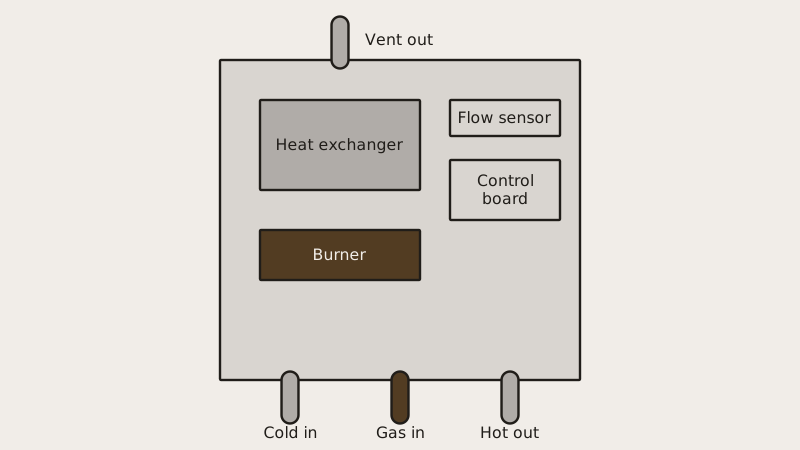
When a Rinnai tankless heater fails, the display shows a number. Codes 10, 11 and 12 point to air supply, ignition and flame problems, 14 and 16 to overheating, and LC to scale in the heat exchanger. Some resets are safe, but repeated resetting is not. Your model's manual is the final word, since codes differ between series. For the bigger repair-or-replace picture, see water heater replacement, or request a visit through the quote form.
Which Rinnai codes show up most, and what do they say?
The codes you meet most often are 11 (the burner failed to ignite), 12 (the flame went out), 10 (blocked air supply or exhaust), 14 and 16 (overheating), 79 (a water leak inside the unit) and LC (scale buildup). Meanings can vary between models, and the manual for your series has the full list.
| Code | What it usually means | Your first step |
|---|---|---|
| 10 | Air or exhaust blockage | Do not keep resetting; call the same day |
| 11 | Ignition failed | Confirm gas valves are open, check other gas appliances |
| 12 | Flame lost while running | Note when it happens; a plumber tests gas pressure |
| 14, 16 | Overheat or over-temperature | Do not bypass; often scale or low flow |
| 79 | Water leak inside the unit | Close the water to the unit and call |
| LC | Scale in the heat exchanger | Book a descaling flush soon |
These summaries come from published plumber guides, not from Rinnai, and one code, 99, is described differently by different guides, so check your manual. A code that comes back after one reset points to a real fault. The exception is a gas smell, which sends you out the door. From the yard, SoCalGas answers at 1-800-427-2200, and 911 covers real danger.
Why does my Rinnai show no hot water or a cold-water sandwich?
Three usual reasons: the unit lost gas or power, a code has locked it out, or scale and a clogged inlet filter have cut flow below the level that triggers the burner. A tankless heater fires only above a minimum flow rate, and a partly blocked filter or aerator can pull you below it.
Check what is cheap first. Start with power: is the breaker on, is the display lit? Then gas: is the shut-off open, and does the stove still light? Finally, the cold inlet should be wide open. Clean the inlet filter and the faucet aerators, since both collect grit and scale. A cold-water sandwich, where hot water turns cold for a few seconds mid-shower, can also be a sign of low flow or a fault, but a short pause between short uses is normal with some units. If the display is dark and the breaker is fine, the unit has no power, and that is a plumber's check. Wider causes appear in reasons the hot water is missing.
Is hard water the reason my Rinnai keeps failing?
Often. Pasadena Water and Power measured hardness at 202 to 256 parts per million for 2025, and the calcium and magnesium that make water hard bake onto the heat exchanger as scale. The scale narrows the passages, raises temperatures and triggers LC, 14 or 16 codes. Regular descaling is the main defense.
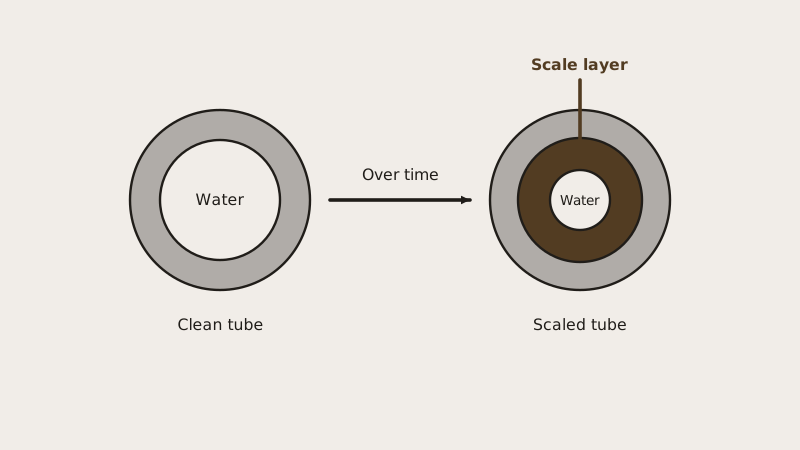
Published guidance for hard-water areas is a descaling flush about every six to twelve months, with isolation valves installed so the job takes under an hour. Your manual states Rinnai's own schedule. A softener or scale-prevention cartridge before the heater lowers the load, and softener installation covers that. For scale elsewhere in the house, see hard water scale removal. Department of Energy figures say most tankless heaters should last over 20 years, and descaling is how they get there.
Which repairs can I try, and which are a plumber's job?
Safe owner tasks are limited: resetting once, checking breaker and gas valves, cleaning the inlet filter and aerators, and clearing a blocked air intake that you can see. Anything involving gas, the burner, the flame rod, the vent, the heat exchanger or the control board should go to a plumber. Rinnai itself says professional installation is highly recommended.
The reasoning is simple. A flame rod or igniter lives next to the gas train. A vent fault can push carbon monoxide into the house. Scale flushing involves a pump, hoses and valve positions that, if wrong, flood the unit or the floor. Licensing law steps in at $1,000 across labor and parts. Past it, the work is for a California license holder, and many tankless repairs get there once parts are added. When we arrange the visit, the plumber who comes out diagnoses the fault from the codes and puts a written quote in your hands before replacing anything.
What does a Rinnai tankless repair cost?
Published guides put the national average tankless repair at about $600. A professional descaling flush runs $150 to $350, sensor replacements $150 to $400, and a heat exchanger repair or replacement $500 to $1,300. A new tankless heater installed costs $2,500 to $4,500 nationally and more in California. Treat these as a guide, with the real price in the quote.
Most figures are for tankless heaters generally, not Rinnai alone, and Southern California labor sits above the national average. Once a repair nears what a new heater costs, replacement deserves thought, particularly for a unit scaled up for years. If you are weighing a new one, the pages on tank versus tankless and Rinnai installation can help. Other brands have their own repair pages, such as Navien tankless repair and Noritz tankless repair.
Common questions
What does the repair do to my schedule?
A descaling flush keeps the plumber busy for an hour or two. Swapping a sensor, igniter or flame rod takes a similar stretch after diagnosis. A part on order turns it into two visits. Time on site also covers testing gas pressure and checking the vent.
Can I reset a Rinnai tankless heater myself?
Once, yes, by switching it off and on at the unit or breaker. If the same code returns, stop. Repeated resets on codes 10, 14, 16 or 79 can mask a safety problem, such as a blocked vent or an overheating heat exchanger. Close the gas or call a plumber instead.
What descaling schedule suits Pasadena water?
Rinnai's manual sets the interval. Published guidance for hard water suggests roughly every six to twelve months, and Pasadena's water is hard. If the display shows LC or a maintenance code, do not wait. A plumber can also check that the unit has service valves, which make flushing quicker and cheaper.
Should an aging Rinnai be repaired or retired?
Often repair wins, because tankless units are built for long life with replaceable parts, and the Department of Energy cites more than 20 years. A badly scaled or cracked heat exchanger, or a repair that rivals a new unit's price, shifts the math. Ask the plumber to quote both.
Am I required to be present for the repair?
Ideally yes, to let the plumber in, approve the work and watch the test run. It may hang in the garage, a closet or outdoors, so clear a path to it. Hot water goes off mid-visit, so schedule showers and laundry around it.
Further services are on the Pasadena Pipe Works home page.
Sources
- Rinnai, tankless water heaters (professional installation recommended)
- U.S. Department of Energy, tankless or demand-type water heaters
- Pasadena Water and Power, 2026 annual drinking water quality report
- SoCalGas, emergency information
- Rinnai error code summaries from published plumber guides, checked November 2026; your model's manual governs
- Angi, tankless water heater repair cost
- HomeGuide, tankless water heater maintenance cost
Page updated