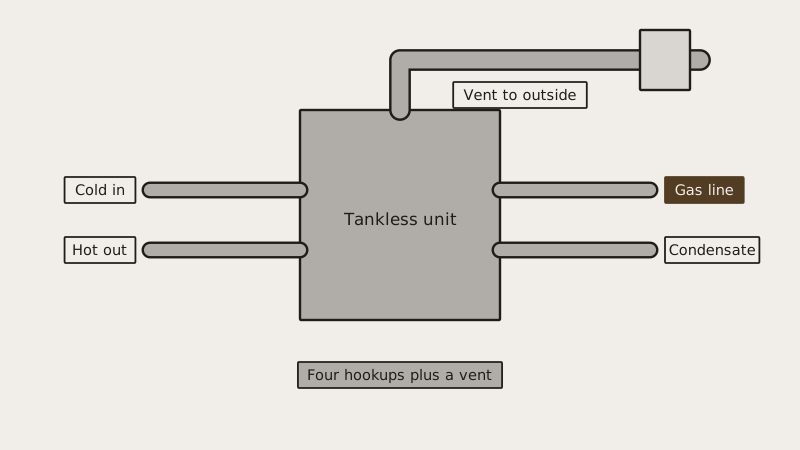
Before anyone prices a Rinnai installation, three things decide the job: whether the existing gas line can feed a unit that burns up to 199,000 BTU, whether there is a legal path for the vent and the condensate, and whether the wall can take it. The Rinnai RU199iN, a common residential model, modulates between 15,000 and 199,000 BTU on a 3/4 inch gas connection. A tank it replaces burns far less, so the pipe is often the surprise.
Our broader page on water heater replacement explains the choice between types. This page is for the person who has settled on Rinnai and wants to read a quote intelligently.
What does a Rinnai tankless installation involve?
The old heater comes out, the Rinnai goes on the wall with isolation valves on its water connections, and a gas pipe sized to the unit follows. Then the vent is built, the condensate piped, power wired for the electronics, and the whole job permitted and inspected. Gas piping, venting and the wall take most of the labor, not the unit.
Rinnai's own manuals set the framework. The manuals list required clearances around the unit, and condensing models carry a 1/2 inch condensate connection. The company's documents are the reference, and the installer follows the manual for your model.
The sequence, roughly:
- Close the water, gas and power, drain the old tank and haul it away.
- Mount the bracket and unit, and fit service valves so the heat exchanger can be flushed later.
- Run or upsize the gas line, adding the shutoff and sediment trap that the manual and code demand.
- Install the vent and combustion air path for the model.
- Pipe the condensate to a legal drain, and add a neutralizer if required.
- Connect electrical power and test.
- Get the permit inspected, then program and demonstrate the controls.
Which Rinnai model do I need?
Match the model to your hot water demand and your gas supply. Rinnai's residential range includes condensing models such as the RU199iN and the RX160iN, which tops out at 160,000 BTU. Higher BTU means more hot water at once, but it also means a bigger gas line. A plumber sizes the unit from the number of fixtures running together and the incoming water temperature.
Models differ in details that matter for installation. Some are rated for indoor mounting, and some models can go indoors or outdoors, depending on the series. Some support recirculation, and the RUR series has a built-in pump. Ask whether you want a recirculation setup, because the plumbing is different.
Rinnai lists its condensing units as as ultra-low NOx and approved by the regional air district; the district's full name is the South Coast AQMD, and Pasadena sits inside it. Confirm the exact model is approved for sale and use here, using the maker's literature.
Is my gas line big enough for a Rinnai?
Often no, if the house had a standard tank. Rinnai's guidance says to add up the BTU input of every gas appliance on the line, divide by the gas heating value from the utility, and use the pipe sizing tables for your pipe type and run length. A 3/4 inch connection on the unit doesn't mean a 3/4 inch pipe is enough all the way back to the meter.
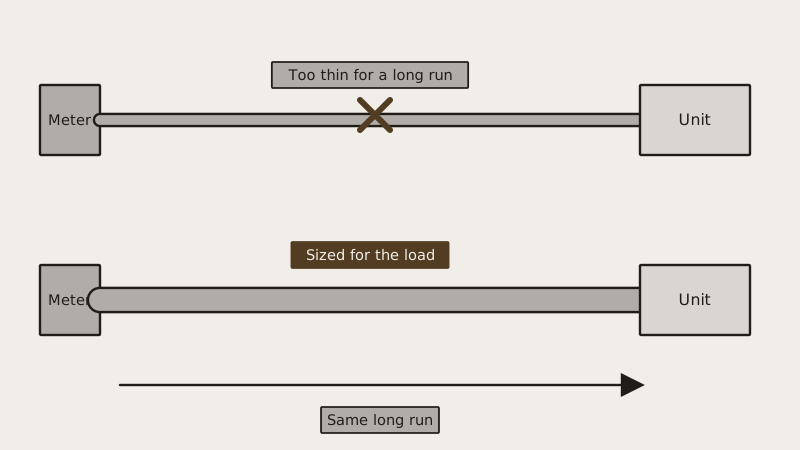
A long run or an older line with a furnace, range and dryer on it may need upsizing. Changing gas pipe is regulated work, limited under California rules to a contractor with a license. Our page on natural gas pipe explains the materials and rules. Smelling gas means leaving first; SoCalGas answers at 1-800-427-2200 once you are outside.
Some older Pasadena houses have crowded utility closets and tight garage corners, which can make the clearances and the vent route the real limit. A plumber should walk the route before quoting, not guess from a photo.
How is a Rinnai vented, and where does the condensate go?
Condensing Rinnai models vent through PVC or CPVC, in concentric or two-pipe configurations, out a wall or up through the roof, depending on the model. A condensate line, 1/2 inch, carries mildly acidic water to a drain, and many installs add a neutralizer. The vent path is a code matter, so it is measured and approved with the permit, not improvised.
Rinnai's installation manual lists vent options for its residential series: concentric or Schedule 40 PVC or CPVC, direct vent, room-air models and common venting under specific conditions. It also says the condensate pipe must be corrosion-resistant, as long as the unit's connection, and arranged so condensate cannot drain back into the heater. A condensate neutralizer kit is available from Rinnai.
Because the old tank's flue is usually the wrong type and size, expect a new vent. That affects cost and where the unit can go, so it is worth settling first.
What permits and rules apply in Pasadena?
The City of Pasadena requires a plumbing permit whenever a water heater is replaced, and its Building and Safety Division reviews the location. The inspection covers items such as the relief valve discharge, venting and combustion air. The contractor files the permit, and gas and venting work goes to a contractor whose license is current.
Other rules in play: the air district's low-NOx limits for gas units, California's energy code for water heating, and the building code's clearance and ventilation rules. We have not verified the exact energy code requirements for a Rinnai in a specific house, so ask the plumber what documentation the city expects. State law has tank heaters strapped for earthquakes, while a wall-hung tankless heater is secured by its own mounting; the inspector decides what applies.
Heavy units on a wall are another question for a pro: the framing needs to carry it. And Rinnai's manual includes the California Proposition 65 notice, which is a labeling requirement, not an installation rule.
What does a Rinnai tankless installation cost?
National guides put gas tankless installs at roughly $2,100 to $5,600 overall, about $2,100 to $4,500 when the existing line and vent can be reused, and $3,000 and beyond for a first-time conversion that needs gas pipe, venting and wall work. Those are guides. The unit price and the Pasadena permit are on top of, or inside, the quote.
What moves your number: the model, the gas pipe length and size, the vent route, a condensate drain, whether an electrical outlet exists, whether a recirculation line is wanted, and the work to remove the old tank. Full ranges sit in tankless installation cost, and tank versus tankless compares the economics.
Ask for a written quote itemizing the model, gas work, vent, condensate, permit and old-tank removal. If one quote lacks a permit line, ask why.
How do I look after a Rinnai in hard water?
Plan to flush the heat exchanger. Pasadena Water and Power describes the city's water as very hard, averaging around 12.9 grains per gallon on its FAQ page, and scale builds inside tankless heat exchangers. Rinnai's manuals call for maintenance, and isolation valves installed at the start make a flush quick. Ask the plumber what interval your model's manual lists.
Error codes, a clogged inlet filter and venting faults are the usual service calls. When it needs work, see Rinnai tankless repair. A softener upstream reduces scale, which our page on softener installation explains. For a broader look at installers' work, read tankless installation service.
To get a visit with a written price, begin at the quote page. The home page shows what else we arrange across Pasadena and the San Gabriel Valley.
Common questions
How long should the Rinnai job last?
With a suitable gas line and vent, a swap can fill most of a day. A tank conversion, with new gas pipe, venting and wall work, may run longer, and the inspection adds a separate visit. We can't promise a duration before a plumber has seen the house, so ask for one in writing.
Does Rinnai set requirements for who installs it?
Check your model's warranty terms, because manufacturers often tie coverage to proper installation and sometimes to who installs. Separately, gas piping and any job over $1,000 fall to a contractor with a California license. Ask the plumber to show their license number and the warranty requirements before work starts.
Can I replace a tank heater with a Rinnai in the same spot?
Sometimes. The spot needs the clearances in the manual, a vent route, a drain for condensate, power, and room to service the unit. A tight closet may not work. Garages have rules about location and approval under Pasadena's water heater standard, so the plumber should check before pricing.
Is a Rinnai quieter or safer than a tank?
Tankless units have no tank to rupture, but they still burn gas and need correct venting, so safety depends on installation. Noise varies by model and location. Ask what the manual says about clearances and what the plumber has seen. Install a carbon monoxide alarm near any gas appliance regardless of type.
What size Rinnai do I need for a family home?
The answer turns on how many fixtures run together and how cold the incoming water is. A plumber estimates demand by counting showers, the kitchen and laundry in use together, then picks a model with enough flow at your temperature rise. Oversizing wastes money and undersizing leaves you with lukewarm water, so ask to see the calculation.
Sources
- Rinnai, RU199iN product page
- Rinnai, RX160iN product page
- Rinnai, direct vent tankless water heater installation and operation manual
- City of Pasadena Building and Safety Division, water heater standard
- HomeGuide, tankless water heater cost
- TidyBoss, tankless water heater cost
- Pasadena Water and Power, water quality FAQs
- Published installed-price guides for gas tankless water heaters, checked November 2026
Page updated