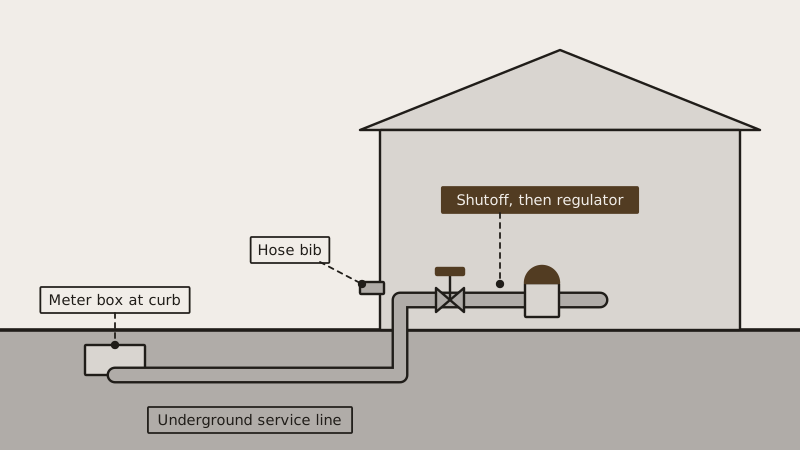
Go to the point where the main water line reaches your property and look for a squat brass fitting with a dome or bell shape, a threaded cap and a locknut on top. In many houses it sits close to the front hose bib, just past the main shutoff. In others it hides in a garage, basement or crawlspace. Some homes have none at all. The wider topic is on our water pressure and valves page.
Ahead: where regulators tend to hide in different Pasadena home types, what the fitting looks like, a quick pressure test, and what to try when you cannot find it.
Which spot should I check first?
The main line at the point it enters the house, immediately beyond the main shutoff, and often close to the front hose bib. Pasadena Water and Power gives customers the same pointer: look beside the front hose bib at the spot where the service line arrives. Garages, crawlspaces and utility closets are the next likeliest places.
By home type:
- House on a raised foundation. Often under the house near the front, where the line rises, or by the front hose bib outside.
- House on a slab. Beside the front hose bib, or in the garage at the supply entry, sometimes behind a small access panel.
- Hillside homes. Supply may enter low on a slope, so check any garage at street level and any ground box near the front.
- Condos and townhomes. One regulator may serve the whole building from a shared utility room, and the association may own it.
- Apartments. The landlord usually controls it.
Follow the pipe running from the street meter box to the house, from the curb toward the foundation. The first thing on it after the shutoff that resembles a squat brass bell is the regulator.
Not every property has one. Pasadena Water and Power's troubleshooting page covers the case where all outlets run weak and no regulator exists: if the front hose bib pressure is low too, contact the utility. That shows regulators are common but not universal.
What should the fitting look like?
Typically a brass valve shaped like a bell or dome, roughly fist-sized or bigger, with a threaded cap or adjusting screw on top held by a locknut. Water passes through in one direction, shown by an arrow cast into the body. Many carry a small strainer cap underneath or on the side.
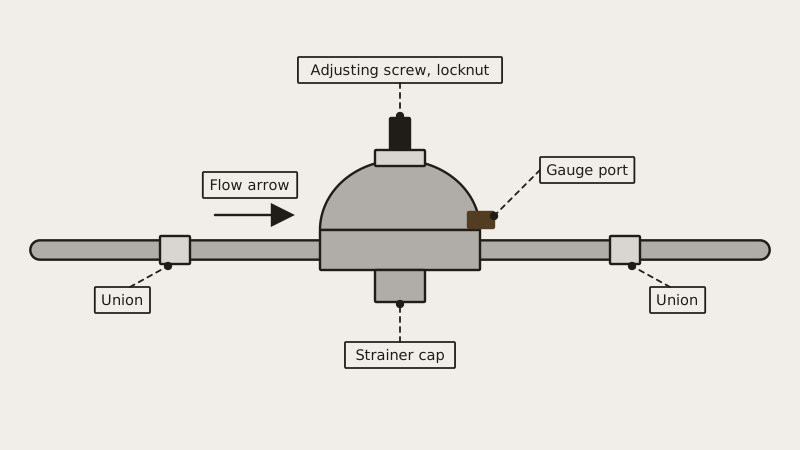
Features that confirm you found it:
- The adjusting screw and locknut. On top, usually a hex bolt or a capped screw.
- A flow arrow. Cast into the brass, pointing toward the house.
- A bell or dome shape. Wider in the middle than the pipe.
- Pipe unions or shutoffs on both sides. Some installs include them for easy replacement.
- A gauge port. Some have a small threaded port for a pressure gauge.
Several lookalikes cause mix-ups. The water heater's relief valve has a test lever and a discharge pipe. A backflow preventer is a larger assembly, usually on irrigation or a fire line. An expansion tank is a small tank, often on the cold line above a heater. The city's standard for gas water heaters calls for an expansion tank where valves or devices close off the system, so one near the heater hints that a regulator or check valve sits upstream.
Gas has its own regulator, and the one on the gas meter is SoCalGas equipment, unrelated to this topic. Never adjust it. On any gas odor, get out first, then report it from outside to SoCalGas, 1-800-427-2200.
How do I know it is doing its job?
Screw a pressure gauge onto an outdoor spigot, close every tap, and read the dial. Many plumbers like to see about 50 to 70 psi, and 80 psi is the usual ceiling in plumbing codes. A reading that climbs overnight, or sits far higher than expected, means the regulator is worn out or missing.
Do the test properly:
- Buy a gauge. A hose bib pressure gauge is inexpensive at a hardware store.
- Choose a clean bib. Use the outdoor bib closest to the main, and make sure no taps or appliances are running.
- Read it. Record the number. Check again in the evening, and the next morning.
- Compare. A reading that rises with no use, called creep, signals a worn valve seat. Readings below about 40 psi suggest weak flow or a failing valve.
Symptoms that fit a bad regulator include banging pipes, spitting faucets, a dripping water heater relief valve, running toilets and weak showers. Our water hammer guide and shower pressure page cover single-symptom cases.
A regulator's service life is commonly put at 10 to 15 years, though that is a rule of thumb. If yours is that old and pressure is erratic, plan to replace it. Hard water, 202 to 256 ppm in the utility's 2025 report, can shorten it.
Pasadena Water and Power also says pressure varies from home to home and that living near a pressure reducing station can lower it. If everything is weak and the house has no regulator, the utility is who to ask. For a permanent drop in pressure, its emergency line is 626-744-4138.
What if I search and find nothing?
Try the garage, the crawlspace and any wall access panel near where the pipe comes in, and trace the line from the meter. No bell-shaped valve along it probably means the house has none and pressure arrives straight from the main. Have a plumber check with a gauge, since a missing regulator plus high pressure is worth fixing.
A few things hide it:
- Landscaping or stored items. Boxes and shrubs along the front wall often cover it.
- A boxed installation. Some regulators sit in a small ground box with a lid.
- Wall panels. Remodels may enclose the main line behind a panel in a garage or utility closet.
- Attic or crawlspace routing. Attic and crawlspace plumbing describes what those spaces contain.
Gate valves and the meter's own shutoff are different parts, and the regulator sits downstream of them. The utility owns the curb meter box, so leave it closed.
Found it and tempted to adjust? Read adjusting a regulator first, because a quarter turn changes pressure and a mistake can strain the plumbing. What a new one costs is in regulator installation cost; published 2026 guides put a professional replacement at roughly $250 to $900, a guide only. Sizes are covered under whole-house regulators.
When does a plumber become necessary?
Book a visit when the gauge reads above 80 psi, the reading creeps overnight, pipes bang, a relief valve drips, you cannot find the regulator, or you want one installed or replaced. A regulator sits on the main line, so replacing it cuts into the supply pipe, which can involve a permit; California ties a contractor license to any job that reaches a thousand dollars or needs a permit.
The plumber measures static and working pressure, checks the regulator and expansion tank, and gives a written price for repair or replacement. Older Pasadena homes may also have galvanized lines that restrict flow regardless of the regulator, which our page on why pressure is low explains.
To book, send the quote request; how it works explains the steps. Requests are read Monday through Friday, nine to five. The home page covers other plumbing work.
Common questions
Is it the same thing as the main shutoff?
No. The main shutoff is a handle valve that stops all water to the house, while the regulator is a bell-shaped valve that lowers and steadies pressure. They sit close together on the main line, usually shutoff first. Know where both are, because the shutoff is what you close in an emergency.
Is it possible to have none?
Yes. Some homes take acceptable pressure straight from the street, and Pasadena Water and Power says it keeps pressure well above the state minimum but that it varies by home. If you have no regulator, test with a gauge. A high reading means one is needed.
Does it sit indoors or outdoors?
Either. Often it is outdoors next to the front hose bib, or indoors in a garage, crawlspace or utility closet, wherever the main line enters. Placement depends on the building and whoever installed it. Follow the pipe from the curb meter to the house and you will find it.
What about sprinklers or a well?
A private well uses a pressure tank and switch, which is a different system. An irrigation line may be served by the main regulator or a separate one, and sprinkler heads need steady pressure to spray evenly. Have a plumber measure at the line rather than guess, because settings differ.
When does a regulator need replacing?
Watch for rising pressure with no use, banging or spitting pipes, a dripping heater relief valve, running toilets and erratic flow. A gauge test confirms it. A life of 10 to 15 years is commonly cited, so an old valve with those symptoms is a candidate, and a plumber can verify it and quote the swap.
Sources
- Pasadena Water and Power, water troubleshooting (regulator near the front hose bib, pressure variation, emergency line)
- SoCalGas, natural gas leaks
- U.S. EPA WaterSense, Fix a Leak Week (meter leak test)
- City of Pasadena Building and Safety Division, typical residential water heater requirements (expansion tank where the system is closed)
- Published 2026 pressure regulator cost and lifespan guides, checked November 2026
Page updated