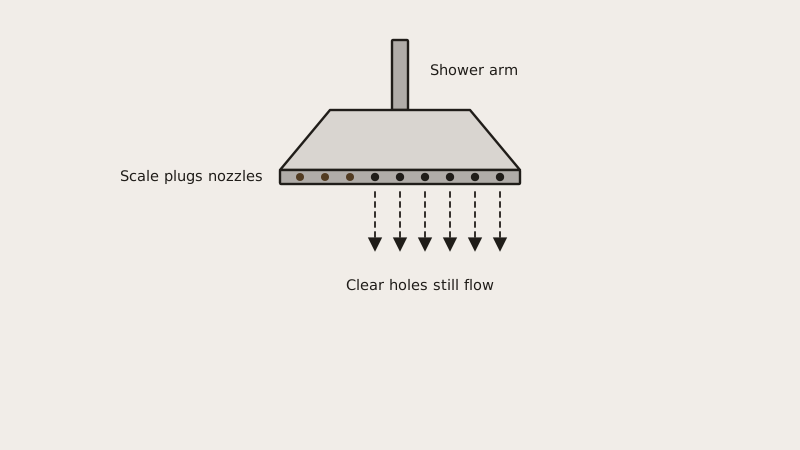
Before you blame the city, check one thing: does the weak flow show up only in the shower? If the kitchen faucet and the bathroom sink run strong while the shower dribbles, the fault is almost certainly in the shower fixture itself, most often scale inside the head, or a worn-out cartridge. That puts it squarely in the family of repairs on our fixture repair page.
Below, the cheapest checks come first and the whole-house causes later, along with a pressure test, the hard water angle and the moment to bring in a pro. A booking starts on the quote page.
Why is the shower weak while the sinks run strong?
Then the fault belongs to that one fixture: a showerhead plugged with mineral scale, a worn or scaled valve cartridge, a shower stop turned partway, or a kinked hose on a handheld model. Whole-house causes would hit every faucet, so comparing them points you to the right place.
A quick test: run a sink and the shower side by side. Then unscrew the showerhead and let the bare arm run. A strong gush clears the valve and blames the head; a weak flow moves suspicion to the valve or the plumbing behind the wall.
Keep in mind that State appliance rules in California limit a new showerhead to 1.8 gallons a minute, measured at 80 psi, compared with the older national 2.5. A brand-new head can therefore feel softer than the old one with nothing wrong in your plumbing.
How can I descale a showerhead at home?
Remove the head from the arm, leave it in white vinegar for a few hours or overnight, scrub the nozzles with a worn toothbrush, rinse it, and refit it with a new wrap of thread tape. The vinegar dissolves mineral deposits and the spray normally recovers. Follow the maker's advice for brass or special finishes.
Hard water is the usual cause here. Pasadena Water and Power describes the city's water as very hard, averaging about 13 grains per gallon in 2025, and calcium scale builds in the tiny nozzles. Heads in this area may want a vinegar bath every few months.
Some heads have a flow restrictor, a small disc inside the connection. It is there on purpose and rules limit how much water a head may use, so do not remove it to chase pressure. If the head is old and corroded, replacing it is cheaper than cleaning it. Fixtures in general are covered by our scale removal guide.
Could the shower valve or cartridge be the problem?
Yes. If a clean showerhead does not help, the shower valve may be partly blocked with scale or debris, or its cartridge may be worn. Signs include weak flow on one side of the handle's range, a handle that is stiff, and temperature that swings. Replacing the cartridge or valve falls to a plumber.
Grit can arrive after repairs or a flush of the water main and settle in the cartridge or the valve's inlet screens. Hot-only weakness points at the hot side, perhaps a valve, or the water heater's supply. Hot-side weakness is covered separately under low hot water pressure.
Cartridge swaps are a routine job, and the plumber may open the wall only if the valve body itself has failed. For how that goes, see the repair section of our shower repair page.
Is the whole house low on pressure, and how do I test it?
Thread a low-cost pressure gauge onto an outside spigot, or the washer's cold supply, with every fixture shut, and read the dial. Sources commonly describe about 40 to 60 psi as normal, and many guides say fixtures work best around 45 to 60 psi. Below about 40, the whole house is low.
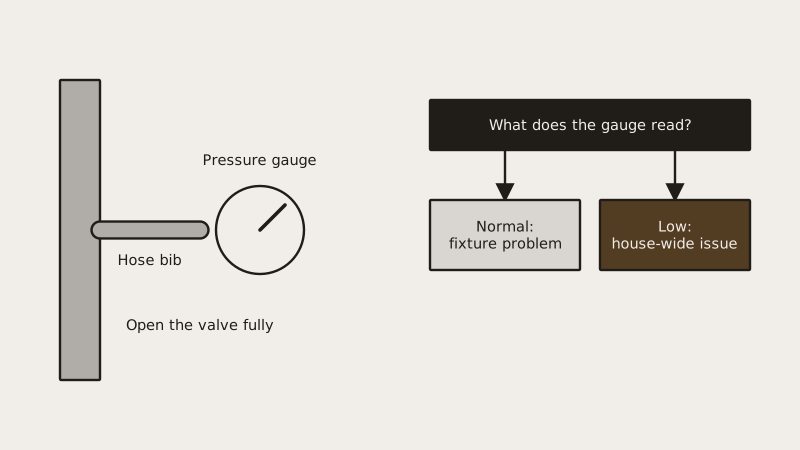
If every faucet is weak, the usual suspects are a partly closed main shutoff, a pressure regulator that is failing, a clogged inlet screen, corroded galvanized pipe, or a leak. Plumbing contractors point out that the state plumbing code requires a regulator once street pressure passes 80 psi, which is why many houses have one close to the main valve.
A house can read healthy pressure at the hose bib and still have a weak shower if the pipes are undersized, clogged or corroded, since flow and pressure are different things. Related reading: reasons for weak pressure and the note on finding the pressure regulator.
Does a pressure regulator affect shower pressure?
It can. A regulator that has failed closed or drifted low reduces pressure to the whole house, which shows up first at the shower and fixtures that need more flow. A regulator that has failed high causes the opposite problem, strain on pipes and fixtures. A gauge reading tells you which.
Low or jumpy gauge readings with the main valve wide open make the regulator a prime suspect. Replacing it is plumber work, and our pages on adjusting a regulator valve and pressure regulator installation cost explain what is involved.
Never twist a regulator's adjustment screw blind; without a gauge you can overshoot, and excess pressure harms fixtures and water heaters.
What if the pressure dropped suddenly or only in a bathtub?
A sudden drop deserves a quick look for a leak or a closed valve. Check whether a neighbor has the same problem, since a street-side repair can affect the supply. A tub or shower with no pressure while other taps are strong is its own case, with a page of its own.
Hunt for leak clues: damp patches, a hissing noise, or a water meter whose dial moves with all taps closed. For a single-fixture case, read about a bathtub with no water pressure when other taps are fine. The same reasoning applies to the kitchen sink.
If you find a wet area or the meter keeps running, shut off the main and book a plumber.
Which findings mean it is time to hire a plumber?
Hire one if a cleaned showerhead changes nothing, if the whole house reads below roughly 40 psi, if a leak or failing regulator is likely, if the valve is stiff or the temperature swings, or if a wall would have to be opened. Those jobs involve valves, pressure and sometimes permits.
A plumber tests pressure with a gauge, checks the valve and cartridge, looks at the regulator and traces blockages. Prices vary with the cause: a cartridge swap is a modest job, while a regulator or a section of corroded pipe costs more. Expect the quote on paper first.
A local plumber drives out across Pasadena and the San Gabriel Valley, and you can arrange it on the quote page.
Common questions
What would make shower pressure fall overnight?
Common sudden causes are a showerhead choked with scale, a valve or stop that is partly closed after work, debris in the cartridge, a failing regulator or a leak. Check the other faucets. A shower that is weak on its own points to the head; weakness everywhere calls for a house pressure test.
Does hard water reduce shower pressure?
It can, indirectly. Hard water leaves mineral scale that clogs the small holes in a showerhead and can coat cartridges and pipes over time. Pasadena's water is described as very hard, so a vinegar soak of the head every few months is a sensible habit.
Should I take the restrictor out of my showerhead?
Showerhead water use is regulated, and California limits new ones to 1.8 gallons per minute, with the restrictor built into that design. Clean or replace the head before anything else, because pressure complaints more often come from scale than from the restrictor.
How do I get stronger flow from my shower?
Clean or swap the showerhead, check the valve and cartridge, confirm the main shutoff is open all the way, and ask a plumber to test house pressure and the regulator. Booster pumps are a final option, and a plumber should size one.
What is a healthy pressure reading for a house?
Many sources call 40 to 60 psi normal, and some guides say fixtures operate best between 45 and 60 psi. California's plumbing code wants a regulator when street pressure runs above 80 psi. Your own number comes from a gauge on a spigot.
This guide is one of many on plumber in Pasadena.
Sources
- EPA WaterSense, showerheads
- California Energy Commission, showerhead flow limits under appliance efficiency rules (Title 20), checked November 2026
- California Plumbing Code section 608.2, water pressure regulators, as described by plumbing contractors, checked November 2026
- Pasadena Water and Power, water quality FAQs
Page updated