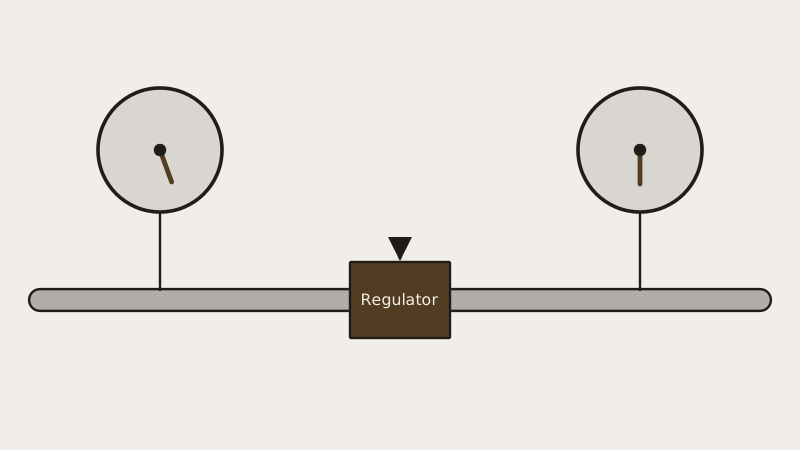
A whole-house regulator is a squat brass valve in the supply line, normally downstream of the main shut-off, that steps incoming street pressure down to a steady level for the house. Without a working one, high pressure stresses every pipe, fixture and appliance, and it can show up as banging pipes, dripping relief valves and early failures. You can check your pressure in two minutes with a gauge. Our hub on water pressure and valves covers the parts, and the rest of this article covers testing, signs and price.
What does a whole-house pressure regulator actually do?
It reduces the pressure coming from the street to a lower, steady setting, typically in the range plumbers call normal for homes, and holds it there. A spring and diaphragm inside the valve open and close as demand changes, so fixtures get a constant pressure regardless of what the main line does.
Think of it as a governor on the whole system. Utilities supply water at pressures chosen for the neighborhood, with hillside and valley streets differing. Pasadena Water and Power says the city maintains pressures well above the state minimum, and that pressure can vary from home to home, with homes on a hill or far from a booster pump seeing lower pressure. A regulator tames the high end for homes that receive more than the plumbing wants. Some houses never needed one; others have one that is decades old.
Does my Pasadena house need one?
Contractor guides say the California Plumbing Code, in section 608.2, expects a regulator when static pressure rises above 80 psi; household settings usually sit between 50 and 65 psi. Test your pressure to see where you stand, and ask the plumber or the city to confirm the rule that applies to your address.
Guessing from the street does not work. Pressure depends on elevation, distance from tanks and pumps, and time of day. A foothill street in Altadena or the hillier parts of Pasadena can differ a lot from a flat block in Alhambra. Homes dating to the Craftsman era or the postwar decades may carry a regulator installed once and never touched, or none at all. If your pressure reads above 80, or swings widely between day and night, a regulator is worth fitting or replacing.
How do I test my water pressure?
Fit a pressure gauge on an outdoor spigot, confirm nothing is running indoors, open the spigot all the way and read the dial. Test at several times of day, since pressure often peaks late at night when demand is low. A reading at or above 80 psi justifies a call to a plumber.
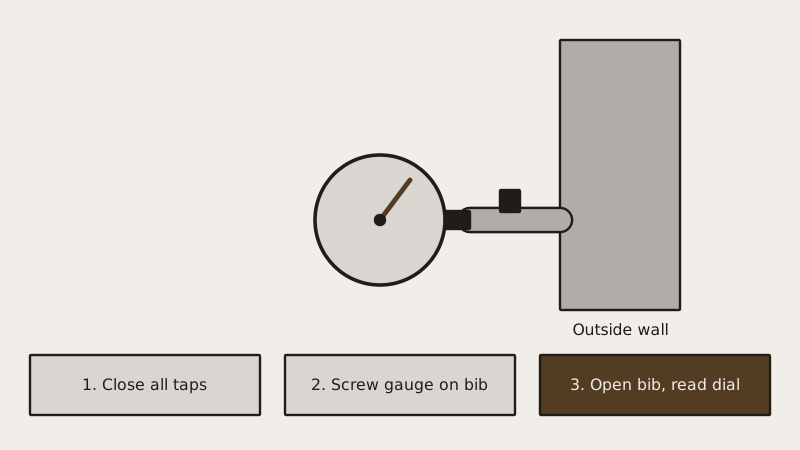
A gauge is a cheap hardware-store item. Use the bib closest to where the main enters the house for the cleanest number. Take readings in the morning and late evening and write them down. If the needle creeps upward while nothing is running, the regulator may be failing and letting pressure build. A gauge on the water heater's drain valve or a laundry sink can work if no bib is available. For low readings, why water pressure is low lists the causes, which include a regulator that has failed closed.
How can I tell the regulator is wearing out?
Pipes that bang or hum, pressure that jumps around, a drip from the heater's relief valve, faucets and toilets that leak or run on, appliance hoses that burst early, or a sudden change to weak or fierce flow. A gauge reading over 80 psi settles it.
A worn regulator usually fails toward one extreme. Stuck open, it passes full street pressure, which punishes washing machine valves, dishwashers and heater parts. Stuck closed or clogged, it weakens showers. Mineral content speeds the wear, since the city utility's 2025 report lists 202 to 256 ppm and scale can foul the seat and strainer. Hammering noises have their own guide, water hammer sounds. If just the hot side is feeble, begin with low hot water pressure.
Where does the regulator live and how is it fitted?
Look on the supply line right after the shut-off valve: near the meter by the street side, in the garage, or in a utility closet. A plumber fits it with a strainer, a shut-off and a gauge port, and checks whether the system now needs an expansion tank.
Once a regulator or backflow device closes the system, the pressure from heated water has nowhere to go. The City of Pasadena's water heater handout cites the California Plumbing Code in saying any normally closed device that stops pressure from returning to the main needs an approved, sized expansion tank. A new regulator can therefore add an expansion tank to the job; see expansion tank replacement. A separate guide, where a regulator is located, shows what to look for. Replacement may need a plumbing permit, which the plumber can confirm with the city. Pasadena Water and Power notes that you are responsible for plumbing devices on your own property.
What does a pressure regulator cost?
In 2026 guides, a regulator replacement lands at roughly $385 to $700 installed, with the valve itself $50 to $250, and adding a new main shut-off pushes it toward $450 to $800. Expect a service life around a decade to fifteen years, less in hard water.
Price depends on valve size, access, whether the main shut-off is old and needs replacing, and whether an expansion tank has to be added. These are national and regional guide figures, not a quote for your house. Our water pressure regulator installation cost page has the breakdown. Do-it-yourself parts run about $40 to $120, but the work involves the main line, a shut-off and a possible permit, so most owners leave it to a plumber. If you only need a setting change, read how to adjust a pressure regulator first.
Common questions
How long will the water be off?
A straightforward swap takes an hour or two, and the house has no water meanwhile. Corroded shut-offs, a missing main valve, or an expansion tank to add all stretch the job, so the written quote should include a time estimate and the expected hours without water.
What goes on the quote for a regulator job?
Get pressure readings before and after, the final setting, and a line stating whether a new shut-off and an expansion tank are included and whether any permit applies. Look up the contractor's California license with the state, and get the quote on paper.
Do I have to be at the house?
Yes, an adult who can show the plumber the main shut-off, approve the quote and read the new gauge value afterward, since it is the proof the job worked. Plan showers, laundry and cooking around a short outage, and clear stored items from around the valve beforehand.
Is low pressure a regulator problem?
It can be. A regulator that has failed or clogged chokes the whole house, though low pressure also comes from a partly closed main, scaled pipes, a leak or the street. Test pressure at a hose bib first, and report a street-level drop to the water utility.
Booking begins on the quote form. See where we work for the cities we cover; the home page leads to our other plumbing work.
Sources
- Pasadena Water and Power, water quality and pressure FAQs
- Pasadena Water and Power, troubleshooting and water emergency hotline
- City of Pasadena Building and Safety, typical residential gas-fired water heater handout (expansion tank, CPC 608.3)
- Pasadena Water and Power, 2026 Annual Drinking Water Quality Report
- Published plumber and cost guides for pressure reducing valves, checked November 2026
Page updated