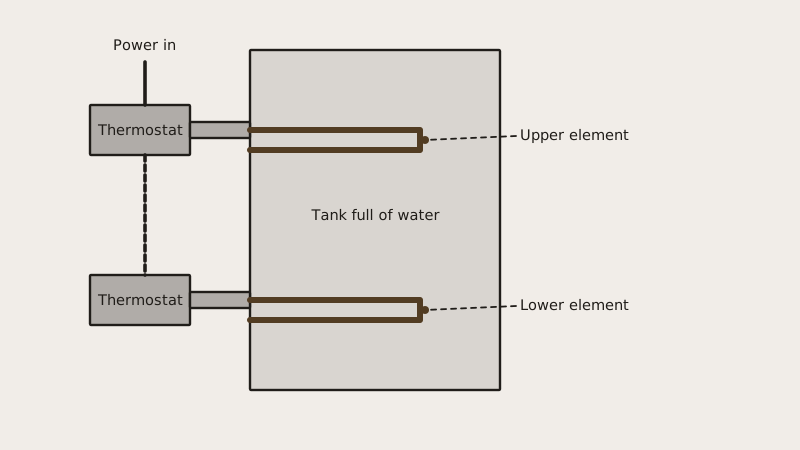
Heating elements exist only in electric tanks, so read the label first. On an electric heater that delivers lukewarm water, or runs cold after a short shower, a burned-out element is a prime suspect. The part is inexpensive, the swap takes a skilled person roughly an hour, and the old element should be tested before anyone buys a new one. A heater that is ancient or leaking belongs on our water heater replacement page instead. The quote form starts a visit, and the figure reaches you on paper beforehand.
How can I tell the element is dead?
Watch for water that never gets properly hot, a supply that is exhausted much sooner than it once was, or nothing but cold. Electric tanks carry two elements, one high and one low. Lose the upper element and the tank may deliver nothing warm; lose only the lower and you get a small pool of hot water that quickly gives out.
Rule out cheaper explanations first. A tripped two-pole breaker, a high-limit button that popped on the thermostat, or a thermostat that has died can all pass for a bad element. The checklist in electric heater, no hot water goes in order, and thermostat replacement on an electric heater covers the neighboring part.
Water seeping from the tank's body is another matter. No element swap mends a corroded shell, and the unit has finished its working life.
What happens during an element swap?
The plumber kills the breaker, proves the circuit is dead with a tester, takes off the access cover and puts a meter on the element. A bad one reads open, or shorts to the tank. Next the tank is drained below the element, the old one is backed out with an element wrench, and a fresh one with a new gasket is threaded in and snugged.
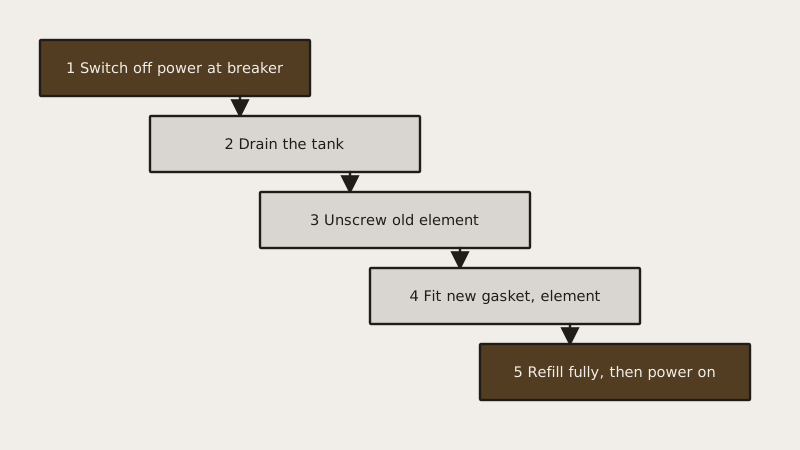
Water goes in before power does. A dry element can burn out in seconds, so the tank must be completely full when the breaker is switched back on. Keep a hot tap running until the flow is steady and the air is gone, then restore power and check the gasket for drips. Guides agree on this order, and the maker's manual gives your model's exact steps, wattage and voltage.
The new part has to equal the old in voltage, wattage and mounting style, whether screw-in or bolt-in. A common residential element is 4,500 watts at 240 volts, but read your heater's nameplate rather than assuming. The wrong wattage can overload the wiring or the thermostat.
Is this a job for a homeowner?
Some homeowners handle it, though the job mixes 240-volt power, hot water and a full tank. If you can use a meter and follow a manual, it is within reach. If there is any doubt that the power is off, stop; shock and scalding are real hazards, and a slip can damage the tank.
Care counts for more than speed. Switch off the heater's own breaker, then confirm at the heater, not just the panel. Give the tank a few hours to cool before draining. Never let an element run dry. A corroded flange, a seized element or scorched wiring is the moment to call a plumber.
What does element replacement cost?
Cost guides show a plumber-installed element at about $120 to $400 overall, most often near $150 to $350. The part runs $10 to $60 and labor $100 to $250, and doing both elements together adds only a little. These numbers are for orientation; the quote you receive sets the price.
The pieces, itemized:
| Item | Typical range |
|---|---|
| Element, standard to stainless | $10 to $60 |
| Plumber labor, one to two hours | $100 to $250 |
| Total with a plumber | $120 to $400 |
| Do-it-yourself parts | $30 to $80 with tools |
Cramped access, a corroded flange or heavy scale that locks the old element in place will lift the bill. On a heater around ten years old or more, ask whether the money belongs in a new unit, and set it against the water heater replacement price.
Why do elements burn out early in Pasadena?
Hard water and sediment are the usual reason. Pasadena Water and Power's recent report puts local hardness around 12 to 15 grains per gallon, and heating the water makes minerals drop out as scale on the element. A scaled element runs hotter, wears faster and can burn out. Sediment piled at the tank floor buries the lower element.
A yearly drain of some tank water helps, and so does a stainless or low-watt-density element, which resists scale and costs a bit more. A softener attacks the cause itself; hard water scale removal lays out the options, while the anode rod guide deals with the part that protects the steel. Popping or rumbling from the tank usually means sediment.
When is a new heater the better choice?
If the tank leaks, the unit is far beyond its expected life, or repairs keep recurring. An element cures a heating fault, never a corroded tank. A Pasadena replacement needs a plumbing permit covering strapping, venting on gas units and energy rules, and the plumber generally handles it.
Anything permitted needs a contractor with a California license, so a swap-out goes to a plumber who has one. Unsure what you are dealing with? The page on causes of no hot water lists the usual suspects in order.
Common questions
What is the lifespan of a heater element?
There is no fixed number. Many last several years, and in hard water or with sediment buildup they can fail sooner. When one element fails, the other is the same age and often close behind, so some plumbers replace both during the same visit. Ask for that option when the tank is already drained.
Which of the two elements has died?
No hot water whatsoever points at the upper element or upper thermostat. A short supply that fades fast points at the lower element. A meter reading on each settles it and saves paying for a part you did not need.
How much of the tank gets drained?
Only down past the element in question: about half for the upper one, all of it for the lower. Cooling first prevents scalds. While the tank is empty a plumber can also flush out sediment, which helps the new element last.
Can a bad element trip the breaker?
Yes. A shorted element can pull too much current or leak current to the tank and trip the breaker over and over. Do not keep resetting it. Turn the breaker off, leave the heater alone and have it tested, because a fault to ground is a safety issue as well as a repair.
Is an element replacement covered by a warranty?
Possibly, if the heater is within the manufacturer's warranty period, but terms vary by brand and model. Check the label for the model and serial numbers, then read the warranty or call the maker. Keep the plumber's invoice. Warranties often cover parts and not labor, and may exclude damage from poor water quality.
See everything else we arrange on the Pasadena Pipe Works home page.
Sources
- Pasadena Water and Power, water quality FAQs
- City of Pasadena Permit Center, apply for a permit
- California Contractors State License Board, what kind of contractor do you need
- Published electric water heater element part prices and plumber labor prices from home improvement retailers and cost guides, checked November 2026
- Step-by-step element replacement guides from several home repair publishers, checked November 2026
Page updated