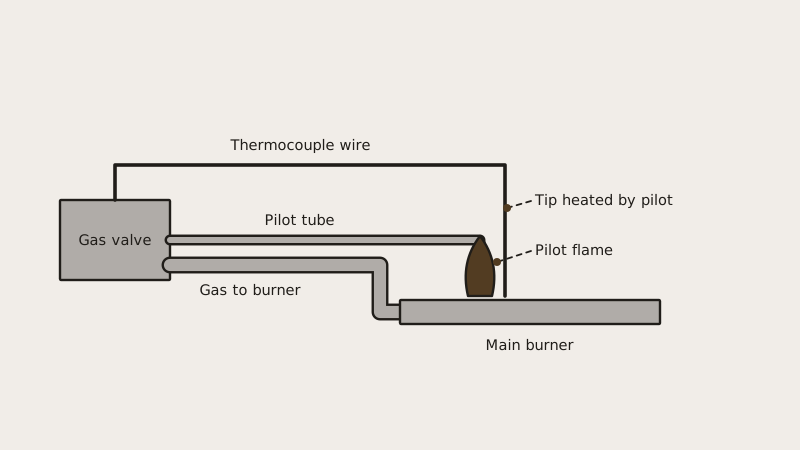
You hold the knob in, the pilot catches, you let go, and the flame dies. On a gas tank heater that keeps a pilot burning, that routine usually traces to a worn thermocouple: a cheap part with a serious job, sitting right at the gas control valve. Because of where it sits, the swap counts as gas work. The wider picture for the tank is on our water heater replacement page.
What follows: how the part works, the signs it has died, lookalike faults, the price range, what the plumber does on site, and the point where buying a new heater wins. To book, go to the quote page.
How does a water heater thermocouple work?
Think of it as a tiny flame-powered generator that also acts as a guard. Its tip sits in the pilot flame, and the heat produces a very small voltage, often quoted at about 25 to 30 millivolts. The signal is what holds the gas valve open. No flame means no signal, and the valve closes.
Older standing-pilot heaters lean on it entirely, so it decides whether you get hot water at all. As the metal ages, the voltage sags. The pilot will light under your thumb and then drop out the moment you stop pressing.
Plenty of newer heaters use electronic ignition or another flame sensor instead of a thermocouple. Read the rating label or the manual first; a heater with a control board is a different repair altogether.
What are the signs a thermocouple has gone bad?
The giveaway: a pilot that burns just as long as your thumb stays on the knob. Others: a sooty or bent sensing tip, a weak or yellow pilot flame, and a burner that never roars to life even though the pilot seems fine. A multimeter reading from a plumber settles it.
Rule out the easy suspects before blaming the part. A pilot orifice clogged with lint, a draft shoving the flame around, a vent or combustion air problem, or a failed gas control valve can each copy the symptoms. Swapping a thermocouple that was innocent wastes money and can hide a real hazard.
If the pilot stays lit but the water stays cold, you have the reverse problem, covered under no hot water with the pilot light on.
Can a homeowner swap the thermocouple?
Our advice is no. The repair manuals make it look quick, but the sensing line threads into the gas control valve, so it is gas work, and gas work is for someone with a California contractor license. Relighting a pilot by the label is one thing; opening up gas components is quite another.
Part prices run about $10 to $50 and published guides put a do-it-yourself swap at 20 to 60 minutes. Cheap and short, yes, but a cross-threaded fitting or a badly seated nut can let gas escape, and a small seep is easy to miss.
A gas odor at any point ends the job: everyone leaves the building. The SoCalGas number to dial from the yard is 1-800-427-2200, and real danger goes to 911. State rules bring jobs of $1,000 and over, or jobs needing a permit, under contractor licensing.
What does a plumber do during a thermocouple replacement?
With the gas off and the heater cool, the plumber unscrews the old sensor from the valve and pilot bracket, mounts a matching new one so its tip sits properly in the flame, and tightens it by the book. The pilot gets relit, and every joint is tested with leak solution before the visit ends.
A thorough visit goes beyond the one part. The flame should be steady and blue, the main burner should ignite cleanly, the vent should draw, the relief valve and the pipe running off it should be intact, and the straps that hold the heater against earthquakes should be tight.
On an elderly tank the plumber may also mention corrosion or leaks at the base. Ask for those observations, and the price, in writing.
What will a thermocouple replacement cost?
Published price pages show a plumber's replacement at about $100 to $325 all in, many near $125 to $200, with the part itself costing $10 to $50. Call-out fees, hourly rates and evening work shift the total. A failed gas control valve is a bigger bill, so diagnosis comes first.
Guides list a gas valve replacement in the several-hundred-dollar range and a pilot light repair lower. Which of the three applies only becomes clear after testing, and that is the reason to hear a diagnosis before a number.
Prices differ from Pasadena to Altadena, Arcadia and our other cities, and the number that matters is the one quoted for your address. For the next rung on the ladder, see gas water heater replacement cost.
Thermocouple, pilot assembly or gas valve: which one failed?
Three parts sit close together and fail differently. A tired thermocouple gives a pilot that dies on release. A clogged orifice or damaged pilot assembly gives a flame that is small, yellow or wandering. A bad gas control valve leaves the pilot burning while the main burner refuses to fire.
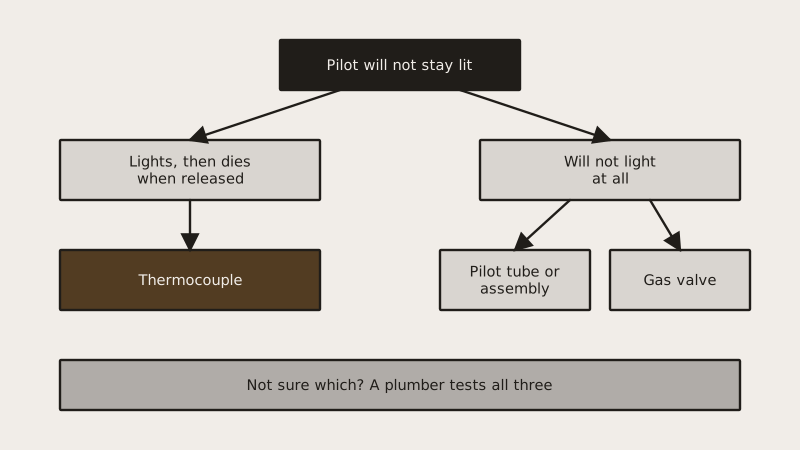
The plumber separates them with a meter and a look at the flame. For the neighbors of this fault, read about pilot light repair and about replacing the gas valve.
Age counts for more than the badge on the tank. Rheem, A. O. Smith or another maker, the diagnosis logic is the same, though parts differ; a brand-specific walk-through is in Rheem gas water heater repair.
At what point should I buy a new heater instead?
Past roughly ten years, or with a leaking base or rust at the tank bottom, or with repairs piling up, put the money toward a replacement. A $100 to $325 repair on a young heater is sound value. The same money on a failing tank only delays the bill.
Weigh the age on the serial number, the condition of tank, flue and anode rod, and what a new unit costs fitted. The page on replacement timing frames the decision.
A replacement carries a plumbing permit, according to Pasadena's Building and Safety Division. Gas heaters built since 2003 are flammable vapor ignition resistant, meaning a flame arrestor guards the burner. The plumber handles both the paperwork and these details.
Common questions
How many years does a thermocouple last?
No fixed number applies. Many work for years, and heat, corrosion and a sooty pilot shorten the life. If the heater has served for a decade and the pilot suddenly refuses to stay lit, a worn sensor is likely. With a heater that old, ask about replacing the whole unit.
What makes a pilot light keep going out?
Common culprits are a worn thermocouple, a pilot orifice clogged with lint, a draft that snuffs the flame, weak venting, or a gas control valve nearing the end. A pilot that lights under the knob and dies on release points to the thermocouple, and a plumber can confirm it with a test.
Are thermocouples and thermopiles interchangeable?
No. A thermocouple converts pilot heat to a small voltage, and that current stops the gas valve from closing. A thermopile bundles several junctions to produce more voltage, enough to run a valve on certain appliances. The right part depends on how your heater is designed.
Is a failing thermocouple a danger?
A thermocouple exists for safety, and a dead one typically errs toward shutting the gas. Danger comes from botched repairs or a gas smell nobody notices. With any gas odor, everyone goes outside, and the SoCalGas line (1-800-427-2200) is called from a safe distance. Anyone at risk means 911.
Is a permit needed to change the part?
Permits usually attach to replacing the heater, not to changing a single part. Cities differ in what they require, so the plumber confirms with the building office covering your address before any gas work begins, and tells you what, if anything, is needed.
For the wider picture, start with Pasadena Pipe Works plumber.
Sources
- HomeGuide, water heater repair cost
- Fixr, water heater repair cost
- Manufacturer FVIR consumer information on residential gas water heaters (ANSI Z21.10.1), checked November 2026
- California Contractors State License Board, hiring a contractor
- SoCalGas, safety and prevention
Page updated